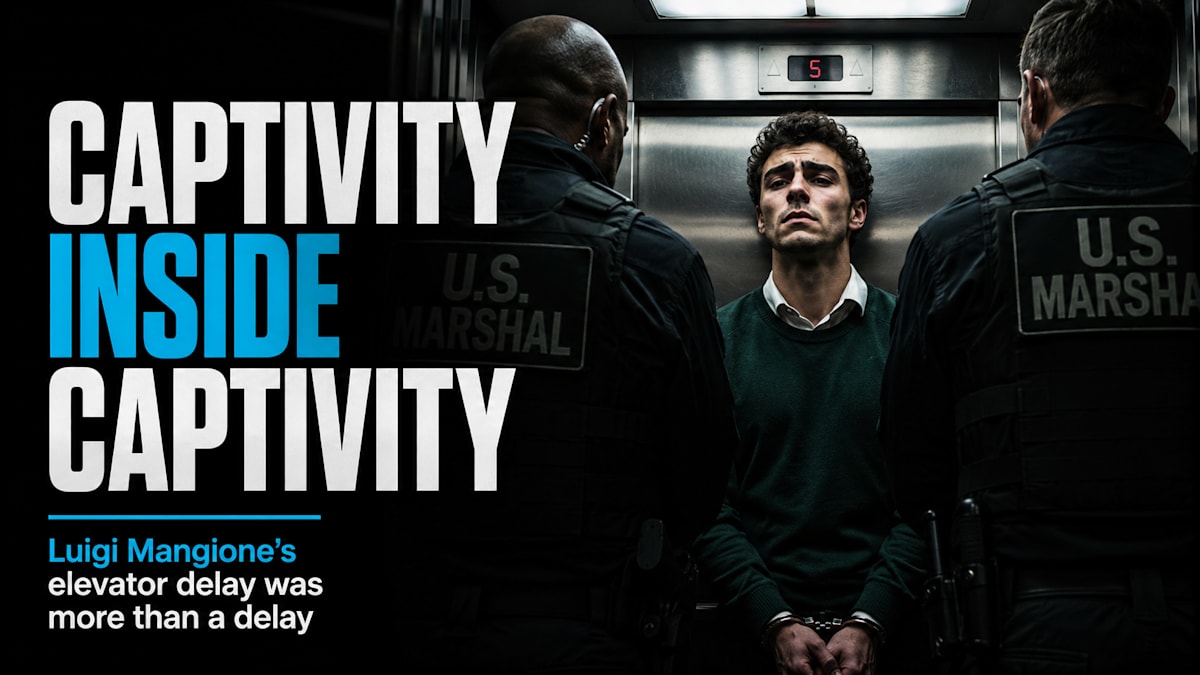
Luigi Mangione’s Elevator Delay Was Not Just a Delay
6v969s8vwxc4jd81zx7l4jmu52mg1.61 MBLuigi Mangione’s Elevator Delay Was Not Just a Delay. It Was Captivity Inside Captivity.
By Michele Evans New York City, New York 6/29/2026
Category: Courts / Criminal Justice / Public Interest
NEW YORK CITY, NY - Luigi Mangione’s federal court appearance was delayed Monday after he reportedly became stuck in a courthouse elevator with U.S. marshals. That is the kind of sentence mainstream court reporting loves because it is clean, factual, and easy to move past. A delay. An elevator issue. A brief inconvenience before the real legal business began.
But anyone who has ever been trapped in an elevator knows better.
I know better.
I have been trapped in an elevator. I know how quickly a few minutes can stop feeling like time and start feeling like survival. I know the way the air changes. I know the way your body starts calculating danger before your mind has words for it. Is the elevator going to drop? Is it going to jerk? Is anyone coming? Can I breathe? What if I need the bathroom? What if I panic and there is nowhere to go? What if the people around me do not understand what is happening inside my body?
That is not drama. That is physiology.
Now imagine that experience not as a free person, but as a defendant in federal custody. Imagine being inside a small metal box with the government physically controlling your movement. You cannot simply walk away. You cannot decide to take the stairs. You cannot leave the officers, leave the building, or remove yourself from the situation. You are transported, held, watched, and delivered. Your body is not fully yours in that moment.
That is the part sterile reporting erases.
Mangione’s federal hearing started late because he was stuck in a courthouse elevator. The federal trial has now been pushed to January 2027 so it does not collide with the state murder trial still scheduled for September 2026. Jury selection in the federal case is set for January 5, with opening statements planned for January 25. Mangione has pleaded not guilty in both state and federal cases.
On paper, that makes the elevator incident a scheduling detail.
In real life, it may be something very different.
Mangione is not just any defendant walking through an ordinary courthouse calendar. He is facing parallel state and federal prosecutions arising from the same killing. The federal case carries stakes New York itself does not impose in its own state murder prosecution. His lawyers have also already placed extreme emotional disturbance into the public record, even though they later withdrew the formal CPL 250.10 notice tied to a psychiatric defense. ABC News reported that the defense withdrew that notice one day after indicating it planned to invoke a psychiatric defense; the Guardian has since noted the confusion around whether that means the broader emotional-disturbance strategy is fully gone or merely procedurally altered.
That context is important.
If a defendant’s emotional state has been important enough to appear in court filings and public reporting, then the conditions surrounding his transport to court should not be dismissed as courthouse trivia. A person already under extreme psychological pressure can be affected by confinement. A person with panic attacks can be affected by confinement. A person with claustrophobia can be affected by confinement. A person who has lived through violence, fear, restraint, or sudden loss of control can be affected by confinement.
And if the officers in that elevator were armed, the psychological weight becomes even heavier.
That does not mean anyone did anything intentional. It does not mean Mangione visibly panicked. It does not mean anyone can diagnose him from a news report. But it does mean a responsible court system should understand that being trapped in an elevator while in custody is not the same thing as a lawyer being late because traffic was bad.
This was not just a delay.
It was confinement inside confinement.
For twenty minutes, Mangione was reportedly stuck in a small enclosed space while surrounded by the same government apparatus responsible for prosecuting, transporting, and containing him. If there were restraints, that matters. If there were guns, that matters. If the elevator jerked, that matters. If he had to use the bathroom, that matters. If he felt panic rising and had nowhere to put it, that matters. If he entered court afterward appearing calm, that does not mean nothing happened. Many people who have lived through panic, trauma, custody, or violence know exactly how to look fine after their nervous system has been dragged through hell.
That is why lived experience matters in court reporting.
A sterile report can tell you the hearing started late.
A person who has been trapped in an elevator can tell you what twenty minutes inside that box can do to the body. I recently wrote about it here.
I cannot know what happened inside Luigi Mangione’s mind in that elevator. But I can understand the architecture of that fear. I can understand how a small enclosed space becomes smaller by the second. I can understand how helplessness grows when you cannot control the door, the air, the movement, or the people standing inches from you. I can understand why a defendant already facing life-altering prosecutions might experience those twenty minutes not as an inconvenience, but as another moment where the system held his body and told him to wait.
That is the story mainstream reporting keeps missing.
The legal system is not just statutes, motions, trial dates, and courtroom calendars. It is also elevators, holding cells, overheated courtrooms, missing clothing, transport failures, locked doors, armed custody, and the moments where a human being is expected to remain composed while the machinery around him malfunctions.
When that machinery breaks down, the court record may call it a delay.
But the body keeps a different record.
*Michele Evansis an independent journalist, author, and former ESPN technical producer whose work has appeared in The New York Times.
Michele got her start in 2001 covering the NBA and NFL.
She now covers New York City courts, criminal-justice procedure, NYPD, FDNY, domestic-violence systems, media accountability, public safety, advocacy efforts, and New York civic life through courthouse observation, public records, legal analysis, and lived-experience reporting.