When the Uniform Throws the Sign: NYPD Officers, Gang Symbolism, and the Collapse of Public Trust
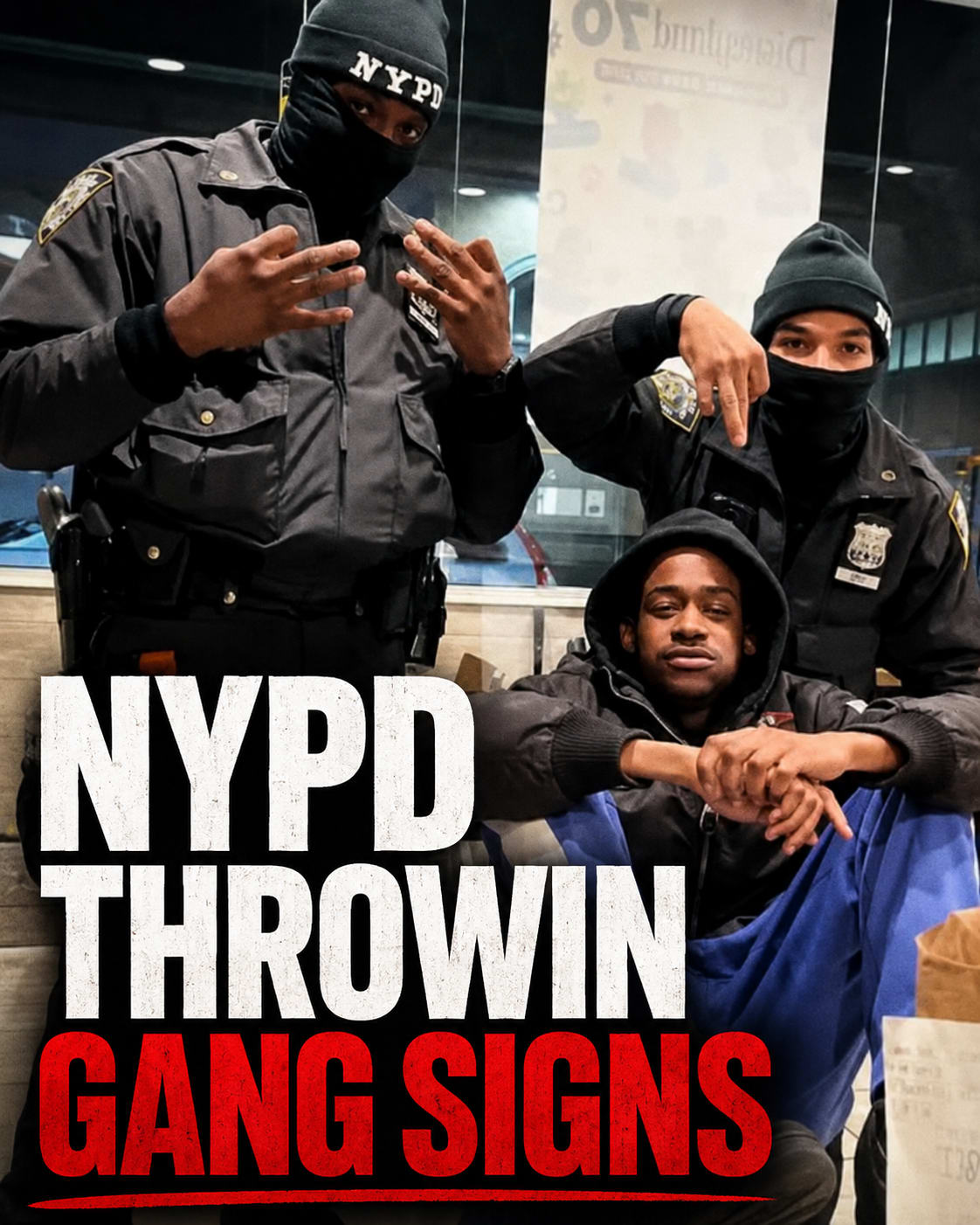
When the Uniform Throws the Sign: NYPD Officers, Gang Symbolism, and the Collapse of Public Trust
By Michele Evans
New York City, New York
5/24/2026
Category: Courts / Criminal Justice / NYPD
New York City, New York - There are mistakes. There are lapses in judgment. And then there are moments that expose something deeper about institutional culture.
A viral photo reported by the New York Post shows two uniformed NYPD officers allegedly flashing hand signs associated with the Mac Baller Brims, a violent Bloods subset long tied to shootings, robberies, narcotics trafficking, and racketeering. The photo, reportedly taken inside a McDonald’s, shows the officers masked, in uniform, posing with a civilian while making gestures that former law enforcement officials told the paper resembled gang signs. The NYPD says the matter is now under internal review.
That phrase, internal review, is doing a lot of work.
Because the issue here is not simply whether two officers are gang-affiliated. That has not been proven. It is not even whether the gesture was meant as a joke, as one law enforcement source reportedly claimed. The issue is that an NYPD uniform is not a costume, not a social-media prop, not streetwear, not an accessory for a viral pose, and not a shield behind which officers get to cosplay the same culture of intimidation the department claims it is fighting.
If a civilian in the Bronx, Brownsville, East New York, or Harlem posed in the same way, police would know exactly how to interpret it. Prosecutors might use it as context. Investigators might place it in a gang file. A teenager’s hand gesture can become part of a narrative of suspicion, association, danger, and criminality.
So what happens when the hand is inside an NYPD sleeve?
That is the pressure point.
The Mac Baller Brims are not some vague internet meme. Federal prosecutors have described Mac Baller Brims activity in serious terms, including racketeering, narcotics, firearms offenses, and attempted murders connected to Bronx gang activity. In 2019, federal authorities charged 13 members and associates of the Mac Baller Brims with racketeering, narcotics, and firearms offenses, alleging the gang used shootings, robberies, and drug sales to protect territory, power, and profits. In 2020, federal prosecutors announced murder-related charges against Mac Baller Brims members in connection with a Manhattan robbery that left 27-year-old Jonathan Rodriguez dead.
That history matters because the photo does not exist in a vacuum. It lands in a city where young Black and Latino men are routinely judged by symbols, colors, associations, neighborhoods, music, friends, photos, and gestures. It lands in a city where police intelligence units and prosecutors have long treated alleged gang signals as evidence of identity and threat.
But when officers do it, suddenly the story becomes: maybe they were joking.
That double standard is corrosive.
If the NYPD wants the public to believe gang symbolism is serious enough to justify surveillance, prosecution, enhanced scrutiny, and aggressive policing, then it cannot turn around and treat the same symbolism as harmless horseplay when performed by officers in uniform. Either these signs carry meaning, or they do not. Either association matters, or it does not. Either public conduct reflects risk, judgment, and institutional fitness, or it does not.
The answer cannot depend on who has the badge.
According to the Post, one officer was identified by sources as Shane Cruz, who joined the NYPD in 2024 and had worked in the 43rd Precinct in Soundview before transferring to Brooklyn’s 73rd Precinct. The second officer was not identified in the report because his shield was not visible. The department has not publicly concluded that either officer is gang-affiliated, and no such conclusion should be assumed.
But the question of affiliation is only one part of the inquiry.
The larger question is judgment.
What kind of officer believes it is acceptable to pose in uniform, masked up, flashing signs associated with a violent gang? What kind of supervision allows that culture to develop? What kind of recruitment, screening, training, and discipline system produces officers who either do not understand the significance of what they are doing, or understand it and do it anyway?
That is where this becomes bigger than one photo.
The NYPD has already been under pressure over recruitment and staffing. In 2025, the department announced that it would reduce the college-credit requirement for entering the Police Academy from 60 credits to 24, while arguing that academy training and reinstated fitness standards would preserve quality. The department said 29% of NYPD applications in 2023 had been disqualified solely because of the old college-credit requirement.
Recruitment challenges are real. But lowering barriers while maintaining public trust requires more transparency, not less. It requires stronger screening, stronger ethics training, stronger supervision, and a clearer public record when officers cross lines.
The public does not need vague assurances. It needs answers.
Were these officers on duty?
Were they assigned to patrol in communities affected by gang violence?
Was the civilian in the photo known to either officer?
Was he known to law enforcement?
Did either officer have prior disciplinary complaints?
Did supervisors know about the image before it went viral?
Was this reported internally, or did the department only respond after public exposure?
Will the findings be made public, or buried in the familiar fog of “personnel matter” language?
These are not anti-police questions. They are pro-accountability questions.
Good officers should be angrier than anyone. Every reckless image like this makes their job harder. Every display of gang symbolism by an officer in uniform undermines community trust, damages investigations, gives defense attorneys legitimate questions to ask, and deepens the public suspicion that there are two justice systems: one for civilians whose images can be weaponized against them, and another for officers whose conduct is softened into “bad optics.”
But this is not merely optics.
Optics are when a tie is crooked at a press conference. Optics are when a logo is badly placed. Optics are when a public official chooses the wrong backdrop.
An armed state employee in uniform appearing to mimic gang symbolism is not optics. It is a public-safety problem. It is a credibility problem. It is a courtroom problem. It is a community problem.
Because policing depends on legitimacy. The badge carries power only because the public is asked, and often forced, to recognize it as lawful authority. When that authority starts borrowing the language of the street gangs it claims to suppress, the line between enforcement and performance begins to blur.
And in communities already over-policed, under-protected, and overexposed to both gang violence and state violence, that blur is dangerous.
The NYPD cannot ask parents to trust that officers are protecting their children from gang culture while officers pose like gang culture is a joke. It cannot tell young people that symbols matter, then excuse officers for playing with those same symbols. It cannot build cases on alleged associations while asking the public not to infer anything from officers’ own public conduct.
The department’s response must be more than internal review.
At minimum, the NYPD should publicly explain whether the officers were placed on modified duty, whether the image violated department policy, whether any gang-intelligence review was conducted, and whether recruitment or training failures contributed to the incident.
If the officers are cleared of gang affiliation, the department should still address the professional misconduct question directly. If stronger evidence exists, the public deserves to know that too.
This is not about demanding punishment before investigation. It is about refusing to minimize the seriousness of the conduct before the investigation even begins.
Because the badge is not neutral when it is worn in public. It communicates authority. It communicates state power. It communicates the city itself.
And when that badge is photographed beside alleged gang signs, the message is not funny.
It is a warning.
*Michele Evans is an independent journalist, author, and former ESPN technical producer whose work has appeared in The New York Times.
Michele got her start in 2001 covering the NBA and NFL.
She now covers New York City courts, criminal-justice procedure, NYPD, FDNY, domestic-violence systems, media accountability, public safety, advocacy efforts, and New York civic life through courthouse observation, public records, legal analysis, and lived-experience reporting.
Read more independent journalism by Michele Evans.
Follow Michele Evans on Facebook and Substack for new reporting, analysis, and updates.