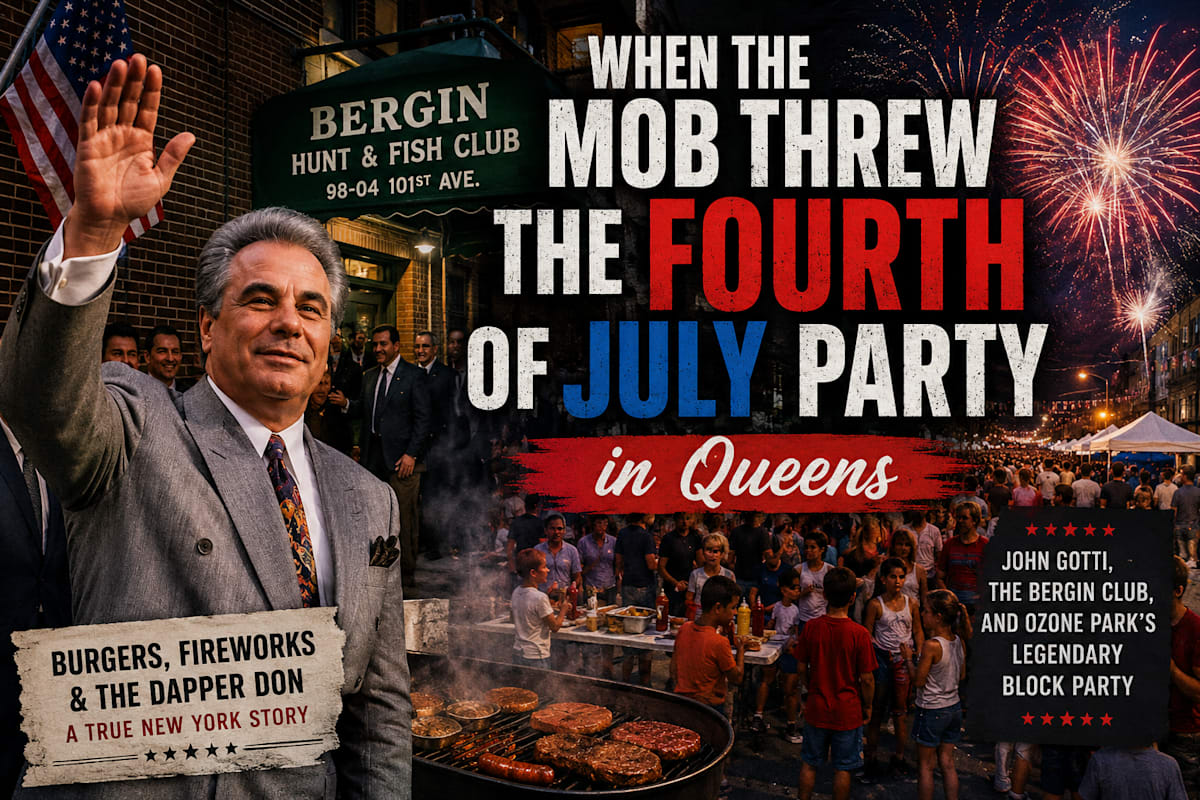
When the Mob Threw the Fourth of July Party in Queens
tnzl1izdb9ymdnkl7grfay9r81fk3 MBWhen the Mob Threw the Fourth of July Party in Queens
By Michele Evans New York City, New York 7/5/2026
Category: New York City History / Mob Life / Queens
QUEENS, NY - Before every neighborhood had a corporate sponsor, a permit problem, and somebody arguing on Facebook about where the fireworks should be launched, there was a Fourth of July tradition in Queens that belonged to another New York era entirely.
It was loud. It was crowded. It was old-school. It had barbecue, kids, fireworks, neighbors leaning out of windows, and one of the most infamous men in America standing somewhere near the center of it all.
John Gotti, the Gambino crime family boss known as both the “Dapper Don” and the “Teflon Don,” loved Independence Day. In Ozone Park, that love turned into an annual neighborhood spectacle outside the Bergin Hunt and Fish Club, the mob social club on 101st Avenue that became closely associated with Gotti and the Gambino family. The club was no ordinary neighborhood hangout. It was widely known as a Gambino base, even if plenty of people in the neighborhood preferred not to say that too loudly.
For years, the Fourth of July party outside the Bergin became part of local legend.
There were burgers. Hot dogs. Steaks. Games for children. Crowds in the street. Fireworks lighting up the Queens sky. And sometimes, according to the stories passed around New York for decades, Gotti himself would come out from the club, wave to the crowd, and receive the kind of cheers usually reserved for ballplayers, boxers, and movie stars.
Only in New York could a block party become a mob history lesson.
Only in Queens could somebody say, “Yeah, the fireworks were great,” and then casually add, “John Gotti paid for them.”
That was the contradiction of the Gotti era. To law enforcement, he was the face of organized crime. To federal prosecutors, he was a target. To newspapers, he was headline gold. But to some people in Ozone Park, he was also the guy whose Fourth of July party fed the block.
That does not erase what the Mafia was. It does not soften the violence, extortion, racketeering, fear, or bodies behind the mythology. But mob life is part of New York life because New York has always been a city where power lives on the street before it ever reaches City Hall.
And for a time, on July 4th in Ozone Park, power looked like fireworks over 101st Avenue.
The Bergin Hunt and Fish Club itself was almost comically named. There was no real hunting. No fishing. It was a brick storefront social club, the kind of place with men outside, cars idling nearby, and neighbors who knew enough not to ask too many questions. The location has been identified as 98-04 101st Avenue in Ozone Park, Queens.
In old New York, social clubs were more than storefronts. They were offices, courts, waiting rooms, command centers, and theaters of reputation. Who stood outside mattered. Who walked in mattered. Who was allowed to sit down mattered even more.
The Bergin was part of that world.
So was the Fourth of July party.
The event became famous because it mixed two things New York understands very well: neighborhood loyalty and public spectacle. The block party had the feel of an old-fashioned community celebration, but the man behind it was one of the most famous mob bosses in American history.
That tension is what makes the story so New York.
Gotti was not hiding in the shadows during his peak. He became a public figure in expensive suits, surrounded by cameras, lawyers, associates, admirers, and enemies. His image was as much a part of the story as the criminal cases against him. He understood theater. He understood loyalty. He understood the value of being seen.
A Fourth of July block party did more than entertain the neighborhood. It sent a message.
The message was simple: I take care of my people.
That has always been one of the oldest forms of power in New York City. Long before influencers, campaign consultants, and public relations teams, there was the local boss. The person who fixed things, paid for things, made introductions, got favors done, and expected respect in return.
Gotti’s fireworks were not just fireworks. They were reputation in the sky.
By 1991, the event was already famous enough to make news when things went wrong. UPI reported that three people were injured after fireworks accidentally exploded during the annual Fourth of July celebration allegedly funded by Gotti.
That detail matters because it reminds us this was not just a cute neighborhood memory. It was real. It was crowded. It was dangerous. It existed in the same messy space where New York nostalgia often lives.
The party continued into the early 1990s, even after Gotti was convicted in 1992 and sentenced to life in prison without parole. Gotti died on June 10, 2002, in federal custody.
By then, the world around the Bergin had already changed.
The mob was no longer untouchable. Federal prosecutions had damaged the old families. The city was changing. Giuliani-era law enforcement pressure reshaped public tolerance for open mob displays. The old neighborhood culture was fading, and the kind of public celebration that once made Gotti look larger than life became harder to sustain.
The Fourth of July parties eventually ended.
But the story survived because New York stories do not die easily. They get retold in diners, Facebook groups, old neighborhood pages, YouTube clips, documentaries, podcasts, and late-night conversations that start with, “You remember when?”
The Gotti Fourth of July party belongs to that category of New York memory where the truth, the legend, and the attitude all sit at the same table.
Was it a community party? Yes.
Was it mob theater? Also yes.
Was it a contradiction? Absolutely.
That is why it still works as a New York story.
New York has always been complicated about its outlaws. The city condemns them, mythologizes them, films them, quotes them, tours their neighborhoods, and then acts surprised when the public remembers the style as much as the crimes.
Gotti understood that better than most.
He gave the tabloids a character. He gave prosecutors a target. He gave the neighborhood fireworks.
And every July 4th, outside a Queens social club with one of the most misleading names in city history, New Yorkers gathered under the smoke, noise, and summer heat for a party that could only have happened here.
Mob life was never all of New York life.
But it was part of it.
And for one old Ozone Park block, the Fourth of July once came with barbecue, fireworks, and the Dapper Don waving to the crowd.
*Michele Evansis an independent journalist, author, and former ESPN technical producer whose work has appeared in The New York Times.
Michele got her start in 2001 covering the NBA and NFL.
She now covers New York City courts, criminal-justice procedure, NYPD, FDNY, domestic-violence systems, media accountability, public safety, advocacy efforts, and New York civic life through courthouse observation, public records, legal analysis, and lived-experience reporting.