When the Gatekeeper Becomes the Smuggler: A Rikers Officer, Drug-Soaked Papers, and the Corruption Inside the Walls
When the Gatekeeper Becomes the Smuggler: A Rikers Officer, Drug-Soaked Papers, and the Corruption Inside the Walls
By Michele Evans
New York City, New York
5/22/2026
Category: Courts / Criminal Justice / Advocacy
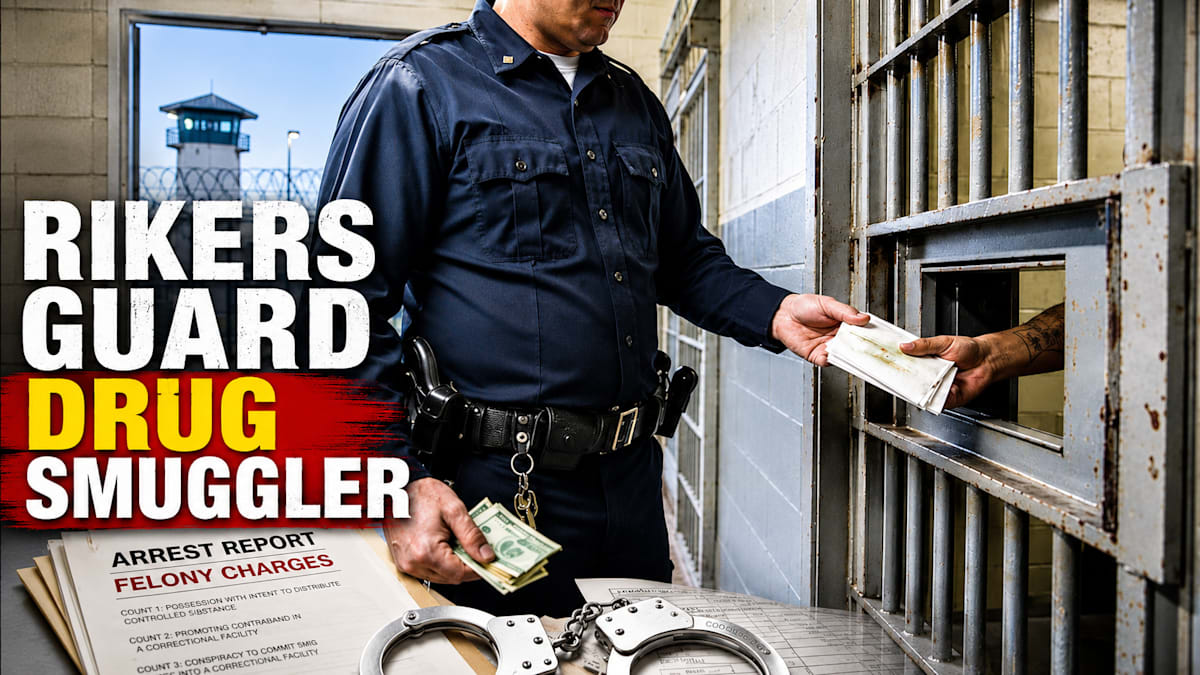
Bronx, New York - A New York City correction officer assigned to Rikers Island has been accused of taking thousands of dollars in bribes to smuggle drug-soaked papers into the jail complex - another allegation that cuts through one of the most persistent myths about Rikers: that danger inside the jail comes only from the people locked in cells.
According to prosecutors, Eric Rivera, 54, a Department of Correction officer, was arraigned in Bronx Supreme Court on charges including second-degree bribe receiving, third-degree bribe receiving, official misconduct, and second-degree promoting prison contraband.
Prosecutors allege that between June 1, 2025, and September 15, 2025, Rivera accepted more than $5,000 in bribes in exchange for bringing documents purportedly soaked with narcotics, including K2 and fentanyl, into Rikers and delivering them to an inmate. He is due back in court July 22. The charges are allegations, and Rivera is presumed innocent unless and until proven guilty.
But the case is larger than one officer.
It lands inside a jail system already under extraordinary federal scrutiny, a system where violence, overdoses, contraband, staff misconduct, and failed supervision have become part of the public record. Rikers is not simply dangerous because of the people housed there. It is dangerous because the institution itself has repeatedly failed to control what moves through its own doors.
Bronx District Attorney Darcel Clark said drug-soaked documents “threaten the safety of inmates and staff,” warning that papers treated with narcotics can put lives at risk. Department of Investigation Commissioner Nadia Shihata said correction officers have a duty to safeguard people in their care, and that the alleged conduct betrayed that obligation by endangering both incarcerated people and fellow officers.
That word - care - matters.
People inside Rikers are not free to leave. They cannot choose the officers assigned to their housing areas. They cannot choose whether their dorm becomes a marketplace for drugs, phones, blades, cigarettes, or violence. They live under the power of the same institution that searches them, disciplines them, transports them, locks them in, and tells the public it is keeping order.
So when contraband gets inside, the public should ask not only who received it, but who had the authority to bring it in?
The answer, too often, is not the person in the cell.
This latest indictment follows a pattern. In 2024, federal prosecutors charged six defendants in a separate Rikers corruption case involving correction officers, a program counselor, a contractor, and a detainee, alleging that staff accepted bribes to smuggle drugs and other contraband into city jails.
In that case, prosecutors described schemes involving oxycodone, marijuana, fentanyl, K2, and other contraband moving through facilities that were supposed to be secured by the very employees accused of violating that trust.
The problem is not theoretical. Contraband inside Rikers fuels debt, intimidation, fights, overdoses, and violence. It creates an underground economy in a place where people are already vulnerable and where desperation can be weaponized quickly.
The person with drugs may be blamed. The person using drugs may be punished. The person harmed by drugs may be reduced to a statistic.
But when an officer is accused of accepting bribes to bring those drugs in, the story changes.
It exposes the power imbalance.
An incarcerated person can be searched, strip-searched, locked down, disciplined, written up, transferred, isolated, or criminally charged. But an officer walks through a different door. An officer carries authority. An officer’s uniform itself becomes a passcode. If the allegation is true, the danger was not smuggled past the system. It was carried in by the system.
That is why this case matters.
It also complicates the public narrative around Rikers. Politicians and officials often talk about jail violence as if it rises naturally from the incarcerated population, as if chaos begins and ends with the people wearing uniforms issued by the city as detainees.
But Rikers has always been more complicated than that. Violence inside a jail is shaped by staffing, supervision, corruption, medical neglect, classification failures, gang dynamics, disciplinary culture, and the small daily decisions of people who hold keys.
The keys matter.
So does the money.
Prosecutors allege Rivera accepted more than $5,000 to move drug-soaked papers inside. That figure should make the public pause. Rikers contraband is not just a security problem. It is an economy. In a closed system, ordinary items become valuable. Drugs become power. Phones become access. Cigarettes become currency. Officers who participate in that economy are not merely breaking rules; they are helping create the conditions that make the jail more dangerous for everyone inside it.
That includes incarcerated people.
It includes correction officers who do not take bribes.
It includes medical staff, counselors, visitors, attorneys, and civilian employees.
It includes families waiting for someone to come home alive.
The allegation also arrives after years of warnings that Rikers has become unmanageable under ordinary city control. In May 2025, U.S. District Judge Laura Taylor Swain ordered the appointment of a court-supervised remediation manager with broad authority over the city jails after years of failed reform efforts and ongoing violence.
That federal intervention did not happen in a vacuum. It happened because the city’s jail system has been failing in public, in litigation, in monitor reports, in headlines, and in the lived experience of the people who pass through it.
I know what it means to be inside Rikers and understand that the rules do not operate evenly.
Inside, every person in custody is treated as a potential threat. Every movement is controlled. Every request can be denied. Every mistake can become discipline. Yet the people with the most access - the people with keys, radios, uniforms, and institutional protection + can also become the people who move danger through the building.
That is the part the public does not always want to see.
When drugs enter a jail, incarcerated people suffer the consequences first. They are the ones who overdose. They are the ones threatened over debts. They are the ones trapped in dorms where contraband changes the atmosphere. They are the ones punished during sweeps and lockdowns. They are the ones whose humanity disappears when the system describes them only as inmates, detainees, bodies, counts, or risks.
But if a correction officer is bribed to smuggle narcotics into Rikers, the public record should not allow the institution to pretend this is merely an inmate problem.
It is a corruption problem.
It is a supervision problem.
It is a public safety problem.
And it is a custody problem, because people in custody are legally and physically dependent on the government for their safety.
Rivera is entitled to the presumption of innocence. That matters. Charges are not convictions. Allegations must be proven.
But the pattern is already visible.
Rikers is not just a place where people are confined. It is a place where the city’s failures are confined with them. And when the people assigned to keep the jail safe are accused of selling access to danger, the question is no longer whether Rikers is broken.
The question is how many more warnings the public needs before it admits who keeps breaking it.
*Michele Evans is an independent journalist, author, and former ESPN technical producer whose work has appeared in The New York Times.
Michele got her start in 2001 covering the NBA and NFL.
She now covers New York City courts, criminal-justice procedure, NYPD, FDNY, domestic-violence systems, media accountability, public safety, advocacy efforts, and New York civic life through courthouse observation, public records, legal analysis, and lived-experience reporting.
Read more independent journalism by Michele Evans.
Follow Michele Evans on Facebook and Substack for new reporting, analysis, and updates.