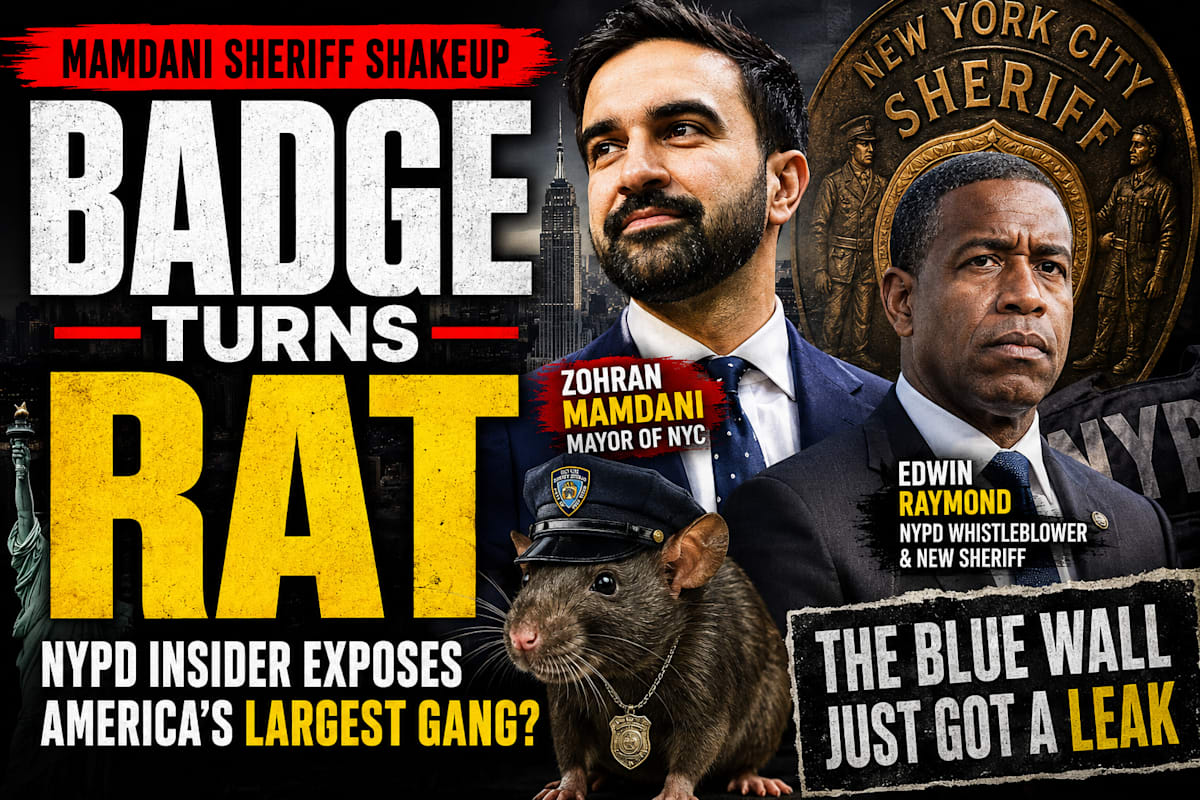
When the Badge Turns Rat: Mamdani’s Sheriff Shakeup and the Blue Wall Problem
576myd29j01btnp2hhdsrb4ie5cd2.93 MBWhen the Badge Turns Rat: Mamdani’s Sheriff Shakeup and the Blue Wall Problem
By Michele Evans New York City, New York 5/28/2026
Category: NYPD / NYC Mayor / Whistleblower
New York City, New York - New York City Mayor Zohran Mamdani’s reported decision to remove controversial Sheriff Anthony Miranda and appoint former NYPD Lieutenant Edwin Raymond is more than a personnel change.
It is a signal.
For years, New Yorkers have watched law enforcement institutions defend themselves with the same tired choreography: deny, deflect, investigate internally, wait out the outrage, then move on.
But the most dangerous witnesses against a powerful institution are often the people who once wore its uniform.
That is what makes Raymond’s reported appointment so politically charged.
Raymond is not an outside critic shouting from across the barricade. He is a former NYPD lieutenant who became known for challenging the department from within, including over allegations of quota-driven policing and discriminatory enforcement. He represents something City Hall has not always known how to handle: the insider who refuses to stay quiet.
And that is the real story here.
Because when insiders start talking, the wall is already cracked.
Whistleblower Is Corporate. Rat Is the Street Translation.
Let’s be honest about the language.
“Whistleblower” is the word they use when everybody is wearing suits.
It sounds clean. Legal. Sanitized. Like someone discovered misconduct, reported it to compliance, and waited patiently for Human Resources to pretend retaliation is against company policy.
But that is corporate language.
Where I come from, when somebody inside the crew starts talking about what the crew has been doing, there is another word for it.
Rat.
That is not polite language. It is not grant-funded language. It is not the kind of word people use at press conferences while standing in front of flags.
It is the language of the street, the jail tier, the courthouse hallway, the neighborhood, and every room where people understand exactly what happens when loyalty is used to hide dirty work.
And that is why it fits.
Because when the institution moves like a crew, protects its own like a crew, punishes dissent like a crew, and expects silence like a crew, then the person who starts talking is not just a whistleblower.
He is the rat.
The one who knows where the bodies are buried.
The one who knows who gave the order.
The one who knows what was written down, what was left out, and what everybody was told not to say.
I used to speak corporate. I could say “transparency,” “accountability,” and “institutional reform” like I still believed the memo mattered.
But I am no longer corporate.
I belong to the streets now.
And on the streets, if the largest police department in America is accused of moving like the biggest gang in the city, then the man who comes from inside and starts telling the truth is not just blowing a whistle.
He is wearing a wire on the blue wall.
And honestly?
About time.
The Blue Wall Does Not Crack From Polite Requests
Police departments survive on hierarchy, loyalty, and silence.
The public often hears about “the blue wall” as if it is just a phrase. But for many New Yorkers, it has meant something much more concrete: complaints disappearing into bureaucracy, officers protecting one another, retaliation against people who speak up, and communities being told their own experiences do not count unless the institution validates them.
That is why insiders matter.
When an ordinary New Yorker says the system is abusive, they are often dismissed as angry, biased, criminal, political, unstable, or unreliable. When an officer says the same thing, the institution has a harder time pretending the problem is imaginary.
That does not mean every whistleblower is a hero. It does not mean one appointment fixes a culture. It does not mean the public should stop asking hard questions.
But it does mean the city is being forced to confront a truth many communities have been naming for decades: the problem is not just a few bad actors.
The problem is the machinery.
The Sheriff’s Office Became Part of That Machinery
The New York City Sheriff’s Office is not the NYPD, but it operates inside the same broader world of enforcement power, raids, seizures, political pressure, and public trust.
The Sheriff’s Office is the city’s primary civil law enforcement agency. Under Anthony Miranda, who was appointed by former Mayor Eric Adams, the office became especially visible through the city’s crackdown on unlicensed cannabis shops.
That crackdown was promoted as necessary enforcement. But it also raised serious public-interest questions about raids, cash, property, closures, due process, and accountability.
When enforcement power is used aggressively, who watches the watchers?
When raids involve businesses, cash, inventory, closures, and communities already familiar with over-policing, what safeguards actually exist?
And when complaints, investigations, or whistleblower allegations surface, does City Hall respond with accountability or damage control?
That is why this reported shakeup matters.
Replacing Miranda with Raymond would not just change leadership. It would change the symbolic center of gravity.
It would say the city understands people are fed up.
Why People Talk About Police Power Like Gang Power
There is a reason so many people use harsh language when they talk about policing in America.
When a group has uniforms, weapons, political protection, internal loyalty codes, unions, lawyers, overtime budgets, press offices, and the power to stop, search, arrest, seize, surveil, and shape the record, communities may begin to experience that power less like public service and more like organized domination.
That is why people reach for words like “gang.”
Not because every officer is corrupt.
Not because every enforcement action is illegitimate.
Not because public safety does not matter.
But because the structure can behave like a protected fraternity with consequences for everyone outside it and very few consequences for those inside it.
And when people inside that structure begin to talk, it usually means the pressure has become impossible to contain.
Whistleblowers do not emerge from healthy institutions.
They emerge from systems where normal channels failed.
Raymond’s Appointment Would Be Judged by What Changes
The danger now is symbolism without substance.
It is easy to appoint a reform-minded figure. It is harder to change incentives, discipline, supervision, transparency, paperwork, enforcement culture, and retaliation patterns.
It is harder to protect people who report misconduct.
It is harder to stop retaliation before it ruins careers.
It is harder to make sure communities are not used as testing grounds for aggressive enforcement strategies later sanitized by press releases.
If Edwin Raymond becomes New York City sheriff, the appointment should not be treated as a victory lap.
It should be treated as a test.
Will the Sheriff’s Office become more transparent?
Will seizure practices be reviewed?
Will whistleblowers be protected?
Will communities affected by raids and enforcement actions have meaningful recourse?
Will the city examine how policing culture migrates from one agency to another?
Will public safety be measured by public trust, or just by the number of doors kicked open?
Those are the questions that matter.
The Public Record Is Shifting
For years, New Yorkers have been told to trust the system.
Trust the process.
Trust internal review.
Trust the chain of command.
Trust the same machinery that too often protects itself first.
But public trust is not restored by demanding silence.
It is restored by telling the truth.
If Mamdani’s reported replacement of Miranda with Raymond means anything, it is that City Hall may finally understand police accountability cannot be built only from the outside.
Sometimes the most important witness is the person who knows the system from within.
The person who knows what was said in the room.
The person who knows how the numbers were made.
The person who knows what was hidden under policy language.
The person who knows the difference between public safety and institutional self-protection.
Corporate America calls that person a whistleblower.
The streets call him a rat.
But when the institution has been moving like a crew, the public should not get precious about the label.
The real question is not whether he talked.
The real question is what the city does with what he knows.
Because when the badge turns rat, the blue wall does not just crack.
It starts making noise.
*Michele Evansis an independent journalist, author, and former ESPN technical producer whose work has appeared in The New York Times.
Michele got her start in 2001 covering the NBA and NFL.
She now covers New York City courts, criminal-justice procedure, NYPD, FDNY, domestic-violence systems, media accountability, public safety, advocacy efforts, and New York civic life through courthouse observation, public records, legal analysis, and lived-experience reporting.