When PREA Becomes a Weapon on Rikers Island
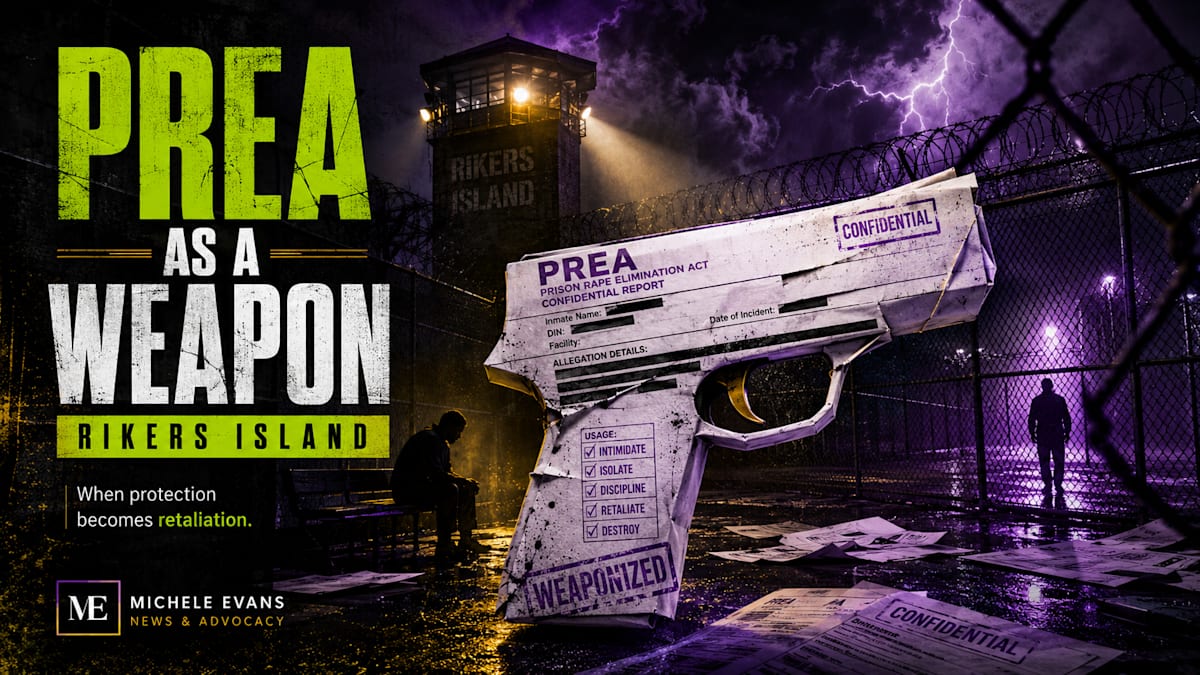
When PREA Becomes a Weapon on Rikers Island
By Michele Evans
New York City, New York
6/3/2026
Category: Rikers Island / PREA / Criminal Justice
New York City, New York - PREA is supposed to protect people.
The Prison Rape Elimination Act exists because sexual abuse in custody is real. Sexual harassment is real. Staff misconduct is real. Coercion is real. Retaliation is real. People inside jails and prisons are vulnerable in ways the public often does not understand, because the state controls everything: housing, movement, privacy, food, medical care, safety, and access to help.
So let me be clear.
PREA is necessary.
But on Rikers Island, even necessary protections can become dangerous when they enter a system already ruled by chaos, retaliation, rumor, staff neglect, gang politics, and fear.
Inside Rikers, a PREA report does not land in a clean, neutral environment. It lands inside a dorm. It lands inside jail politics. It lands inside old beefs, jealousy, broken friendships, romantic drama, staff games, power struggles, and survival math.
That is what people on the outside need to understand.
At Rikers, PREA is not only a reporting system. It can also become a threat.
“If you make a report on me, I’ll make one on you.”
“If you say something, I’ll say something too.”
“I’ll PREA you.”
That is the culture.
A law created to protect people from sexual abuse can become, inside the dorm, a bargaining chip, a revenge tool, a housing weapon, and a way to remove someone you do not like.
People know what a PREA allegation can do. They know it can get someone moved. They know it can separate couples. They know it can bring heat on a dorm. They know it can put a target on someone’s back. And because everyone knows that, the threat of PREA becomes part of the language of intimidation.
It does not have to be true to do damage.
The allegation alone can change someone’s housing. It can brand someone. It can isolate someone. It can separate people. It can trigger retaliation. It can bring officers into the dorm. It can make everyone choose sides before an investigation ever begins.
That is how protection becomes another weapon.
In 2B, the dorm was so chaotic, so political, and so full of daily drama that people called it “the projects.” It had its own social order. Everyone knew who had status. Everyone knew who was with who. Everyone knew who was fighting, who was jealous, who owed somebody, who had protection, and who had enemies.
Two of my friends, Fire and Dred, were a popular couple in Rikers.
They were not shy about loving each other. They held hands. They kissed. They were affectionate in a place where tenderness was rare and usually punished by the environment around it. Bathroom makeout sessions were routine. Everybody knew they were together, and everybody knew they were not hiding it.
Then someone made a PREA report.
After that, Fire and Dred were separated into different dorms.
They were never put back together.
On paper, someone might call that procedure.
Inside Rikers, it felt like something else.
It felt like someone had discovered the fastest way to break them apart.
Word in the dorm was that another detainee had made the report to get back at them. I cannot prove that. I can only say that was the dorm belief, and dorm belief has consequences.
The person people believed had made the report became a target.
She would not go into the bathroom because she was afraid of getting jumped. That fear was not imaginary. The dorm had already turned on her. Eventually, people caught her outside the elevator. Everyone was after her. And the elevator scene was not the end of it. Later, in the mess hall, she was sucker punched to the ground by a much larger detainee.
People talked about it like it was legendary.
But there was nothing legendary about it.
It was a warning.
It was a symptom.
It was what happens when a jail allows rumor, retaliation, fear, and leaked information to govern the lives of people in custody.
That is the danger no policy memo can fully capture.
PREA is supposed to protect people from sexual abuse and sexual harassment. It is also supposed to protect people from retaliation for reporting or cooperating with an investigation. But what happens when people do not trust the process? What happens when a report is believed to be a weapon? What happens when the threat of a report becomes a way to control other people? What happens when confidentiality breaks down? What happens when the dorm finds out who is connected to a report before anyone is protected?
What happens is Rikers.
Not long after Fire and Dred were separated, I found a piece of paper near my bed.
I picked it up and looked at it. It was an internal Department of Corrections email. It named several people who had filed or were connected to a PREA report.
I did not know if it was the report involving Fire and Dred. I did not know if it had been dropped accidentally or left there intentionally by an officer. But I knew where I found it.
It was near the head of my bed, by the wall, in a place where no officer had any business being.
That is why I suspected it had been left there on purpose.
Inside Rikers, paperwork is not just paperwork. A name is not just a name. An internal email naming people connected to reports can become a hit list, a warning, a setup, or a spark. It can put someone in danger before they even know they have been exposed.
Given the politics of the dorm, I did not know what to do with it.
I knew I could not sit on it myself.
I also knew that if I handled it wrong, the consequences could fall on me, on the people named, or on people already caught in the middle of dorm conflict.
So I took it to the person who had the most authority in the dorm, the leader of the gang, and said, “I found this. I thought you would be the person to know how it should be handled.”
She thanked me and gave me a knowing nod.
What became of that paper, I do not know.
But I know what it meant.
It meant that confidential information connected to reporting was loose inside the dorm. It meant people’s names were floating around in a place where names can get people hurt. It meant the system that was supposed to protect people had created, or allowed, another danger.
And that is exactly why this conversation cannot be reduced to whether PREA is good or bad.
PREA is good.
PREA is needed.
PREA exists because people in custody are at risk of sexual abuse, staff abuse, coercion, harassment, and retaliation. There must be ways to report abuse. There must be third-party reporting. There must be anonymous reporting. There must be outside reporting. There must be investigations.
But there must also be confidentiality.
There must be protection from retaliation.
There must be competent handling of reports.
There must be a process that does not turn allegations into dorm-wide gossip, separation into punishment, reporting into danger, or paperwork into a weapon.
A serious PREA system must be able to do two things at once: protect real victims and prevent the reporting process from being used as retaliation.
That requires more than a poster on the wall.
It requires confidential intake, outside reporting channels, careful housing decisions, real investigation, protection from retaliation, consequences for staff who leak information, and a process that does not automatically let dorm politics decide who is believed, who is moved, and who is punished.
Because when PREA is weaponized, everyone loses.
Real survivors lose.
People falsely accused lose.
People afraid to report lose.
People named in leaked paperwork lose.
Witnesses lose.
The whole dorm loses.
And the jail gets to hide behind the appearance of procedure while the people inside absorb the damage.
The issue is not only what happens when people report.
It is what happens after they report.
Are they protected?
Are they believed?
Are they moved safely?
Are their names kept confidential?
Are they retaliated against?
Are reports investigated seriously?
Are false or weaponized reports handled responsibly without discouraging real victims from coming forward?
Are officers leaking information?
Are people being separated as a safety measure, or punished without due process?
Are vulnerable people being left to face dorm justice?
Those are not abstract questions.
Those are life-and-death questions inside a jail.
Fire and Dred’s story did not end with that report.
They went on to get married at Rikers. Not long after, Dred had to undergo brain surgery. Fire wrote a letter to Dred during that time called “A Wife’s Cry.” She read it to me, and it brought tears to my eyes.
That is the part people forget when they talk about incarcerated people as if they are case numbers, charges, bodies, or problems to be managed.
People love inside jail.
People marry inside jail.
People grieve inside jail.
People wait for medical news inside jail.
People write letters that sound like prayers inside jail.
People build families in places designed to break them.
And sometimes the system breaks them anyway.
The separation did not end when the dorm doors closed behind them.
Eventually, Dred was released. Fire went upstate. Their relationship had already survived Rikers, PREA politics, forced separation, medical fear, marriage inside jail, and the kind of pressure most couples on the outside could not imagine.
But forced separation creates its own damage.
It creates distance. It creates confusion. It creates missed protection. It creates pain that follows people out of the building.
And in Dred’s case, the danger did not stay behind the walls.
After Dred was released, Dred was shot multiple times, point blank, in the face.
Dred survived and later said they were lucky the person was a bad shot.
That sentence should stop everyone cold.
Because this is not a game.
These are not harmless dorm rumors. These are not petty housing moves. These are not just “jail relationships” outsiders can laugh off or dismiss. These are human lives. These are marriages. These are medical crises. These are people trying to hold onto love, safety, and stability in a system designed to strip all three away.
After the shooting, the fear did not disappear just because Dred survived. Public transportation felt vulnerable Moving around the city felt different after being shot point blank in the face. For a time, I drove Dred around so getting from place to place did not feel so exposed. Later, when I had to go upstate, I donated the car to the cause.
That is how far the consequences reached.
A PREA report made inside Rikers. A separation. A relationship strained by forced distance. A release. A shooting. A surviving person nervous to move through the city. Friends stepping in because the system that helped create the damage was nowhere to be found when the damage followed people home.
When a PREA report is weaponized to separate people, remove enemies, retaliate, threaten someone into silence, or settle dorm politics, the consequences do not always end at the housing-unit door.
They can follow people into other dorms.
They can follow people upstate.
They can follow people home.
They can follow people into the street.
A false or retaliatory report can break trust. A leaked report can put names in danger. A housing move can separate someone from the only person helping them survive. A dorm rumor can become violence. A system that treats all of this like routine procedure is ignoring the human wreckage left behind.
PREA is supposed to prevent harm.
At Rikers, when the process is mishandled or weaponized, harm can multiply.
That is why this issue has to be treated with seriousness, not slogans.
No one should use the possibility of sexual abuse as a weapon.
No one should be able to threaten another person with a PREA report as retaliation.
No one should be able to use PREA to remove a rival from a dorm.
No one should be falsely accused because someone wants revenge.
No real victim should stay silent because they are afraid everyone will think they are lying.
No confidential report should end up loose in a dorm.
No one’s name should become jail currency.
No one should have to calculate whether reporting danger will create more danger.
That is not protection.
That is institutional failure.
Rikers does not need less accountability around sexual abuse. It needs more. It needs real confidentiality. Real retaliation protection. Real outside oversight. Real investigation. Real consequences for staff who leak information, mishandle reports, ignore threats, or use paperwork to stir chaos in the dorms.
Because inside Rikers, information can be dangerous.
A rumor can be dangerous.
A threat can be dangerous.
A report can be dangerous.
A leaked name can be dangerous.
A housing move can be dangerous.
And when the state takes custody of a human being, it takes responsibility for what happens to that person after the report is made, after the rumor spreads, after the threat is spoken, after the paper is dropped, after the housing move, after the separation, after the person is left exposed.
PREA was created because sexual abuse in custody is real and people need protection.
But protection cannot become another weapon.
At Rikers, a report can separate a couple. A rumor can make someone a target. A leaked name can put someone in danger. A housing move can tear away the person who was helping someone survive. And the consequences can follow people far beyond the dorm, beyond the jail, beyond release.
This is not paperwork.
This is not gossip.
This is not dorm drama.
This is not a game.
These are life-and-death consequences inside a system that keeps pretending procedure is the same thing as protection.
Resources for Families and Loved Ones
If someone you love is in custody and reports sexual abuse, sexual harassment, retaliation, staff misconduct, or a PREA-related concern, document everything you can: the person’s name, book and case number if available, facility, housing area, date, time, names of staff or witnesses if known, and exactly what happened.
Family members, attorneys, advocates, service providers, and other third parties can make reports. Reports may be anonymous. A person does not always have to disclose their own name or the name of the alleged victim or alleged abuser to make a third-party report.
For people in New York City Department of Correction custody, concerns can be reported through NYC 311 or directly to the Department of Correction. DOC’s contact page includes information for reporting sexual abuse and sexual harassment, as well as general complaints and medical emergencies.
Families should also consider reaching out to outside survivor-support organizations, legal advocates, public defenders, and oversight bodies when there is fear of retaliation, staff involvement, medical neglect, or leaked confidential information.
Useful links:
PREA Resource Center, Reporting Standard:
https://www.prearesourcecenter.org/standard/115-61
PREA Resource Center, Retaliation Protection Standard:
https://www.prearesourcecenter.org/standard/115-67
PREA Resource Center, Resources for Survivors:
https://www.prearesourcecenter.org/about/for-survivors
PREA Third-Party Reporting Fact Sheet:
https://www.prearesourcecenter.org/sites/default/files/library/third-partyreportingfactsheet.pdf
NYC Department of Correction Contact Page:
https://www.nyc.gov/site/doc/about/contact-doc.page
NYC 311 Department of Correction Complaint Information:
https://portal.311.nyc.gov/article/?kanumber=KA-02384
RAINN National Sexual Assault Hotline:
*Michele Evans is an independent journalist, author, and former ESPN technical producer whose work has appeared in The New York Times.
Michele got her start in 2001 covering the NBA and NFL.
She now covers New York City courts, criminal-justice procedure, NYPD, FDNY, domestic-violence systems, media accountability, public safety, advocacy efforts, and New York civic life through courthouse observation, public records, legal analysis, and lived-experience reporting.
Read more independent journalism by Michele Evans.
Follow Michele Evans on Facebook and Substack for new reporting, analysis, and updates.