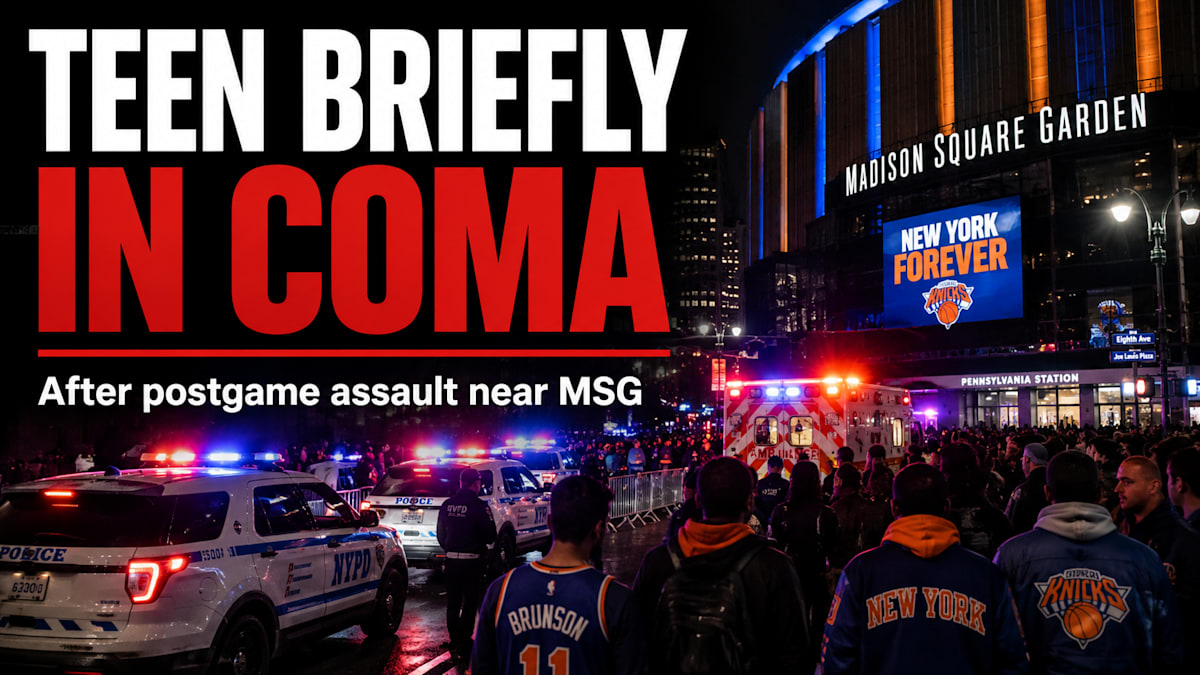
When Knicks Celebration Turns Dangerous, The City Has To Ask Harder Questions
jr4hs0qsayfwf33i83ww7urdrfmc1.8 MBWhen Knicks Celebration Turns Dangerous, The City Has To Ask Harder Questions
By Michele Evans New York City, New York 6/12/2026
Category: NYPD / Public Safety / Sports
New York City, New York - We can laugh at the word “hooligans.”
We cannot laugh at a 17-year-old being beaten into a coma.
After the Knicks’ Game 4 NBA Finals win over the San Antonio Spurs, the celebration around Madison Square Garden crossed a line that no sports joke, social media bit, or crowd-control argument can soften.
According to ABC7, police said a 17-year-old was attacked near 235 West 35th Street around 11:45 p.m. Wednesday after a verbal dispute in the postgame crowd. Authorities said he was kicked multiple times in the head and body, suffered a seizure, went into a coma, and was taken to Bellevue Hospital in critical condition. He has since been stabilized. As of the report, no arrests had been made.
That is not fan passion.
That is violence.
And it should change the conversation around the Knicks crowds outside Madison Square Garden.
For days, New York has been arguing over how much celebration is too much, who gets to control the space around MSG, and whether the NYPD’s “frozen zone” restrictions were necessary or excessive. MSG owner James Dolan and city officials clashed over watch-party limits. Fans complained about restrictions. Police defended the security footprint. Social media turned the whole thing into spectacle.
Then a teenager ended up in a hospital bed.
CBS New York reported that after Game 4, the NYPD took 56 people into custody, including 15 arrests and 41 summonses. Police said some crowds climbed on vehicles, set off fireworks, took over streets, damaged NYPD vehicles, and refused orders to disperse. Ten officers were injured, including one reportedly hit in the head with a glass bottle.
That does not mean every Knicks fan is dangerous. It does not mean celebration should be criminalized. It does not mean the city should treat joy like a threat.
But it does mean New York cannot keep pretending these crowds are unpredictable.
They are not.
Everyone knew the area around Madison Square Garden would fill up. Everyone knew Game 4 had championship stakes. Everyone knew prior games had already produced arrests, crowd surges, and clashes. Everyone knew that even without an official outdoor watch party, fans would still come.
The question is not whether Knicks fans should be allowed to celebrate.
The question is why the city, the Garden, the NYPD, and public officials keep acting surprised when an obvious crowd-control problem becomes a public-safety crisis.
There is a difference between managing a celebration and waiting for it to break.
There is also a difference between public safety and public theater. Barricades, blocked streets, police lines, frozen zones, and last-minute watch-party decisions may control space, but they do not automatically create a safe plan for people moving through that space. A crowd does not become safer just because it is compressed, displaced, confused, or told to go somewhere else.
New York knows how to handle major public events when it wants to. The city manages parades, protests, concerts, marathons, New Year’s Eve, presidential visits, and championship crowds. None of those are easy. All of them require planning, communication, public information, and enough clarity that people know where they can go, where they cannot go, and how to leave safely.
The Knicks’ playoff run has given the city joy it has been hungry for.
That joy should not become a permission slip for violence. It also should not become an excuse for sloppy planning, political blame-shifting, or treating fans as a problem only after someone gets hurt.
The teenager attacked after Game 4 is not a punchline. He is not a footnote in a viral celebration. He is not background noise in a sports story.
He is the warning.
If the Knicks return to Madison Square Garden with the series still alive, New York needs more than arguments about whether fans are “hooligans” or whether officials are “party poopers.”
It needs a real crowd plan.
It needs accountability from the people organizing, permitting, policing, and profiting from these moments.
And it needs the public to understand one thing clearly:
Cheering is celebration.
Beating a teenager into a coma is a crime.
*Michele Evansis an independent journalist, author, and former ESPN technical producer whose work has appeared in The New York Times.
Michele got her start in 2001 covering the NBA and NFL.
She now covers New York City courts, criminal-justice procedure, NYPD, FDNY, domestic-violence systems, media accountability, public safety, advocacy efforts, and New York civic life through courthouse observation, public records, legal analysis, and lived-experience reporting.