When Domestic Violence Victims Go Silent, New York Must Listen Harder
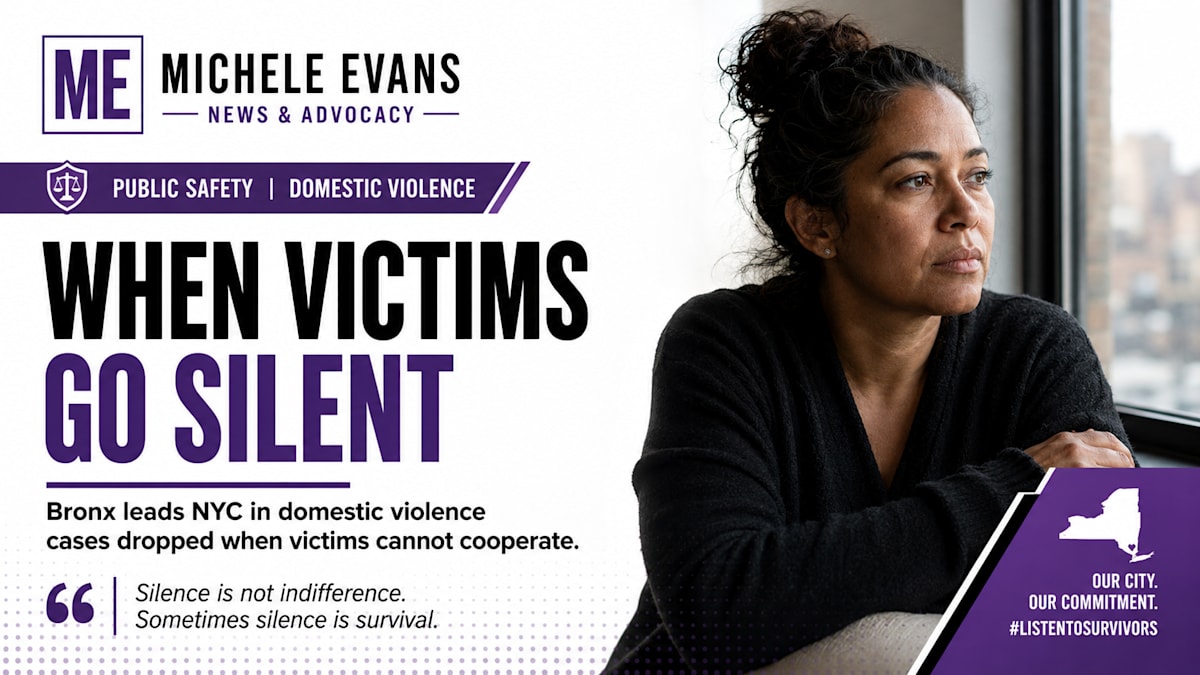
When Domestic Violence Victims Go Silent, New York Must Listen Harder
By Michele Evans
New York City, New York
5/31/2026
Category: Courts / Criminal Justice / Domestic Violence / Advocacy
Bronx, New York - Nearly 1,000 domestic violence-related cases in New York City were reportedly declined by prosecutors in the last three months of 2025 because victims did not cooperate.
The Bronx accounted for the overwhelming share.
That statistic is devastating. But it should not be used to blame victims. It should be used to ask what happens after a woman calls 911, after police leave, after the bruises fade, after the strangulation leaves no visible mark, after a case depends on the cooperation of someone who may still be afraid for her life.
Because “not cooperating” is one of the coldest phrases in the criminal justice system.
It makes terror sound like paperwork.
It makes survival sound like refusal.
It makes a woman who may be trapped, threatened, financially dependent, traumatized, ashamed, isolated, or still living under the control of her abuser sound like she simply failed to do her part.
That is not how domestic violence works.
Domestic violence is not just an incident. It is a system of control. It is fear built into daily life. It is a voice lowered before an argument starts. It is a phone checked. It is money withheld. It is a threat made quietly enough that no one else hears it. It is the calculation a woman makes before she speaks, before she leaves, before she calls police, before she tells a prosecutor what happened.
And sometimes, silence is not indifference.
Sometimes silence is fear.
Sometimes silence is strategy.
Sometimes silence is a woman trying to stay alive.
The story of Bronx mother Josabeth Diaz, reported by the New York Daily News, makes that reality painfully clear. Diaz spent two decades in an abusive relationship before her husband was prosecuted after a 2022 attack in which she said he choked her until she blacked out. She had experienced violence before. She had called police before. She had also declined to cooperate before.
That is not contradiction. That is the cycle.
Diaz described what so many survivors know too well: the apology, the promise to change, the gifts, the self-blame, the pressure from family, the fear that maybe reporting him was the wrong thing to do. She also described growing up around domestic violence, which made the abnormal feel familiar. For too long, she believed what she was living through was simply life.
It was not.
The attack that finally led to prosecution was not only violent. It was nearly fatal. Diaz said she could not breathe. Her voice was so damaged afterward that even calling 911 became difficult. Police came. Her husband was arrested. He later pleaded guilty to criminal obstruction of breathing and criminal contempt for violating an order of protection.
But Diaz is still living with the aftermath. Her vocal cords have not fully recovered. She can no longer sing the way she once did.
That detail should haunt people.
Domestic violence does not only take safety. It takes sound. It takes the body. It takes memory. It takes confidence. It takes years. It takes the ordinary joys a person once assumed would always belong to them.
In another Bronx case cited by the Daily News, Yesenia Hall, 42, was fatally stabbed in February, and her 16-year-old son was badly wounded. Police said the suspect, her longtime boyfriend Juan Rivas, had a history of domestic violence arrests involving Hall, and that she had repeatedly let him back into her life and did not cooperate with prosecutors.
Her family did not blame her.
That matters.
Because the public often asks the wrong question. It asks why she stayed. Why she went back. Why she stopped cooperating. Why she did not leave sooner. Why she answered the phone. Why she opened the door. Why she believed him again.
But the better question is: what made leaving unsafe?
A woman may stay because the abuser controls the money. Because she has children with him. Because she fears deportation threats. Because she has nowhere to sleep. Because shelters are full or frightening. Because she has been isolated from friends and family. Because he has threatened to kill her, her children, or himself. Because she has already learned that calling for help does not guarantee protection.
A woman may stop cooperating because the emergency has passed, but the danger has not.
That is the gap New York must confront.
An arrest can interrupt violence. It does not automatically create safety.
A prosecutor can open a case. That does not mean the victim has housing, child care, transportation, immigration support, trauma counseling, income, phone security, or protection from retaliation.
An order of protection can be issued. That does not mean an abuser will obey it.
A woman can be urged to escape. That does not mean she has a safe way out.
The Bronx numbers should not become another reason to shame victims. They should become a demand for a more realistic domestic violence response, one that understands that cooperation is not just a legal choice. It is often a safety question.
If prosecutors need victims to participate, then victims need conditions that make participation possible.
They need advocates who stay involved after the first arrest. They need trauma-informed support. They need emergency housing that can actually be reached. They need help replacing phones, documents, locks, income, transportation, and the pieces of life an abuser may have controlled. They need courts that take violations seriously. They need police, prosecutors, judges, and service providers trained to recognize strangulation as a grave warning sign, even when no bruises are visible.
And they need the public to stop mistaking fear for failure.
Strangulation deserves special attention because it is one of the most dangerous forms of domestic violence. Survivors may minimize it because there are no marks. Others may minimize it because the victim survived. But being choked is not a private argument that went too far. It is a warning that the abuser has put his hands around the victim’s life.
Diaz survived that moment.
Yesenia Hall did not survive hers.
Their stories sit side by side as a warning to New York: domestic violence does not disappear when a case is dropped. Sometimes that is when it becomes quieter. Sometimes that is when it returns home. Sometimes that is when the victim is left alone with the person everyone else has stopped watching.
So when the system marks a case “victim failed to cooperate,” it should not close the moral file.
It should ask: Is she safe tonight?
Can he reach her?
Does she have somewhere to go?
Does she have money?
Does she have children in the home?
Has he choked her before?
Has he violated an order of protection?
Has he threatened to kill her?
Does she believe he will?
Those questions could save lives.
Women should be urged to escape abuse. But urging is not enough. A slogan is not a safety plan. A hotline is not a home. A court date is not protection. A prosecution strategy is not healing.
New York must build the bridge between calling for help and being free.
That bridge has to be strong enough for a woman who is scared. Strong enough for a mother with children. Strong enough for an immigrant threatened with deportation. Strong enough for someone who went back before. Strong enough for someone who still loves the person hurting her. Strong enough for someone who cannot yet say out loud what happened.
Because leaving abuse is not one brave moment. It is a dangerous sequence of decisions.
The least New York can do is make those decisions safer.
And the least the rest of us can do is stop asking why victims do not cooperate and start asking what they still fear.
If you are experiencing domestic violence in New York City, help is available 24 hours a day through the NYC Domestic Violence Hotline at 1-800-621-HOPE. If you are in immediate danger, call 911.
You are not weak because you are afraid.
You are not foolish because you stayed.
You are not beyond help because you went silent.
And your fear deserves to be heard before your case becomes another statistic.
If You Are Experiencing Domestic Violence
If you are in immediate danger, call 911.
If you are not safe, but cannot speak openly, try to contact a hotline, advocate, trusted person, or local domestic violence program from a safer phone or device. Consider deleting browser history, texts, or call logs if an abuser monitors your activity.
New York City 24-Hour Domestic Violence Hotline
Call 1-800-621-HOPE (4673)
Safe Horizon operates NYC’s 24/7 hotline for people experiencing domestic violence, intimate partner violence, crime, abuse, or sexual assault.
https://www.safehorizon.org/hotline/
NYC HOPE Resource Directory
NYC HOPE connects survivors to free and confidential assistance, including Family Justice Centers and community-based organizations that can help with safety planning, counseling, legal help, shelter referrals, and other support.
NYC Family Justice Centers
Survivors of domestic and gender-based violence can receive free and confidential help at Family Justice Centers in all five boroughs, including case management, economic empowerment, counseling, civil legal assistance, and criminal legal assistance.
https://www.nyc.gov/site/ocdv/programs/family-justice-centers.page
NYC Domestic Violence Shelter and Support Services
New York City’s Human Resources Administration provides information about temporary housing, emergency shelter, counseling, advocacy, and referrals for survivors and their children.
https://www.nyc.gov/site/hra/help/domestic-violence-support.page
New York State Domestic Violence Program Directory
The New York State Coalition Against Domestic Violence maintains a directory of domestic violence programs across New York State, including organizations that provide emergency shelter and supportive services.
https://www.nyscadv.org/find-help/program-directory.html
New York State Office for the Prevention of Domestic Violence
New York State provides survivor and victim resources, including information about abuse, safety, orders of protection, financial assistance, and how to find help.
https://opdv.ny.gov/survivors-victims
National Domestic Violence Hotline
Call 1-800-799-SAFE (7233)
Text START to 88788
The National Domestic Violence Hotline provides confidential support 24/7.
Safe Horizon Legal and Court Support
Safe Horizon provides support for survivors navigating courts, orders of protection, custody, visitation, divorce, child support, and related legal needs.
https://www.safehorizon.org/orders-of-protection/
A note for survivors:
Leaving can be dangerous. Staying can be dangerous. Silence can be survival. You do not have to figure it out alone. A trained advocate can help you think through a safety plan based on your specific situation.
*Michele Evans is an independent journalist, author, and former ESPN technical producer whose work has appeared in The New York Times.
Michele got her start in 2001 covering the NBA and NFL.
She now covers New York City courts, criminal-justice procedure, NYPD, FDNY, domestic-violence systems, media accountability, public safety, advocacy efforts, and New York civic life through courthouse observation, public records, legal analysis, and lived-experience reporting.
Read more independent journalism by Michele Evans.
Follow Michele Evans on Facebook and Substack for new reporting, analysis, and updates.