Trump’s Win Over Letitia James Shows Why Americans Are Suspicious of Lawfare
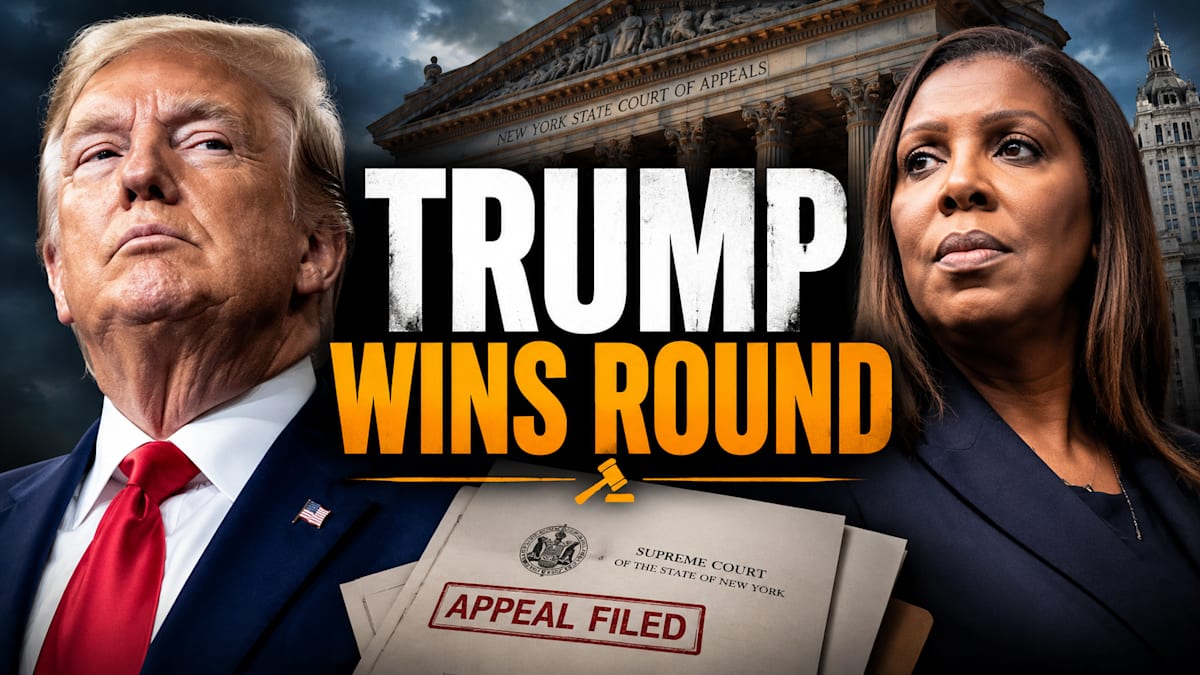
Trump’s Win Over Letitia James Shows Why Americans Are Suspicious of Lawfare
By Michele Evans
New York City, New York
5/19/2026
Category: Courts / Criminal Justice / Trump
Albany, New York - A New York appeals court threw out the massive civil fraud penalty against President Donald Trump, and the ruling raises a larger question about punishment, politics, and prosecutorial power.
President Donald Trump just won one of the most important rounds in his long legal fight with New York Attorney General Letitia James.
A New York appeals court threw out the massive civil fraud penalty imposed against Trump, his family, and his company, ruling that the financial punishment was excessive. The penalty had originally been reported at roughly $454 million, later swelling past $500 million with interest. The appeals court did not erase every part of the case, and it upheld findings that Trump and his company had committed fraud, but it eliminated the enormous monetary penalty that had become the center of the case.
That distinction is important.
This was not a total legal wipeout of the case. It was something more specific, and politically explosive: a court saying the financial punishment went too far.
For Trump’s supporters, that is exactly the point.
The case brought by James had long been viewed on the right as a symbol of the lawfare era, a time when courts, prosecutors, civil lawsuits, and criminal investigations became part of the political battlefield. Conservatives saw the case not simply as a business-fraud action, but as political punishment dressed up as justice.
James built her public brand on pursuing Trump. Trump built part of his political comeback on arguing that Democratic prosecutors and officials were trying to drain him, humiliate him, and keep him trapped in court instead of letting voters decide his fate.
The appeals ruling gives that argument new force.
According to the Associated Press, the court spared Trump from the potential half-billion-dollar financial penalty while leaving some other sanctions and findings in place. The panel was sharply divided, but a majority concluded that the monetary punishment was excessive. Judges Dianne Renwick and Peter Moulton wrote that while harm occurred, it was not the kind of catastrophic harm that justified a nearly half-billion-dollar award to the state.
That is the pressure point.
When a penalty reaches a number that looks designed to destroy a man instead of settle a dispute, Americans notice.
The question is not whether wealthy people, powerful people, or presidents should be above the law. They should not be. The rule of law only means something if it applies to everyone.
But the rule of law also requires proportion.
It requires restraint.
It requires the public to believe that prosecutors are enforcing neutral standards, not using legal tools to damage political enemies.
That is where the James case became bigger than Trump.
Many Americans looked at the civil fraud case and saw a business dispute where banks were repaid, lenders had their own ability to evaluate risk, and no conventional victim appeared in the way ordinary people understand fraud. Trump’s lawyers argued that his financial statements included disclaimers, that lenders conducted their own analysis, and that the loans were repaid. State attorneys argued that inflated asset values distorted the market and gave Trump unfair financial advantages.
Those are legal arguments.
But politics was never far from the courtroom.
One appellate judge, David Friedman, was sharply critical of James and suggested the case was driven by political motives. Bloomberg Law reported that Friedman accused James of bringing the case for partisan reasons in an effort to damage Trump’s political career and real estate business.
That does not mean every part of Trump’s defense was accepted. It was not. The appeals court did not give Trump a clean slate. Bloomberg Law reported that the panel struck down the $464 million fraud penalty while still leaving other parts of the judgment intact, including monitoring requirements and temporary business restrictions, though those sanctions remained paused for further appeal.
But the political significance is undeniable.
The financial penalty was the headline. The financial penalty was the weapon. The financial penalty was the part of the case that made people ask whether justice had crossed into destruction.
When government punishment becomes so large that it appears designed to annihilate, it can backfire. It can turn a defendant into a symbol. It can make even people who dislike Trump question whether the system is being used evenly.
That is exactly what happened here.
Letitia James may argue that her case still has merit, and she has said she would seek review from New York’s highest court. Her office emphasized that the fraud findings were upheld and that Trump and his company were still found liable.
But Trump’s side will point to the ruling and say: this is what we warned you about.
They will say the process was the punishment.
They will say the number was never about restitution, but humiliation.
They will say this was lawfare.
And politically, that message is likely to land.
Because millions of Americans already believe the legal system has become two systems: one for favored political actors, and one for disfavored ones. They look at charging decisions, civil penalties, gag orders, gag-worthy leaks, selective outrage, and courtroom theater, and they do not see blind justice. They see power.
That perception is dangerous.
Not because Trump benefits from it, but because public trust in courts and prosecutors cannot survive if Americans come to believe the law is just politics with subpoenas.
The appeals court ruling does not end the debate over Trump’s conduct. It does not erase the fraud findings. It does not settle every legal question. But it does sharply undercut the most dramatic part of the punishment.
And that is why this ruling is a major moment.
It tells New York prosecutors that even in a case against Donald Trump, even in a courtroom culture where Trump is treated by many as uniquely deserving of punishment, there are still limits.
There has to be a line between accountability and annihilation.
There has to be a difference between enforcing the law and using the law to make an example out of someone.
Trump won this round because the penalty went too far.
Now the larger question goes to the public:
Are Americans comfortable with prosecutors using civil power this aggressively against political enemies, or did this ruling expose exactly why the lawfare argument has become so powerful?
Suggested Facebook caption
Question: Are you happy Trump won this round against Letitia James?
A New York appeals court threw out the massive civil fraud penalty against President Trump, ruling that the financial punishment was excessive. The court did not erase every part of the case, but the decision is a major rebuke to the enormous penalty that had become a symbol of political lawfare.
When punishment looks designed to destroy instead of correct, Americans notice.
*Michele Evans is an independent journalist, author, and former ESPN technical producer whose work has appeared in The New York Times.
Michele got her start in 2001 covering the NBA and NFL.
She now covers New York City courts, criminal-justice procedure, NYPD, FDNY, domestic-violence systems, media accountability, public safety, advocacy efforts, and New York civic life through courthouse observation, public records, legal analysis, and lived-experience reporting.
Read more independent journalism by Michele Evans.
Follow Michele Evans on Facebook and Substack for new reporting, analysis, and updates.