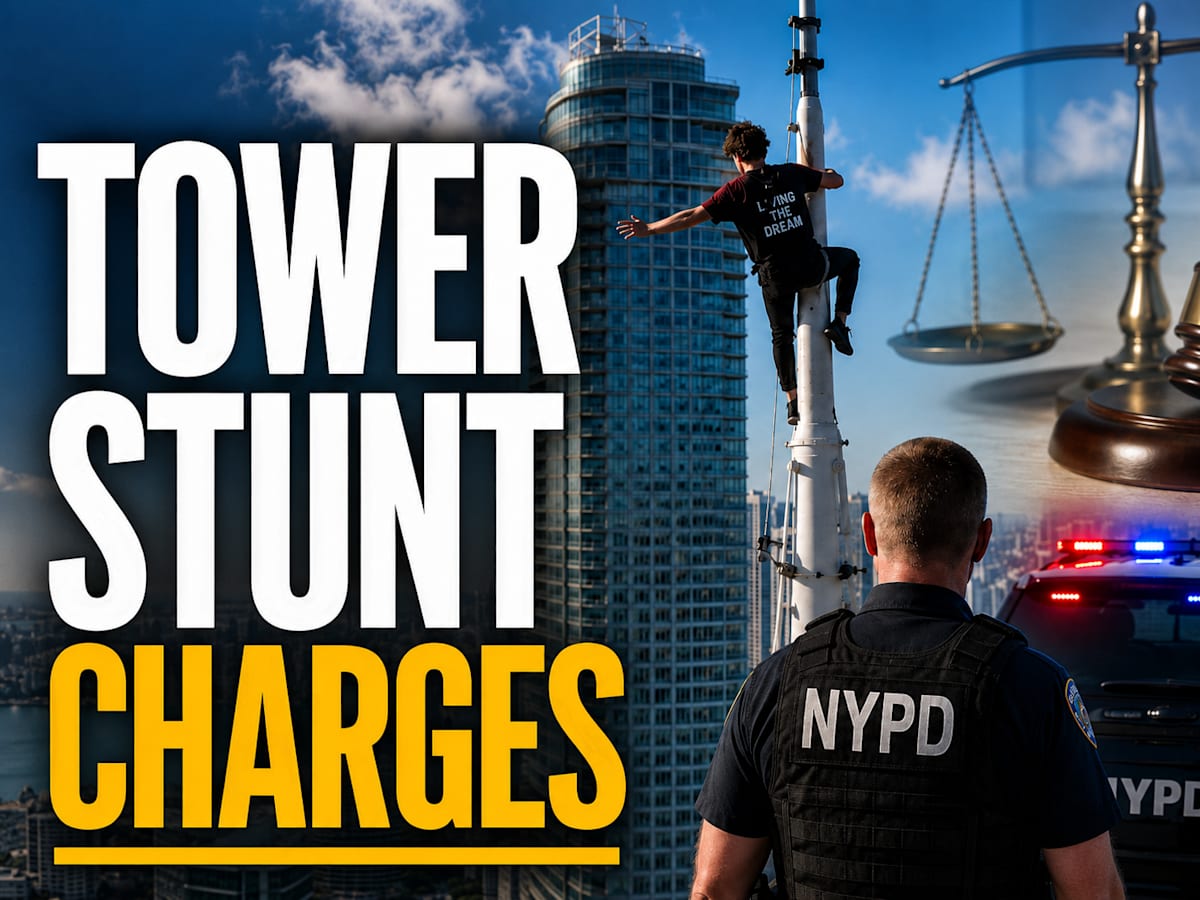
Tower Stunt Charges Put Viral Spectacle in a Public-Safety Frame
80d183pt6rtt7i4ov9bdiyc6b7sq1.91 MBTower Stunt Charges Put Viral Spectacle in a Public-Safety Frame
By Michele Evans New York City, New York Date: 7/2/2026
Category: Public Safety / NYPD / Midtown / Courts
NEW YORK CITY, NY - A marriage proposal on top of the Empire State Building may read like internet theater from a distance. In New York City, it is also a public-safety operation the second police, drones, helicopters, building security, emergency responders, and pedestrians are pulled into the story.
The Guardian reported that Angela Nikolau and Ivan Beerkus, two Russian rooftopping figures known for high-risk climbs, were arrested after climbing to the pinnacle of the Empire State Building on July 1 and unfurling a banner during an apparent proposal. The NYPD reportedly used a drone and helicopter to monitor the pair before they were taken into custody without incident.
That last phrase matters: without incident.
A stunt like this can end differently. A fall. A rescue. A panic. A responding officer or firefighter put in danger. A building evacuation. A Midtown security lockdown. A viral video that turns into a body recovery.
The charges reported in the case, including burglary, criminal trespass, and reckless endangerment, are not just technical labels. They are the legal language the city uses when private spectacle crosses into public risk.
There is a larger media question here too. Social platforms reward danger when danger looks cinematic. The higher the building, the better the view. The closer the edge, the better the clip. But New York City is not a set. The Empire State Building is not a prop. Emergency response is not background production support for a personal brand.
The public does not need moral panic over every stunt. It does need the line drawn clearly. When a private act forces a public response, the city has a right to ask what risk was created, who had to answer it, and what could have happened if one detail went wrong.
That question matters beyond one rooftop proposal. It matters for subway surfing. It matters for bridge climbs. It matters for trespass videos in tunnels, construction sites, rooftops, and restricted spaces where one mistake becomes everyone else’s emergency.
New York is a city of spectacle. It is also a city where emergency resources are finite.
The romance may have been the point of the video. The public-safety cost is the part the city should not ignore.
*Michele Evansis an independent journalist, author, and former ESPN technical producer whose work has appeared in The New York Times.
Michele got her start in 2001 covering the NBA and NFL.
She now covers New York City courts, criminal-justice procedure, NYPD, FDNY, domestic-violence systems, media accountability, public safety, advocacy efforts, and New York civic life through courthouse observation, public records, legal analysis, and lived-experience reporting.