The Take It Down Act Is Now in Force. Survivors Need More Than a Button.
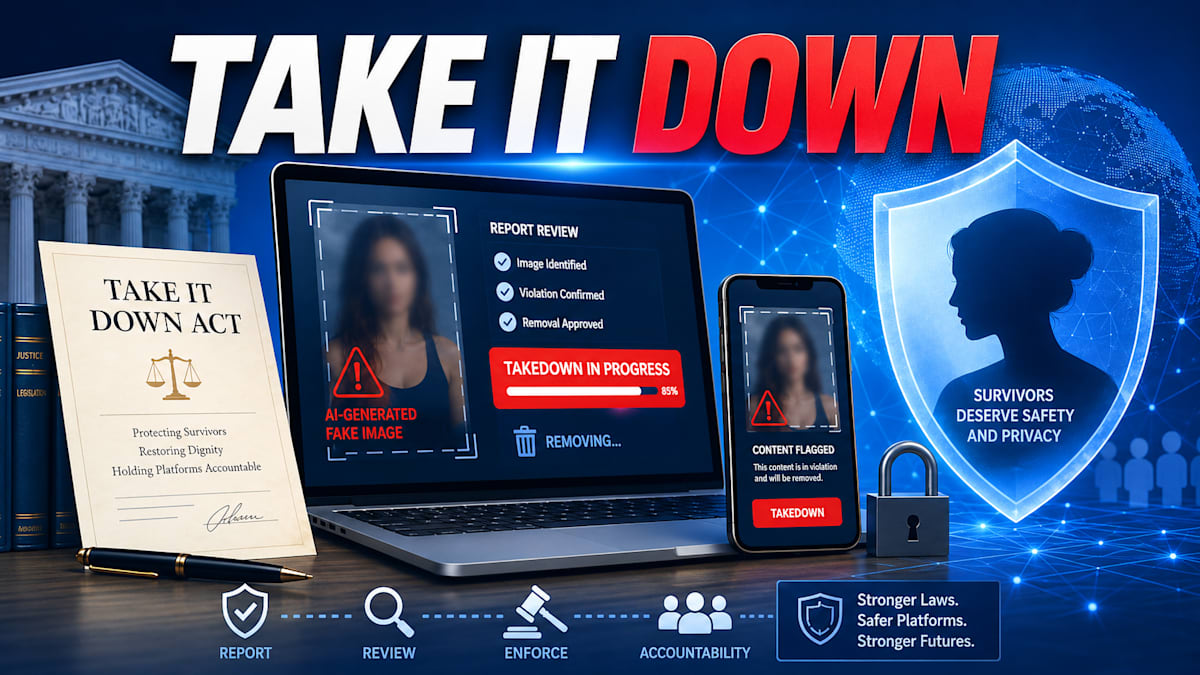
The Take It Down Act Is Now in Force. Survivors Need More Than a Button
By Michele Evans
New York City, New York
5/19/2026
Category: Courts / Criminal Justice / Advocacy
Washington D.C. - A new federal law aimed at nonconsensual intimate images and AI-generated sexual deepfakes is now fully in effect, giving victims a faster path to demand removal of abusive content from major online platforms.
The law is called the TAKE IT DOWN Act, short for the Tools to Address Known Exploitation by Immobilizing Technological Deepfakes on Websites and Networks Act. President Donald Trump signed it into law on May 19, 2025, after bipartisan support in Congress. The law criminalizes the publication of nonconsensual intimate imagery, including AI-generated intimate deepfakes, and requires covered platforms to remove qualifying material within 48 hours after receiving a valid request.
The criminal provision took effect when the law was signed. The takedown requirement, the part that forces platforms to create a reporting process and act on removal notices, became enforceable one year later, on May 19, 2026.
That matters because for victims of image-based abuse, time is not a technical detail. It is the difference between harm contained and harm multiplied.
Once an intimate image, video, or AI-generated fake is posted online, every hour can mean more screenshots, more reposts, more harassment, more humiliation, more employment damage, more family trauma, and more fear. The internet does not merely publish abuse. It preserves it, replicates it, and turns a private violation into a public weapon.
The Take It Down Act tries to interrupt that cycle.
According to Federal Trade Commission guidance, the law applies broadly to covered online platforms, including websites, apps, social media services, messaging services, image and video sharing services, and gaming platforms. The FTC says covered platforms must provide clear, conspicuous, plain-language information about how a person can submit a removal request for nonconsensual intimate photos or videos. The law covers both real intimate images and “digital forgeries,” including images created or altered with software, apps, or artificial intelligence.
A valid takedown request generally must give the platform enough information to locate the content, such as a link, and must include a statement that the material was shared without consent. It also must include a signature from the person depicted or someone authorized to act for them, along with contact information. Once a valid request is received, the platform has up to 48 hours to determine whether the content qualifies and, if it does, remove the material and identical copies.
On paper, that sounds like progress.
In practice, the strength of the law will depend on whether victims can actually find and use the reporting systems, whether platforms act quickly, and whether enforcement is serious when they do not.
That is where the real test begins.
A removal right is only meaningful if the process is visible, understandable, and usable by the people most likely to need it. Victims may be teenagers. They may be survivors of domestic violence. They may be people being stalked, extorted, threatened, shamed, or punished by someone who knows exactly how to weaponize the internet against them.
They should not need a lawyer, a publicist, a forensic tech expert, or a media campaign to get abusive sexual images removed.
Reporting tools buried under corporate help menus will not be enough. Legalistic forms written for compliance departments will not be enough. Automated systems that reject reports for technical defects will not be enough. Platforms should be required not only to create a form, but to make the process easy to find, easy to understand, and safe to use.
That is especially important because the law arrives at the same time AI tools have made image-based sexual abuse easier to create and harder to detect. A person no longer needs a real intimate photo to sexually exploit someone. A face, a social media image, or an ordinary photograph can be manipulated into a fake nude image or video. The abuse may be artificial, but the damage is real.
The Take It Down Act recognizes that reality. It treats AI-generated intimate forgeries as part of the same abuse ecosystem as traditional nonconsensual intimate images. That is an important legal shift.
But civil liberties and digital-rights advocates have raised concerns about the law’s breadth, warning that aggressive takedown systems can lead platforms to over-remove lawful content or create tools that may be misused. The Verge reported that critics have warned about over-moderation, uneven enforcement, and the possibility that the law could be used selectively or politically.
Those concerns should not be dismissed. Any law that forces rapid removal of online material must be carefully enforced, because speed can protect victims, but speed can also create mistakes.
Still, the existence of hard questions does not erase the core problem the law addresses: nonconsensual sexual exploitation online has too often left victims chasing platforms, begging for removal, and watching their abuse spread while companies hide behind delay, confusion, or indifference.
The proper answer is not to leave victims powerless. The answer is to enforce the law carefully, transparently, and consistently.
That means platforms should publish clear instructions. They should preserve evidence when legally appropriate. They should remove confirmed nonconsensual intimate imagery quickly. They should act on duplicates. They should not force victims to resubmit the same traumatic material over and over. They should also provide meaningful appeal and review processes so lawful content is not swept away by abuse of the system.
The FTC has already put major technology companies on notice. According to The Verge, FTC Chair Andrew Ferguson sent letters ahead of the May 19, 2026 enforcement deadline to more than a dozen companies, including Amazon, Alphabet, Apple, Bumble, Discord, Match Group, Meta, Microsoft, Pinterest, Reddit, Snapchat, TikTok, and X. The FTC reportedly reminded platforms that violations could lead to civil penalties of more than $53,000 per violation.
That is the kind of enforcement threat that may finally make platforms pay attention.
But victims should not have to wait for regulators to make an example out of a company. The real measure of this law will be whether an ordinary person, in a moment of crisis, can find a takedown form, submit a report, and see harmful material removed before it ruins their life.
I know firsthand that intimate-image harm is not limited to anonymous websites or revenge campaigns. In my own case, private marital communications and intimate images were placed into the public record without meaningful protection. That experience left me traumatized and made clear to me that survivors need more than removal tools after the fact. They need institutions that understand privacy, dignity, and the irreversible harm of public exposure.
The Take It Down Act is a beginning, not a finish line.
It gives survivors a tool. Now the question is whether platforms, regulators, prosecutors, and courts will make that tool real.
Because for victims of digital sexual abuse, the harm is not theoretical. It is immediate. It is personal. It is searchable. And once it spreads, it can follow a person for years.
The internet made exploitation faster.
The law now has to make protection faster too.
Resources for Survivors & Victims of Image-Based Abuse
If you or someone you know is a victim of non-consensual intimate image sharing or digital exploitation, immediate help and legal reporting options are available. You do not have to navigate this alone.
Where to Report and Remove Content
- FTC Report Fraud Portal: Under the TAKE IT DOWN Act, you can report platforms that fail to remove content within 48 hours or refuse to accept valid takedown requests.
- Link: reportfraud.ftc.gov
- Take It Down (NCMEC): A free, anonymous tool operated by the National Center for Missing & Exploited Children designed to help prevent explicit images/videos of anyone under 18 from being shared online.
- Link: takeitdown.ncmec.org
- StopNCII.org: A free tool operated by the UK Revenge Porn Helpline (in partnership with major tech platforms) that uses hashing technology to stop the spread of non-consensual intimate images for individuals 18 and older.
- Link: stopncii.org
Crisis Support & Advocacy Helpline
- Cyber Civil Rights Initiative (CCRI) Helpline: Offers 24/7 free, confidential support, legal referrals, and technical advice specifically for victims of non-consensual intimate imagery.
- Call: 1-844-878-CCRI (2274)
- Link: cybercivilrights.org
A Note on Evidence: Before using automated takedown tools or reporting to platforms, consider taking screenshots of the URLs, usernames, and timestamped posts if you plan to report the exploitation to law enforcement.
*Michele Evans is an independent journalist, author, and former ESPN technical producer whose work has appeared in The New York Times.
Michele got her start in 2001 covering the NBA and NFL.
She now covers New York City courts, criminal-justice procedure, NYPD, FDNY, domestic-violence systems, media accountability, public safety, advocacy efforts, and New York civic life through courthouse observation, public records, legal analysis, and lived-experience reporting.
Read more independent journalism by Michele Evans.
Follow Michele Evans on Facebook and Substack for new reporting, analysis, and updates.