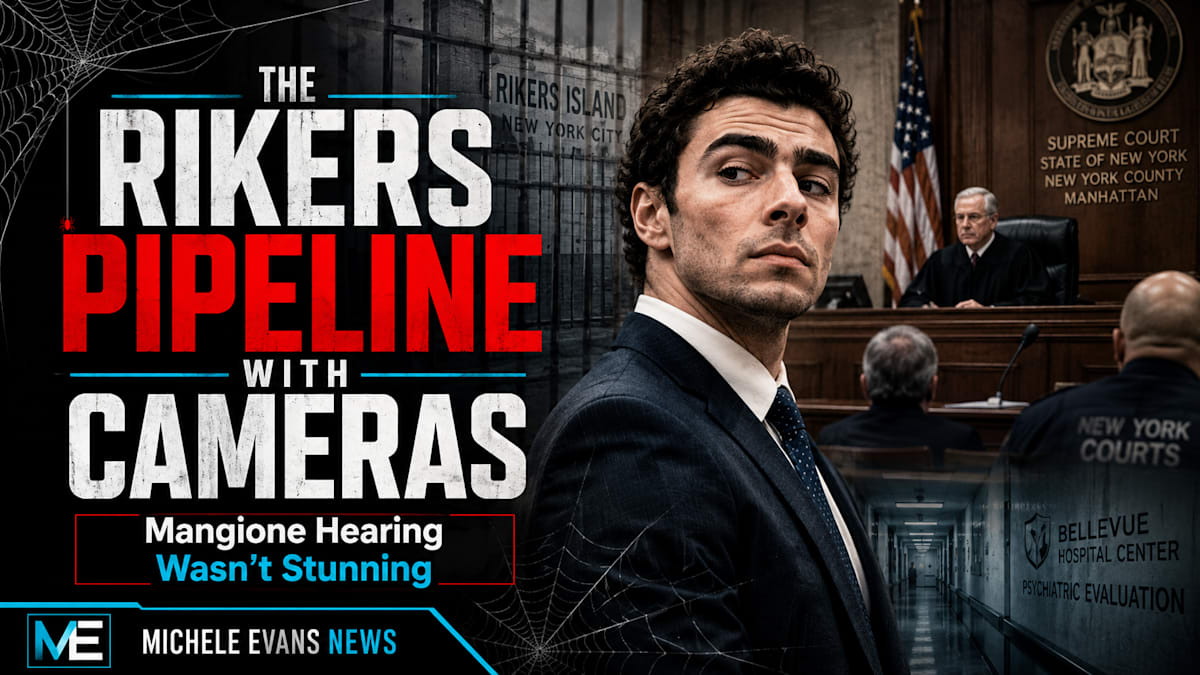
The Mangione Hearing Wasn’t Stunning. It Was the Rikers Pipeline With Cameras
mqaxq9nol9olwivkpq1bo2ymt99v2.1 MBThe Mangione Hearing Wasn’t Stunning. It Was the Rikers Pipeline With Cameras
By Michele Evans New York City, New York 6/17/2026
Category: Courts / Criminal Justice / Rikers Island
New York City, New York - Reporters may want to call Wednesday’s Luigi Mangione hearing a stunning development.
It was not.
It was a Bellevue lane. A psychiatric-defense lane. A discovery lane. A paperwork lane. A sealed-records lane. A jail-transport lane. A courtroom-theater lane.
In other words, it was a regular day in New York City criminal court.
The only thing unusual was the size of the audience.
Mangione appeared Wednesday morning before Judge Gregory Carro in Manhattan Supreme Court after Tuesday’s hearing was postponed because prosecutors failed to serve the paperwork needed to have him brought from federal custody to court. Assistant District Attorney Joel Seidemann acknowledged the error in court the day before, telling the judge, “It’s on us.”
By Wednesday, the defendant was present, the courtroom was packed, and the national press had its headline: Mangione’s lawyers plan to pursue a psychiatric defense at his state murder trial in the killing of UnitedHealthcare CEO Brian Thompson.
Judge Carro disclosed that Mangione’s defense intends to argue extreme emotional disturbance, a New York defense that does not erase responsibility but can reduce murder to manslaughter if accepted by a jury. Prosecutors now want their own psychiatric evaluation. Mangione may be moved from the federal Metropolitan Detention Center in Brooklyn to Rikers Island to facilitate that process.
That may sound stunning to people who have never watched New York’s criminal court machinery work.
To anyone who has lived near the machinery, it is not stunning at all.
I know that because I was housed on Rikers Island in a unit nicknamed the murder dorm. Most of the women around me were accused of murder. Most had psychiatric issues. Most had complicated defenses. Most had discovery problems. Most had Bellevue evaluations. Most had cases where lawyers argued over mental state, paperwork, custody movement, trial timing, and whether the prosecution had turned over what it was supposed to turn over.
What happened in court Wednesday was not unusual for a case with these charges.
It was Wednesday.
That is the part missing from the breathless coverage. In high-level felony cases, especially cases involving serious violence, psychiatric questions, sealed records, and heavy discovery are not shocking on their own. They are part of the ordinary criminal court landscape. The shock comes only when the public sees the machinery clearly for once.
Bellevue. Rikers. Mental health evaluations. Delayed transportation. Missing paperwork. Discovery fights. Sealed records. Lawyers accusing each other of delay. Judges trying to keep the calendar moving while everyone in the room performs for a record that may eventually be appealed.
That is not the exception.
That is the system.
The difference in Mangione’s case is not the procedure. The difference is that everyone is watching.
Carro appeared aware of that imbalance. At one point, he admonished the room that not every case receives this kind of press attention. That may have sounded like a reminder to the gallery, but it was also the most important sentence of the morning.
Because he was right.
Not every defendant gets rows of reporters. Not every defendant gets courtroom sketch artists, national headlines, live updates, law students, interns, fan accounts, and outside analysis before lunch. Most defendants go through the same kinds of delays, evaluations, discovery problems, and jail-transfer issues in near-total obscurity.
The machinery is ordinary.
The attention is not.
The defense issue revealed Wednesday had been lurking behind sealed proceedings. Carro said the earlier sealing was meant to give the defense time to determine whether it would proceed with the psychiatric strategy and the nature of that strategy. He also said redacted records would be released.
That sealing decision has been controversial because the June 3 hearing was closed to the press and public. But the reason for the secrecy also points to the unusual posture of this case: Mangione is not only facing a state murder case. He is also facing a federal case based on the same underlying incident.
That is the part that still deserves more scrutiny.
Mangione is being prosecuted twice for one alleged killing. The state case and federal case are formally separate, but they arise from the same death, the same defendant, the same alleged conduct, and much of the same evidence. Mangione himself previously objected in plain language, saying it was “the same trial twice.”
He has a point.
The federal overlay is what makes every sealed filing, every psychiatric disclosure, every discovery fight, and every courtroom statement more dangerous. A defense available in state court may not help him federally. A sealed state strategy may prejudice him in the federal case. Evidence and statements can ricochet from one courtroom to another.
That is not justice moving carefully.
That is a defendant being boxed in from two directions.
There is no need for two separate prosecutions for one incident when the state case is already capable of carrying a life sentence. The federal case gives the government a second bite, a second venue, a second jury pool, and a second pressure point.
That is the real unusual part.
Not Bellevue.
Not Rikers.
Not the psychiatric issue.
Not the paperwork failure.
Not even the lawyers sniping at each other.
The unusual part is the federal government piling onto a state murder prosecution and creating a two-track system where every move in one case may become ammunition in the other.
Wednesday’s hearing also had the unmistakable feeling of performance.
Seidemann came across as animated and forceful, accusing the defense of delay and complaining that prosecutors still did not know the expert, the theory, or the specific mental defect behind the extreme emotional disturbance claim. Karen Friedman Agnifilo pushed back, calling the prosecution’s suggestion outrageous and insisting the defense had not asked to delay the September trial.
Carro, who in this reporter’s prior experience can be direct but measured, also appeared more animated than usual. He pressed the defense to move quickly and made clear he did not expect the psychiatric defense to derail the trial date.
That was the rhythm of the morning: prosecution pressure, defense objection, judge management, press attention.
But again, none of that is shocking.
It is what happens when a criminal case becomes a stage.
One of the more telling moments involved discovery and media coverage. The defense raised concern connected to a Dateline piece and a law enforcement figure whose role appeared to surface publicly before the defense had been fully provided the corresponding discovery.
That should make everyone pause.
If defense counsel is learning about a law enforcement actor or investigative detail through a television program instead of complete discovery, that is a serious problem. It is also not some exotic Mangione-only problem. Discovery disputes happen constantly. Defendants often sit in jail while lawyers chase records, videos, names, reports, body camera footage, notes, logs, and witness details that should have been produced clearly the first time.
Again, the system is not stunning.
It is routine.
The state trial is currently scheduled to begin with jury selection on September 8. The next state pretrial hearing is scheduled for August 11. The federal case is also looming, which makes every move in the state case more complicated than it needs to be.
That entanglement is the story.
This is not about whether Mangione is sympathetic. This is not about whether people online have turned him into a symbol. This is not about whether the killing of Brian Thompson deserves serious prosecution. It does.
The question is whether the same court system that grinds ordinary defendants through delay, confusion, transport failures, mental health evaluations, discovery fights, and jail transfers becomes visible only when the defendant is famous enough for the press to care.
And that brings us to the Rikers-to-Bellevue problem.
Why should Mangione have to suffer through Rikers simply to get to Bellevue?
Bellevue is not a coffee shop. It is not an outpatient waiting room. It has long functioned as part of New York’s forensic psychiatric machinery. A person sent to Bellevue for a court-ordered psychiatric evaluation is still in custody. There is no magical freedom gap between Rikers and Bellevue. There are cells, there are locked doors, officers, controlled movement, jail procedures, medical custody, and institutional surveillance.
You are not less in custody because the building has a hospital name on the outside.
So why the extra stop through Rikers?
Why move a defendant from federal custody to Rikers Island just to move him again for a psychiatric evaluation at Bellevue? Why expose him to the city jail system, even temporarily, if the actual evaluation is going to happen inside a secure hospital setting?
People who have never gone through one of these evaluations may imagine something clinical, thoughtful, and illuminating.
My experience was very different.
I went through one. It was not a profound search for truth. It was hours of custody movement, waiting, controlled rooms, paperwork, psychological testing, and deeply personal questioning by a stranger whose report, in the end, did not even do the thing the system pretended it was there to do.
You sit in a room so small it feels like the phone booth Superman used to change clothes in. A psychiatrist or evaluator you do not know asks questions that cut straight into trauma: who hurt you, what happened to you, what was your childhood like, why did you respond the way you did?
Then come forms, tests, patterns, inkblots, abstract questions, and exercises that feel less like justice than a Regents exam written by someone who never had to survive the facts being examined.
How does this triangle relate to that triangle? What do you see in this inkblot? Which shape belongs next? What happened to you as a child? Who hurt you?
The absurdity is hard to explain unless you have sat there in custody and lived it. One minute the system is asking you to reduce your trauma to a checklist. The next minute it is treating you like a student taking a standardized test in a room barely big enough to breathe in.
Somewhere inside that process, the court expects truth to emerge.
But human beings are not geometry problems.
Trauma does not fit neatly into an answer bubble. And a person’s state of mind cannot always be extracted through a few hours of institutional questioning by a stranger with a clipboard.
In my case, the evaluation did not meaningfully address the domestic violence I survived or the reason I fled for my life that day. It went to waste. It was all for naught. The machinery moved, the paperwork happened, the useless data was extracted, and the truth still did not land where it needed to land.
That is why the Mangione evaluation issue should not be treated as some glamorous legal twist.
A psychiatric evaluation can be necessary. It can also be invasive, limited, bureaucratic, and disconnected from the human reality of a case. And when the state adds Rikers as an extra stop on the way to Bellevue, the question should not be “how stunning.”
The question should be “why.”
Why Rikers? Why not a direct secure transfer to Bellevue? Why add another custodial institution, another layer of risk, another transport problem, another opportunity for delay, another punishment before trial?
That is the part people who only parachute into high-profile cases often miss.
The evaluation is not just a legal concept.
It is a body in custody, moved through systems, placed in small rooms, questioned by strangers, tested on paper, and then returned to a cage while lawyers argue over what it means.
Carro’s reminder that not every case gets this attention should not be treated as a throwaway admonition.
It should be the frame.
Because every day, people at Rikers sit through versions of this same procedural maze without cameras, without packed courtrooms, without national reporters calling it stunning, and without the public learning their names.
Mangione’s hearing did not reveal a shocking new world.
It revealed the ordinary one.
The only difference was that this time, the Rikers pipeline had cameras.
*Michele Evansis an independent journalist, author, and former ESPN technical producer whose work has appeared in The New York Times.
Michele got her start in 2001 covering the NBA and NFL.
She now covers New York City courts, criminal-justice procedure, NYPD, FDNY, domestic-violence systems, media accountability, public safety, advocacy efforts, and New York civic life through courthouse observation, public records, legal analysis, and lived-experience reporting.