The Knicks Are Winning. Madison Square Garden Is Still Fighting Its Old Court Wars
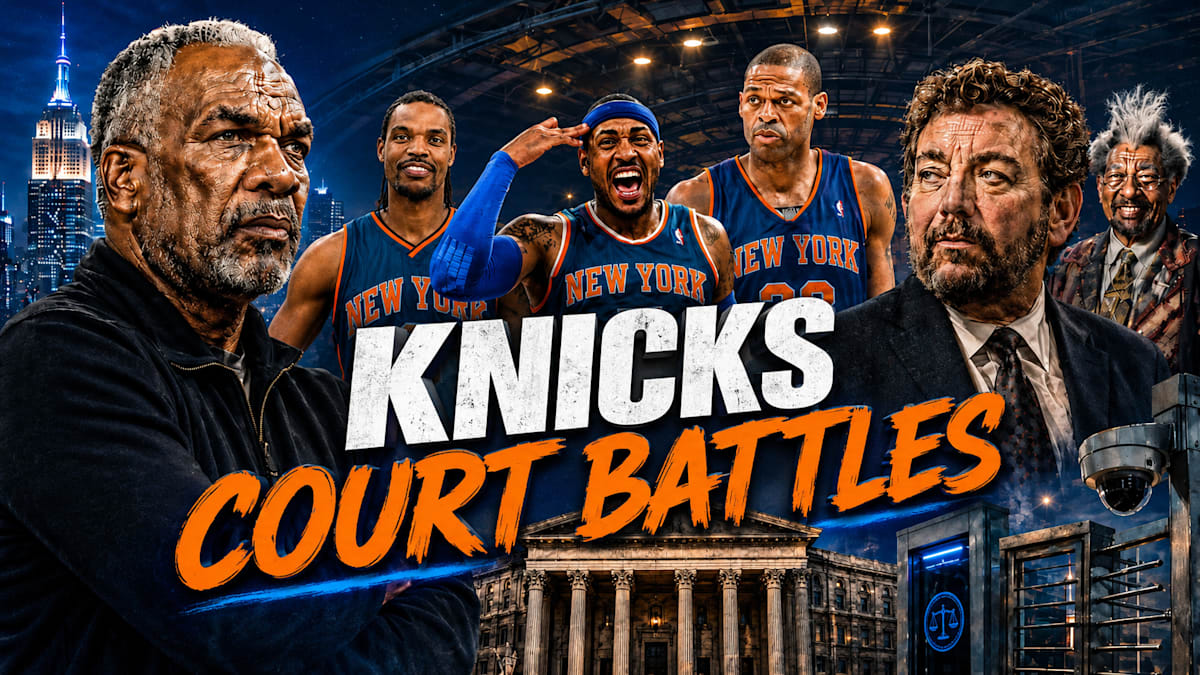
The Knicks Are Winning. Madison Square Garden Is Still Fighting Its Old Court Wars
By Michele Evans
New York City, New York
5/24/2026
Category: Civil Court/ Public Interest/Sports
New York City, New York - The New York Knicks are in the middle of a playoff surge, and the Garden feels alive again.
That means the stars are back. The cameras are back. The old Knicks are back. The city is watching, the building is buzzing, and Madison Square Garden is once again selling something bigger than basketball: nostalgia, belonging, loyalty, New York mythology.
But beneath the playoff glow, the Garden is still fighting its old wars.
Charles Oakley remains the ghost at the baseline.
The former Knicks enforcer, beloved by fans for embodying the bruising, blue-collar identity of the 1990s team, has been locked in a long legal and public feud with Madison Square Garden and Knicks owner James Dolan since his 2017 ejection from a Knicks game. Oakley sued MSG after the incident, and the case has bounced through the courts for years. In November 2025, Reuters reported that a federal judge ordered Oakley to pay more than $642,000 in attorney fees after finding he failed to preserve years of text messages central to the litigation.
That courtroom battle is more than an old celebrity feud. It is the pressure point inside the Knicks’ current renaissance.
Because the Knicks do not just play at Madison Square Garden. They perform inside a privately controlled arena where access, loyalty, and image have long been contested - sometimes at the door, sometimes in court, and sometimes through the team’s own alumni politics.
Oakley’s ejection was the public rupture. The aftermath became a lesson in how the Garden manages dissent.
Two days after Oakley was banned from the building, Latrell Sprewell returned to Madison Square Garden for the first time in 13 years and sat near Dolan. NBA.com, citing the Associated Press, reported that Sprewell sat behind the baseline next to MSG chairman James Dolan shortly after Oakley’s arrest and ban. ESPN reported that Sprewell and Dolan had long been at odds, including after Sprewell’s trade from the Knicks to the Minnesota Timberwolves, when Sprewell screamed obscenities at Dolan during his first game back at the arena in 2003 and was fined $25,000.
That made Sprewell’s sudden reappearance beside Dolan feel loaded.
It was not just a reunion. It was theater.
For years, Sprewell had been one of the franchise’s estranged former stars. Then, at the exact moment Oakley became the exiled Knick, Sprewell appeared back inside the Garden frame. Whatever private conversations led to that moment, the public optics were unmistakable: one old Knick pushed out, another old Knick brought in.
And it worked for both sides.
For Dolan and the Knicks, Sprewell’s return softened the optics of Oakley’s exile by showing that the organization could still embrace former players - just not necessarily Oakley. For Sprewell, reconciliation reopened the door to the Knicks family, the Garden stage, alumni appearances, media visibility, and the emotional currency of being welcomed home by a fan base that never forgot him.
That kind of Garden optics was not foreign to me.
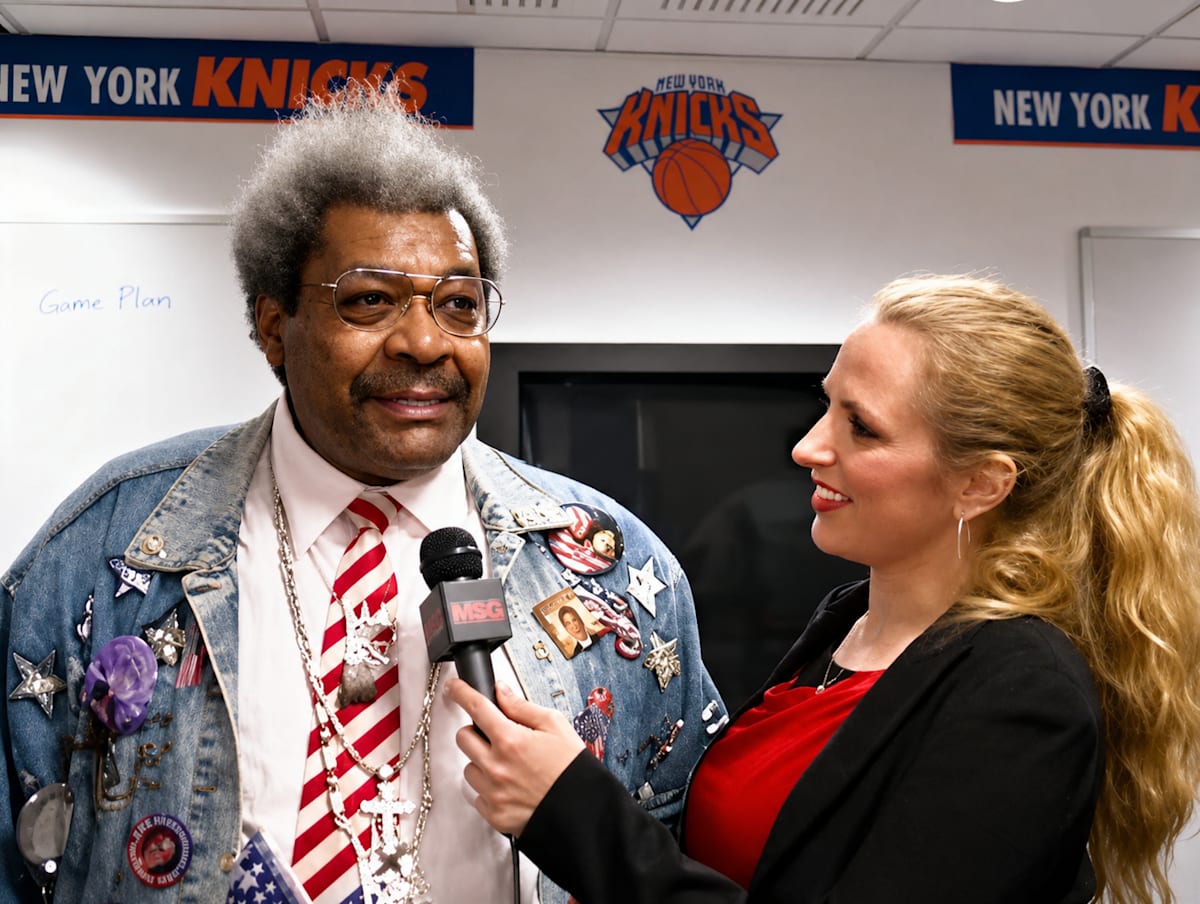
During my own time around the Knicks and Nuggets media scene, I saw how unusual Madison Square Garden could be compared with other NBA environments. At one point, I did a spontaneous locker-room interview with Don King inside the Knicks locker room, where he spoke to me about Carmelo Anthony. It's something many fans never see: the Garden’s locker-room culture was not always limited to traditional credentialed media. Celebrities and power figures could appear inside that space in ways that seemed designed to boost morale, create spectacle, and reinforce the Garden’s role as part basketball venue, part celebrity theater.
That context sharpens the Sprewell moment.
When Dolan brought Sprewell back into the Garden frame shortly after Oakley’s exile, it fit a larger pattern I had already observed up close: MSG has long understood the symbolic power of who appears in the building, who gets placed near the team, who gets photographed, who gets welcomed, and who gets frozen out.
The Carmelo thread makes that even more layered for me.
I was courtside at Madison Square Garden on December 16, 2006, when the Knicks-Nuggets brawl erupted so close it practically spilled into my lap. The fight led to harsh NBA discipline. ESPN reported that Carmelo Anthony was suspended 15 games and six other players were penalized, with total suspensions reaching 47 games.
I would find myself in the Knicks locker-room where Don King talked to me about Carmelo - another reminder that at Madison Square Garden, basketball, celebrity, conflict, and image management have always collided in unusually public ways.
That is the part of the story that fascinates me because I remember the old dynamics.
Back when I covered the Denver Nuggets and moved around the NBA media scene, Marcus Camby once told me that Dolan split up the Marcus-and-Spree duo because, in Camby’s view, Dolan had to be the biggest guy in town and the Sprewell-Camby pairing was taking on a life of its own.
That was Camby’s read, not a court finding and not a fact I can independently prove today. But as a piece of NBA-era memory, it has stayed with me because it matches the larger Dolan pattern that Knicks fans and Garden watchers have debated for years: control the room, control the image, control who gets to be embraced.
The Oakley saga made that pattern impossible to ignore.
Oakley was not merely a former player. He was a symbol of a Knicks identity that fans still romanticize: physical, loyal, stubborn, uncompromising. When he was dragged from the Garden and later sued, it did not feel like just another arena incident. It felt like a fight over who owns Knicks history — the fans, the players who built it, or the billionaire who controls the building.
That question has only grown sharper as MSG has become a flashpoint for surveillance and exclusion.
New York Attorney General Letitia James previously sought information from Madison Square Garden about its use of facial recognition technology to bar lawyers associated with firms involved in litigation against MSG, raising concerns about retaliation, bias, and civil-rights implications. The Attorney General’s office said MSG had reportedly used facial recognition to identify and deny entry to lawyers affiliated with firms representing clients in litigation related to MSG Entertainment.
More recently, WIRED reported that a New York police officer who was injured while working off-duty security at Madison Square Garden during a 2025 boxing event sued MSG and rapper Lil Tjay - and that MSG then banned the officer’s attorney from the venue using facial recognition.
That is where the playoff story becomes larger than basketball.
The Knicks may belong emotionally to New York, but Madison Square Garden is controlled by a private company with a long record of deciding who gets through the door. Fans experience the Garden as civic space. MSG operates it as private property. Courts are left to sort out the collision.
And now, during a playoff run, that collision sits right under the celebration.
The Garden can host celebrities. It can bring back alumni. It can sell nostalgia. It can put beloved former players on camera and invite the city to feel whole again.
But Charles Oakley’s absence still says something.
So does Latrell Sprewell’s presence.
So does a locker-room culture where celebrity access and morale-building spectacle could blur the edges of ordinary NBA media practice.
So does the use of facial recognition to keep out lawyers and perceived adversaries.
So does the fact that, even as the Knicks create one of the most joyful sports moments New York has had in years, the franchise’s home remains tangled in litigation, surveillance controversy, and old wounds over loyalty and control.
This is the contradiction of Madison Square Garden.
It is the World’s Most Famous Arena.
It is also a gate.
And during the Knicks’ playoff run, the question is not only whether New York can win.
It is who gets to come home when they do.
PHOTO HIGHLIGHTS
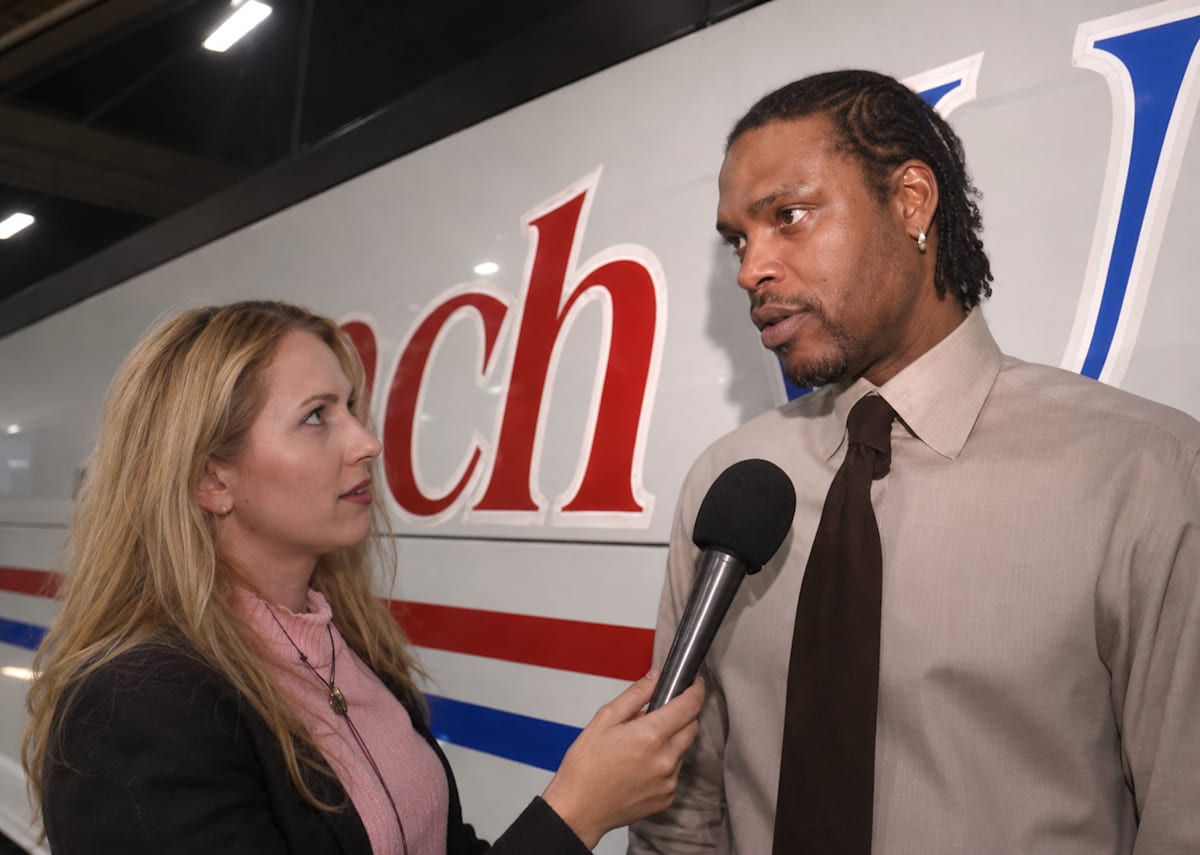
Michele Evans interviews Latrell Sprewell during her time covering the NBA. Sprewell brought a defamation suit against the New York Post over reports about his hand injury; the Knicks fined him $250,000 and told him to stay away from the team after he failed to promptly report the injury.
*Michele Evans is an independent journalist, author, and former ESPN technical producer whose work has appeared in The New York Times.
Michele got her start in 2001 covering the NBA and NFL.
She now covers New York City courts, criminal-justice procedure, NYPD, FDNY, domestic-violence systems, media accountability, public safety, advocacy efforts, and New York civic life through courthouse observation, public records, legal analysis, and lived-experience reporting.
Read more independent journalism by Michele Evans.
Follow Michele Evans on Facebook and Substack for new reporting, analysis, and updates.