The Counselor Inside Rikers Rehab Dorm
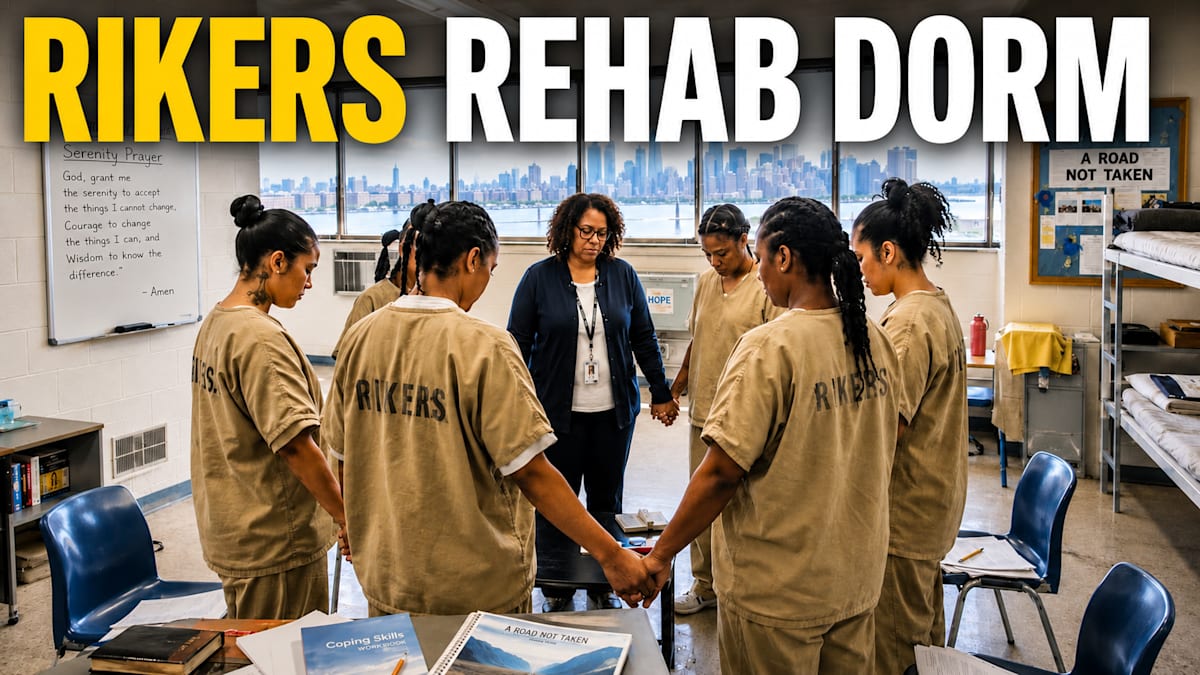
The Counselor Inside Rikers Rehab Dorm
By Michele Evans
New York City, New York
5/21/2026
Category: Courts / Criminal Justice / Advocacy
Bronx, New York - Inside Rikers, recovery was supposed to happen in the same place that punished people for breaking down.
That is one of the contradictions people outside the jail system rarely understand. A rehab dorm inside a jail is not a rehab center. It is not a quiet treatment facility tucked away from crisis. It is still Rikers. It is still correction officers, count times, searches, lockdowns, noise, fear, trauma, and women trying to hold themselves together in a place designed to strip people down.
And yet, inside that impossible environment, there were people trying to help.
For me, one of those people was Virginia Shepherd.
Virginia ran the program dorm called A Road Not Taken. It was not a dorm you could simply be moved into because an officer decided to send you there. You had to be referred by mental health, interviewed by Virginia, and accepted into the program.
I was lucky. I had a therapist, Michelle Bronster, who helped set me up to apply for entrance into the program.
That mattered because A Road Not Taken was highly sought after. Not because it was easy. It was not an easy dorm. But it had fewer women than many other dorms, more structure, and something rare inside Rikers: a sense that someone was at least trying to make the space different.
It also had penthouse views.
That phrase sounds strange to write about Rikers, but it is true. From that dorm, you could see out across the city. The view was beautiful, even if the place we were standing in was not.
That was part of the contradiction too. We were inside one of the most notorious jails in America, looking out at a skyline most people associate with ambition, money, freedom, and possibility.
Inside the dorm, Virginia ran groups. We had AA meetings. We had workbooks. We had homework. We sat in circles and talked about addiction, accountability, choices, pain, survival, and what it might mean to leave Rikers different than we came in.
At the end of every group, we stood in a circle, held hands, and said the Serenity Prayer.
That mattered.
In jail, small rituals become anchors. A workbook can become a way to organize your thoughts. Homework can become proof that your mind still belongs to you. A circle can become a temporary shelter. Holding hands can become a reminder that you are still human.
But none of that made the dorm easy.
Trying to run a rehab program inside a jail dorm is like trying to grow something green through concrete. Every part of the environment works against healing. Women are detoxing, grieving, terrified, angry, sleep-deprived, medicated, unmedicated, fighting cases, missing children, waiting on court dates, and trying to survive the daily humiliations of incarceration. Some are ready to talk. Some are not. Some want help. Some are too hurt to trust the hand reaching toward them.
The counselor has to walk into that every day.
She has to ask people to be honest in a place where honesty can feel dangerous. She has to encourage vulnerability in a setting where vulnerability can be used against you. She has to talk about recovery in a building where punishment is always louder than care.
That is the hardship of the work.
And it is also the hardship of being in the program.
People may imagine rehab at Rikers as a structured path toward wellness. In reality, it was recovery interrupted by incarceration. You could be in a group talking about trauma one minute and hearing yelling in the hallway the next. You could be trying to focus on AA principles while worrying about court, commissary, a sick loved one, or whether someone in the dorm was about to erupt.
The dorm itself became part classroom, part shelter, part pressure cooker.
Groups mattered because they gave the day structure. AA meetings mattered because they reminded people that their lives were bigger than their charges. Even when the room was tense, even when people joked to cover pain, even when the system around us made healing feel almost absurd, those meetings created a small pocket of humanity.
That is not nothing.
In jail, a program can become a lifeline simply because it gives people a place to speak.
But it is important not to romanticize it. No counselor, no matter how committed, can turn Rikers into a place of healing by sheer force of will. One person cannot undo the violence of the institution. One program cannot compensate for solitary confinement, medical neglect, overcrowding, officer abuse, mental health crises, and the constant instability of jail life.
That is why I think about Virginia Shepherd with both gratitude and realism.
She was not operating outside the system. She was operating inside it.
That distinction matters.
There were people in Rikers who cared. There were staff members who saw us as human. There were moments when someone’s tone, patience, or encouragement made a difference. But those moments existed inside a structure that was still harming people every day.
That is what makes A Road Not Taken so complicated to write about.
It would be easy to tell a simple story: jail bad, counselor good. Or the reverse: program good, system improving.
Neither version is honest enough.
The truth is harder.
The truth is that recovery work inside Rikers can be meaningful and still be surrounded by harm. A counselor can help people and still be working inside a machine that breaks them. A group can give women language for their pain and still send them back into a dorm where privacy, safety, and peace are almost impossible.
For some women, those groups may have been the first time anyone asked them what happened to them instead of only asking what they did.
For others, the program may have felt like another requirement, another box to check, another space where they had to perform remorse or readiness for an audience connected to the system.
Both things can be true.
I remember the AA meetings because they brought a different rhythm into the dorm. There is something powerful about hearing people speak in the language of survival while everyone is wearing jail clothes. There is something almost defiant about saying, “I am trying to recover,” while locked inside a place that often reproduces the very trauma people are trying to escape.
Recovery asks for honesty.
Rikers teaches guardedness.
Recovery asks for stability.
Rikers runs on disruption.
Recovery asks people to build trust.
Jail teaches people to trust almost no one.
That is the contradiction Virginia had to manage.
And years later, after I left Rikers, that connection did not fully disappear.
When I published my novel Rikers Island, I reached out to Virginia. I told her the book was dedicated to Layleen Polanco because I had been writing it at Rikers at the time of Layleen’s death. I later asked how I could send a copy back to the dorm because I wanted the women there to know that someone had sat where they were sitting and still made it out with a voice.
She told me I could mail it to the G.A.T.E. Program at Rikers. Later, she confirmed she had received it.
That moment meant something to me.
Not because a book can fix Rikers. It cannot.
But because hope matters inside places built to erase it.
When the New York Times later wrote about incarcerated writers at Rikers, I sent Virginia the article. I also sent her a piece from The Times of London. I asked her to tell the women to keep their heads up, that it gets better. She wrote back: “Will Do! And keep up the good work.”
That is the full-circle part of the story.
I entered A Road Not Taken as someone trying to survive Rikers.
I sat in groups. I did the workbook pages. I completed the homework. I stood in the circle. I held hands with other women. I said the Serenity Prayer inside a jail.
And I wrote.
I left with pages.
Years later, I sent those pages back in.
That does not make the system humane. It does not make the conditions acceptable. It does not excuse what Rikers has done to generations of people.
But it does show that even inside a brutal institution, people still create, recover, witness, and try to reach one another.
Virginia Shepherd’s work mattered because she was trying to make space for recovery in a place that was never built for it.
Michelle Bronster’s referral mattered because access to that space was not automatic.
The women in that dorm mattered because they were trying to heal while still being held.
And the contradiction matters because New York cannot keep pretending that programming alone solves the violence of incarceration.
A Road Not Taken was proof of both things at once: the human need for care, and the institutional failure that makes that care so difficult to deliver.
I am grateful for the people who tried.
I am still angry at the system that made trying so hard.
And I still believe the women in those dorms deserved more than a meeting in the middle of a jail.
They deserved safety.
They deserved treatment.
They deserved dignity.
They deserved a world where recovery did not have to begin behind bars.
*Michele Evans is an independent journalist, author, and former ESPN technical producer whose work has appeared in The New York Times.
Michele got her start in 2001 covering the NBA and NFL.
She now covers New York City courts, criminal-justice procedure, NYPD, FDNY, domestic-violence systems, media accountability, public safety, advocacy efforts, and New York civic life through courthouse observation, public records, legal analysis, and lived-experience reporting.
Read more independent journalism by Michele Evans.
Follow Michele Evans on Facebook and Substack for new reporting, analysis, and updates.