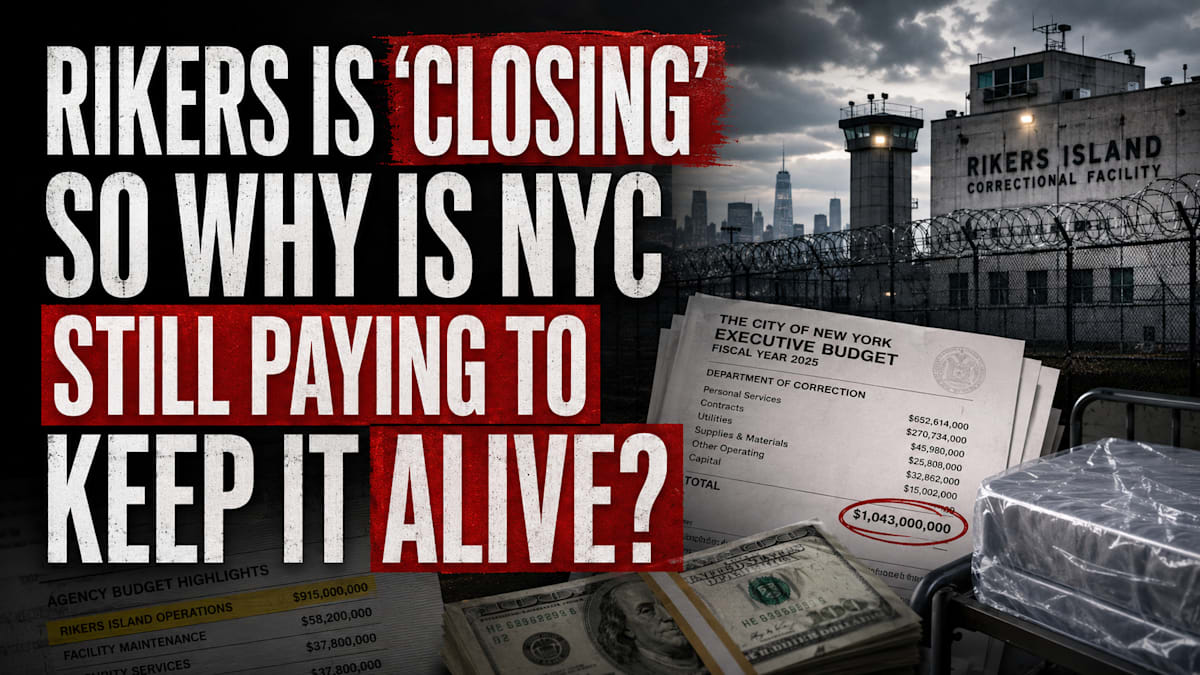
The City Says Rikers Is Closing. The Budget Says New York Is Still Paying to Keep It Alive.
p8046cvkug1xh0lpstyaoz51xagi2.46 MBThe City Says Rikers Is Closing. The Budget Says New York Is Still Paying to Keep It Alive
By Michele Evans New York City, New York 6/30/2026
Category: Rikers Island / City Hall / Public Interest
NEW YORK CITY, NY - New York City has reached a $125.8 billion budget deal for Fiscal Year 2027, and the public headlines are already focused on housing, Fair Fares, and the decision not to expand NYPD headcount. But buried in the correction budget is the part New York should not be allowed to gloss over.
Rikers is still getting repair money.
Not closure money. Not emergency decarceration money. Not a serious plan to stop warehousing people on an island the city has already admitted is dangerous and legally scheduled to close.
Repair money.
According to the City Council’s Department of Correction budget materials, DOC’s proposed Fiscal Year 2027 budget is about $1.26 billion, an increase from the prior adopted budget. The plan includes $23.7 million for Rikers cell-door improvements covering approximately 1,800 doors, even though roughly 2,900 doors need repair. The targeted facilities include OBCC, RMSC, and GRVC.
Read that again.
The city is still budgeting millions to fix cell doors on Rikers while publicly maintaining the fiction that Rikers is on its way out.
That is not a closure plan. That is a maintenance plan with a press release problem.
The budget also includes maintenance funding for Rikers, including painting, mold removal, specialty coating, waxing, other repairs, and clear mattresses for contraband detection. Yes, clear mattresses.
Because apparently someone in city government believes the answer to contraband in a collapsing jail system is a transparent mattress.
Let’s pause there.
If someone is trying to hide something in a mattress, they are not going to tape it to the outside like a museum exhibit. They are going to shove it into the middle of the padding, where the entire point is that you cannot see it. A “clear mattress” sounds less like reform and more like the kind of solution invented by someone who has never had to live on one, sleep on one, search one, or understand how desperation works inside a jail.
It would almost be funny if it were not attached to one of the most notorious jail systems in the country.
This is the Rikers cycle in miniature. The city identifies a crisis. The city funds a gadget, a coating, a repair, a patch, a program, or a new internal procedure. Then the city calls that progress while the underlying structure remains exactly what it was.
Dangerous. Expensive. Delayed. Still open.
The North Infirmary Command is also part of this budget story. The Council’s DOC report says money connected to the accelerated opening of the Bellevue Outposted Therapeutic Housing Unit was used for emergency construction and to prepare GRVC and West Facility for the imminent closure of North Infirmary Command.
That sounds like movement until you ask the obvious question.
Why was an “abandoned” infirmary still part of the operational jail map in the first place?
If people were housed there, it was not abandoned in any meaningful human sense. If it was unsafe, it should not have been used. If it was empty, the city should explain why its closure is being framed like a public safety milestone instead of an indictment of how long the city allowed dead infrastructure to remain inside a live jail system.
Meanwhile, the borough-based jail plan continues to swallow billions. The Council report says borough-based jail projects make up the overwhelming majority of DOC’s capital plan, with projected costs far above the original estimate. It also shows replacement jail timelines stretching beyond the legal Rikers closure deadline, with Brooklyn estimated for 2029, Queens and the Bronx for 2031, and Manhattan for 2032.
That is the contradiction.
The city says Rikers is closing.
The budget says Rikers is being patched.
The capital plan says the replacement jails are years late.
And the people inside Rikers are expected to survive the gap.
New York does this all the time. It turns human suffering into a line item, then pretends the line item proves the problem is being solved. But money alone is not reform. Spending millions on doors, coatings, mold removal, waxing, and see-through mattresses does not answer the central question.
Why is New York City still pouring money into a jail complex it already promised to leave behind?
A real Rikers closure plan would be measured by fewer people detained, safer conditions immediately, transparent timelines, meaningful oversight, and a public accounting of why every deadline keeps slipping.
Instead, this budget tells a different story.
Rikers is not closing fast enough to stop the city from repairing it.
The borough-based jails are not arriving fast enough to replace it.
And the people trapped inside are still being asked to wait inside the failure.
New York City can call this a budget deal.
But when it comes to Rikers, it reads more like a receipt.
The city is still paying to keep the island alive.
*Michele Evansis an independent journalist, author, and former ESPN technical producer whose work has appeared in The New York Times.
Michele got her start in 2001 covering the NBA and NFL.
She now covers New York City courts, criminal-justice procedure, NYPD, FDNY, domestic-violence systems, media accountability, public safety, advocacy efforts, and New York civic life through courthouse observation, public records, legal analysis, and lived-experience reporting.