SUNY Educational Justice Fellowship

SUNY Educational Justice Fellowship Offers $14,000 Opportunity for Formerly Incarcerated and Directly Impacted Students
By Michele Evans
New York City, New York
5/29/2026
Category: Courts / Criminal Justice / Advocacy
New York City, New York - A new fellowship opportunity is open for SUNY students with lived experience of incarceration, and the deadline is coming up fast.
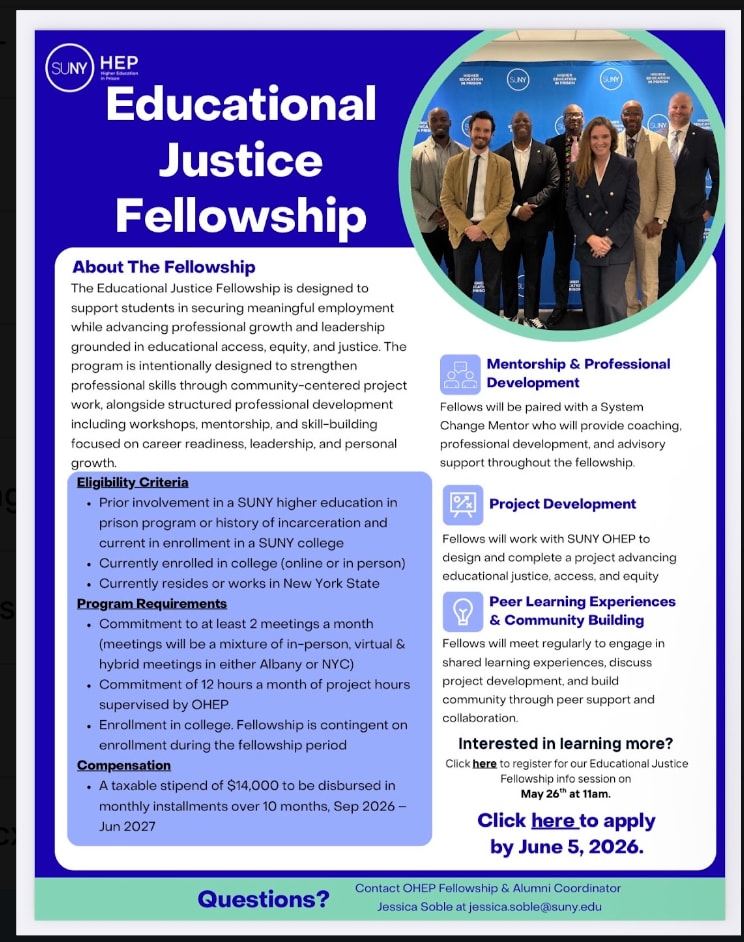
The Educational Justice Fellowship, offered through SUNY’s Office of Higher Education in Prison, supports formerly incarcerated and directly impacted students currently enrolled in SUNY schools. The program is designed to help students build leadership skills, receive mentorship, gain professional development experience, and participate in project-based work connected to educational justice.
Applications are due June 5, 2026.
According to SUNY’s public announcement, fellows will receive a $14,000 stipend distributed over the course of the fellowship, which runs from September 2026 through May 2027. The fellowship also includes mentorship, leadership development, hands-on project experience, and access to a peer learning community.
This is the kind of opportunity that deserves wider attention because it recognizes something too often ignored in criminal justice conversations: education after incarceration is not a side issue. It is a public safety issue, a reentry issue, an economic mobility issue, and a dignity issue.
For people coming home from incarceration, or for students whose lives have been directly shaped by the criminal legal system, access to higher education can change the entire frame. It can create a path toward professional stability, public leadership, advocacy, research, policy work, and community-building.
Programs like this also challenge the old narrative that people impacted by incarceration should only be discussed as defendants, statistics, or cautionary tales. The Educational Justice Fellowship places directly impacted students where they belong: inside the conversation, helping shape the work.
That shift is important.
New York’s criminal justice system has produced generations of people with direct knowledge of incarceration, courts, reentry barriers, family separation, and institutional harm. Those experiences are expertise. When paired with education, mentorship, and professional opportunity, that expertise becomes leadership.
The fellowship also arrives at a time when New York continues to debate the future of incarceration, reentry, sentencing reform, prison education, and survivor-centered justice. If the state is serious about transformation, it has to invest in the people closest to the systems being discussed.
The Educational Justice Fellowship is one example of what that investment can look like.
Eligible SUNY students who are formerly incarcerated or directly impacted by incarceration should review the application materials as soon as possible. Community organizations, advocates, educators, and reentry programs should also help circulate the opportunity before the June 5 deadline.
Opportunities like this can disappear in a crowded inbox. They should not.
For directly impacted students, this is more than a fellowship. It is a chance to be supported, mentored, compensated, connected, and recognized as part of the future of educational justice in New York.
Application deadline: June 5, 2026. Fellowship period: September 2026 through May 2027. Stipend: $14,000. Focus areas: mentorship, leadership development, professional growth, project-based learning, peer community, and educational justice.
SUNY students with incarceration history or prior involvement in a SUNY higher education in prison program can apply through the fellowship flyer link or contact:
jessica.soble@suny.edu
Deadline: June 5.
*Michele Evans is an independent journalist, author, and former ESPN technical producer whose work has appeared in The New York Times.
Michele got her start in 2001 covering the NBA and NFL.
She now covers New York City courts, criminal-justice procedure, NYPD, FDNY, domestic-violence systems, media accountability, public safety, advocacy efforts, and New York civic life through courthouse observation, public records, legal analysis, and lived-experience reporting.
Read more independent journalism by Michele Evans.
Follow Michele Evans on Facebook and Substack for new reporting, analysis, and updates.