Staten Island Shipyard Explosion Shows the Hidden Risk Behind New York’s Industrial Waterfront
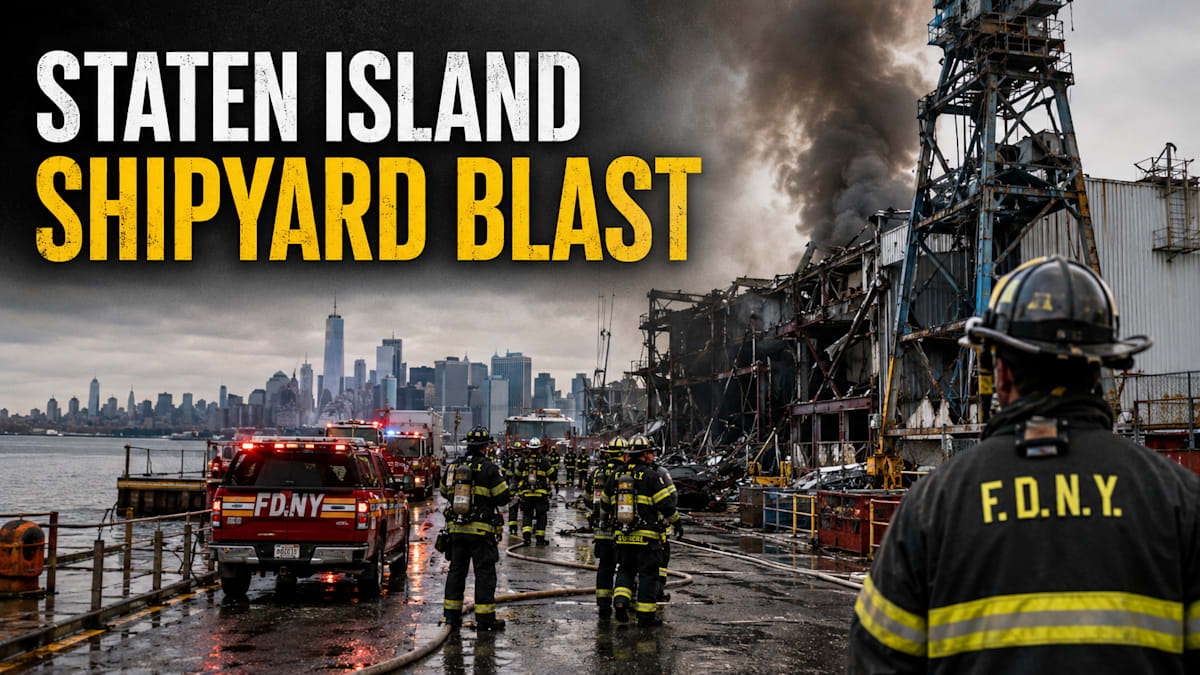
Staten Island Shipyard Explosion Shows the Hidden Risk Behind New York’s Industrial Waterfront
By Michele Evans
New York City, New York
5/25/2026
Category: FDNY
Staten Island, New York - A deadly explosion at a Staten Island shipyard has left one civilian worker dead, dozens of first responders injured, and a city waiting for answers.
The fire broke out Friday afternoon at a shipyard on Richmond Terrace in Mariners Harbor. FDNY officials said crews were responding to reports of smoke and two workers trapped in a basement area of a large metal structure near the docks when the situation escalated into a violent explosion. A second blast followed as firefighters and rescue personnel were still operating in and around the structure.
One worker did not survive. Another civilian was injured. More than 30 firefighters, EMS workers, and first responders were also hurt, including Fire Marshal Christopher Cuccaro, who suffered a fractured skull and brain bleed, and firefighter Vincent Delgado, who remained in serious condition after the explosion.
The cause remains under investigation. But even before investigators determine exactly what ignited inside that shipyard, the incident exposes a larger public-interest question: who is watching the dangerous industrial spaces that still operate inside New York City?
This was not a small backyard fire. This was a shipyard, a waterfront industrial site, a confined-space rescue, and a mass-casualty emergency rolled into one. More than 200 emergency personnel responded. The fire involved a metal structure near the docks, trapped workers, smoke, limited visibility, and blast energy powerful enough to injure rescuers who were trying to save lives.
That combination is exactly why shipyard work carries such serious risk.
OSHA’s shipyard safety materials warn that hot work, including welding, cutting, burning, abrasive blasting, and other heat-producing work, creates an increased risk of fire and explosion because it is often performed in confined or enclosed spaces. OSHA also warns that flammable gases can accumulate in confined spaces with little natural ventilation, creating fire or explosion hazards when workers re-enter or when ignition sources are present.
That does not mean hot work caused this explosion. Investigators have not said that. But it does mean the public should understand the danger profile of these sites before this story disappears into the usual cycle of tragedy, praise for first responders, and silence.
The worker who died was not an abstraction. According to the New York Post, family members identified him as 57-year-old Xiaoyuan Li, a Chinese immigrant who was reportedly working in the lower part of a boat before the blast and had been preparing for a family trip.
That detail changes the frame. This was not just an “industrial accident.” It was someone’s father, someone’s husband, someone’s plan for the future interrupted inside a dangerous workplace.
It was also a reminder that New York City’s industrial waterfront is still active, still risky, and still dependent on workers whose names the public often learns only after something goes terribly wrong.
The FDNY response deserves recognition. Firefighters entered a dangerous, unstable environment because workers were reportedly trapped. A fire marshal with a search dog was part of the rescue effort. The dog was not injured. The fire marshal survived, but his injuries show how quickly rescue work can become catastrophic in enclosed industrial spaces.
FDNY Chief Medical Officer Dr. David Prezant described blast energy as a silent injury mechanism, noting that in confined spaces, explosive force can penetrate organs even when the damage is not immediately visible.
That line should stay with the city.
Because the danger here was not only visible flame. It was pressure, confinement, atmosphere, structure, fuel, ventilation, access, and whatever conditions existed before firefighters ever arrived.
That is where the investigation must go.
City and state officials should not stop at determining the immediate ignition source. They should ask broader questions:
Were workers performing tasks in a confined or enclosed space?
Had the atmosphere been tested?
Were flammable vapors, fuel residue, solvents, coatings, gases, or other hazardous materials present?
Was there a fire watch?
Were workers properly trained for the conditions inside the vessel or structure?
Were emergency responders given accurate information about what was inside?
Had there been prior violations, complaints, inspections, or safety warnings at the site?
Those questions are not about assigning blame before the facts are known. They are about making sure the facts are not narrowed too quickly.
New York often talks about waterfront development in terms of parks, condos, climate resilience, ferries, and views. But the working waterfront still exists. Shipyards, repair facilities, marine terminals, industrial yards, warehouses, and infrastructure sites remain part of the city’s physical economy. They are close to homes, workers, small businesses, and neighborhoods.
When something goes wrong there, the consequences do not stay behind a fence.
Staten Island knows that better than most. Mariners Harbor is not a postcard version of the waterfront. It is a neighborhood shaped by industry, transportation, labor, pollution, working-class life, and public neglect. When a blast shakes that kind of community, the city owes more than condolences.
It owes answers.
The investigation into the Staten Island shipyard explosion should be public, thorough, and specific. Not just “cause under review.” Not just “fire under control.” Not just “first responders are recovering.”
The public needs to know what happened inside that structure, what safety systems were in place, what failed, and whether this death could have been prevented.
A worker went to work and did not come home. Firefighters and EMS workers went in to rescue people and came out injured. A neighborhood was shaken by an industrial blast.
That is not just a Staten Island story.
It is a New York City workplace safety story. It is a first responder safety story. It is a waterfront oversight story. And it is a warning that the hidden machinery of the city can still explode into public view when no one is paying enough attention.
*Michele Evans is an independent journalist, author, and former ESPN technical producer whose work has appeared in The New York Times.
Michele got her start in 2001 covering the NBA and NFL.
She now covers New York City courts, criminal-justice procedure, NYPD, FDNY, domestic-violence systems, media accountability, public safety, advocacy efforts, and New York civic life through courthouse observation, public records, legal analysis, and lived-experience reporting.
Read more independent journalism by Michele Evans.
Follow Michele Evans on Facebook and Substack for new reporting, analysis, and updates.