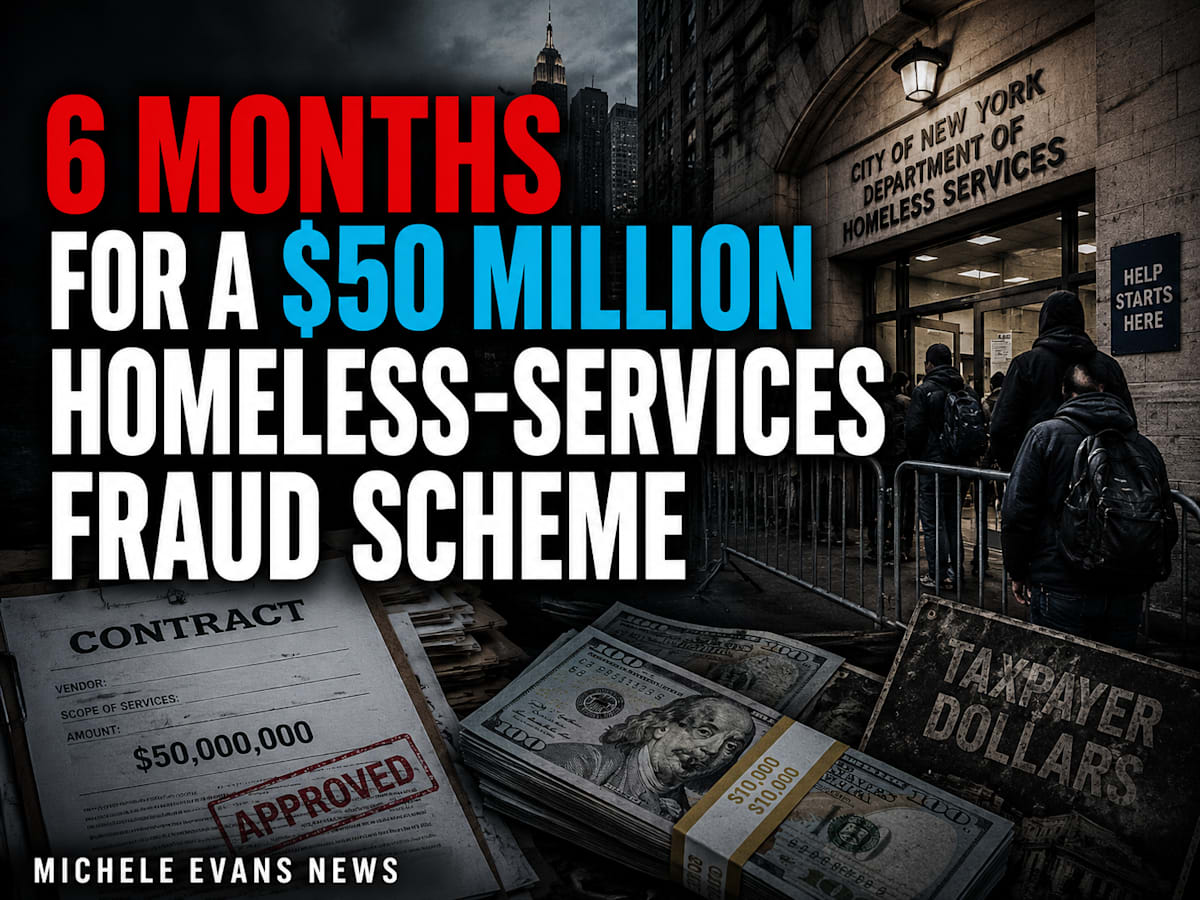
Six Months for a $50 Million Homeless-Services Fraud Scheme
b7dyf6y5p84u2t4hlha4gu378mcf2.3 MBSix Months for a $50 Million Homeless-Services Fraud Scheme?
By Michele Evans New York City, New York 6/23/2026
Category: Courts / Criminal Justice / Advocacy
NEW YORK CITY, NY - New York City says there is never enough money.
Not enough money for safe shelters. Not enough money for housing. Not enough money for mental health services. Not enough money for jail alternatives. Not enough money for people sleeping on trains, families cycling through shelter, or detainees waiting on broken systems to move.
But somehow, there was enough money for a City-funded homeless-services nonprofit to become the center of a fraud scheme DOI says cost New York City more than $50 million.
And the former CEO just got six months in prison.
Thomas Bransky, 50, former CEO of Children’s Community Services, was sentenced Monday by U.S. District Judge Vernon S. Broderick to six months in prison, followed by three years of supervised release. He was also ordered to pay approximately $7.69 million in restitution and $1.2 million in forfeiture. His surrender date is set for September 29, 2026.
Bransky pleaded guilty in October 2025 to conspiracy to commit wire fraud. His co-defendant and business partner, Peter Weiser, 83, also pleaded guilty and is scheduled to be sentenced on July 29, 2026.
According to DOI, Bransky was the CEO of Children’s Community Services, a nonprofit homeless-services provider that had more than $900 million in City contracts. DOI says Bransky and others used the nonprofit and affiliated companies controlled by Weiser to defraud the City through false statements, hidden ownership interests, and inflated costs.
The money was supposed to support New Yorkers in need of temporary housing and homeless services.
Instead, DOI says more than $50 million went to Weiser’s companies for goods and services, many of which were provided by other legitimate companies and then marked up as much as three times their actual cost. Weiser collected more than $7 million in illicit profits, while Bransky earned more than $1.2 million in salary.
Six months.
That is the part New Yorkers should sit with.
Because when poor people miss court, they can sit on Rikers.
When people with mental illness cannot access care, they get cycled through jail, shelter, subway platforms, emergency rooms, and courtrooms.
When domestic violence survivors break under years of abuse, the system can process them like threats before it recognizes them as victims.
But when City-funded homelessness money gets routed through inflated markups and hidden business interests, the sentence can look less like accountability and more like a scheduling inconvenience.
DOI Commissioner Nadia Shihata said the defendants exploited public funds and critical assistance meant for an extremely vulnerable population. She said there is “no excuse or tolerance” for crimes that use the City to illegally enrich private actors.
The statement is correct.
The question is whether the sentence matches the harm.
New York’s homelessness crisis is not abstract. It is visible in shelters, subways, family court, criminal court, hospitals, and jails. Every inflated invoice, every hidden ownership interest, every dollar diverted from services is not just a financial crime. It is a public betrayal.
This was money tied to beds, shelter operations, supplies, support services, and the machinery that claims to serve vulnerable New Yorkers.
And now the public is being asked to accept that six months is justice.
The City loves to talk about accountability when the person in front of it is poor, Black, brown, mentally ill, addicted, unhoused, or accused of street-level survival crime.
But accountability looks very different when the paperwork is corporate, the contracts are massive, and the harm is hidden behind invoices.
New Yorkers deserve to know how a nonprofit with more than $900 million in City contracts became part of a scheme DOI says defrauded the City of more than $50 million.
They deserve to know who was watching.
They deserve to know how many warnings were missed.
And they deserve to know why, when the money belongs to the public and the services belong to the vulnerable, the punishment can still land this lightly.
Because homelessness is not a business model.
Public money is not a private feeding trough.
And six months for a $50 million fraud scheme is not the kind of number that restores trust.
*Michele Evansis an independent journalist, author, and former ESPN technical producer whose work has appeared in The New York Times.
Michele got her start in 2001 covering the NBA and NFL.
She now covers New York City courts, criminal-justice procedure, NYPD, FDNY, domestic-violence systems, media accountability, public safety, advocacy efforts, and New York civic life through courthouse observation, public records, legal analysis, and lived-experience reporting.