Securus Should Not Get a New Rikers Contract to Turn Family Calls Into AI Surveillance
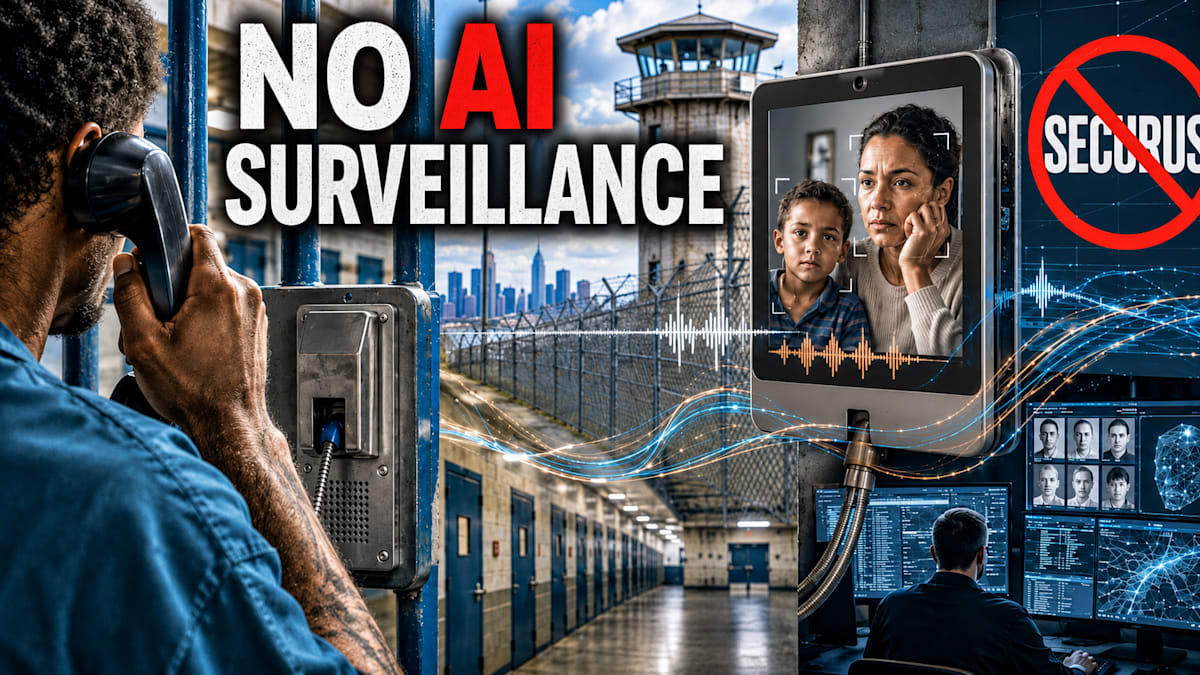
Securus Should Not Get a New Rikers Contract to Turn Family Calls Into AI Surveillance
By Michele Evans
New York City, New York
5/20/2026
Category: Courts / Criminal Justice / Advocacy
New York City, New York - New York City already recognized once that profiting from the pain of people held at Rikers Island was wrong.
In 2019, the city ended the predatory practice of charging people in custody and their loved ones just to communicate by phone. Before that change, people in city jails and their families were paying to maintain basic human contact. The city and Securus Technologies had charged 50 cents to make a call, plus 5 cents per minute, generating millions of dollars each year, with a substantial portion going to the city itself.
I was at Rikers in May 2019, when that practice was thankfully eradicated.
I remember what those calls meant. My longtime romantic partner, Mikey Davis, used to put money on my books so I could speak with him and my family. Those calls were not a luxury. They were oxygen. They were how I stayed connected to the people who loved me, worried about me, and reminded me that I still existed outside the walls of that island.
When the paid-call process ended, Mikey exclaimed that he wanted his money back.
Then he said, “You can have the money. It’s not about that. It’s about the principle.”
He was right.
It was about the principle. It was about whether New York City should allow a private company and a government agency to extract money from families because someone they loved was locked inside a jail. It was about whether human connection should be treated as a revenue stream.
Now, years later, Securus appears to have found another way to profit from the same captive population.
According to recent reporting, New York City’s Department of Correction is preparing to renew a five-year, $23 million telecommunications contract with Securus for phone and tablet services at Rikers, even as advocates raise serious concerns about the company’s use of artificial intelligence to monitor calls.
The issue is not simply whether people at Rikers should have phones or tablets. Of course they should. Communication with family, attorneys, support systems, and the outside world is essential. The city itself has acknowledged that these connections matter. When free calls were implemented in 2019, officials emphasized that people in custody need to remain connected with lawyers, families, and support networks.
The issue is what Securus is doing with those communications.
The Surveillance Technology Oversight Project has condemned the planned renewal, warning that Securus uses artificial intelligence to monitor phone calls through automated voice recognition and automated content analysis. Brooklyn Defender Services has also warned that the surveillance does not stop at the jail wall because it can sweep in friends, family members, and communities outside Rikers.
That should alarm every New Yorker.
People detained at Rikers are overwhelmingly pretrial. Many have not been convicted of anything. Yet their calls to loved ones may be treated as data streams. Their voices may be analyzed. Their families may be pulled into surveillance systems simply because they answered the phone.
This is not reform. This is extraction in a new form.
First, companies charged families for connection. Now, the concern is that the connection itself may become the product.
That is especially troubling because Rikers already has a history of improper surveillance. Documented reported in 2025 that ICE may still have access to Rikers audio surveillance data through a Fusion Center, despite New York City’s sanctuary status. The same report described Securus technology as capable of recording and analyzing conversations through automated voice recognition and content analysis, creating voiceprints that can identify both detained people and those they communicate with.
That is not a small privacy problem. That is a civil-rights problem.
It is also an immigration problem.
Brooklyn Defender Services has warned that Securus’ technology raises sanctuary-city concerns because of its connection to Palantir, a data-analytics firm that partners with ICE. At the same time, ICE detainer requests to New York City jails more than doubled in 2025 compared with 2024, according to Department of Correction information discussed at a City Council oversight hearing.
That context matters.
New York cannot claim to protect immigrant communities while allowing jail communication systems to become backdoor surveillance tools. It cannot claim to be moving away from Rikers while renewing contracts that deepen the island’s technological reach. It cannot say family contact is vital while permitting that contact to be monitored, analyzed, and potentially shared in ways families may not understand.
People call Rikers because they love someone inside.
A mother calls her son. A partner calls the person they are trying to keep alive emotionally. A child hears a parent’s voice. A family member checks in after a court date. A loved one says, “Are you okay?” Someone inside says, “I am still here.”
Those moments should not be converted into surveillance assets.
The city already learned the first lesson: communication should not be a profit center. Now it must learn the second: communication should not be an artificial-intelligence dragnet either.
Securus should not be rewarded with another multimillion-dollar contract unless New York City can guarantee, publicly and enforceably, that the company is not using detainee and family communications to build, train, test, or operate invasive surveillance tools.
There must be clear limits on voice recognition, content analysis, data retention, law-enforcement access, ICE access, third-party sharing, and any use of family communications for AI development. There must be independent oversight. There must be transparency. There must be consequences for violations.
And if those protections cannot be guaranteed, the contract should not be renewed.
Rikers is already a place where people can lose their freedom, their health, their safety, and sometimes their lives. The city should not allow private companies to keep finding new ways to take from them.
In 2019, New York City stopped making people pay just to hear the voices of the people they loved.
It should not now allow Securus to turn those voices into surveillance.
Stop the contract. Stop the AI monitoring. Stop treating Rikers detainees and their families as raw material for another predatory business model.
*Michele Evans is an independent journalist, author, and former ESPN technical producer whose work has appeared in The New York Times.
Michele got her start in 2001 covering the NBA and NFL.
She now covers New York City courts, criminal-justice procedure, NYPD, FDNY, domestic-violence systems, media accountability, public safety, advocacy efforts, and New York civic life through courthouse observation, public records, legal analysis, and lived-experience reporting.
Read more independent journalism by Michele Evans.
Follow Michele Evans on Facebook and Substack for new reporting, analysis, and updates.