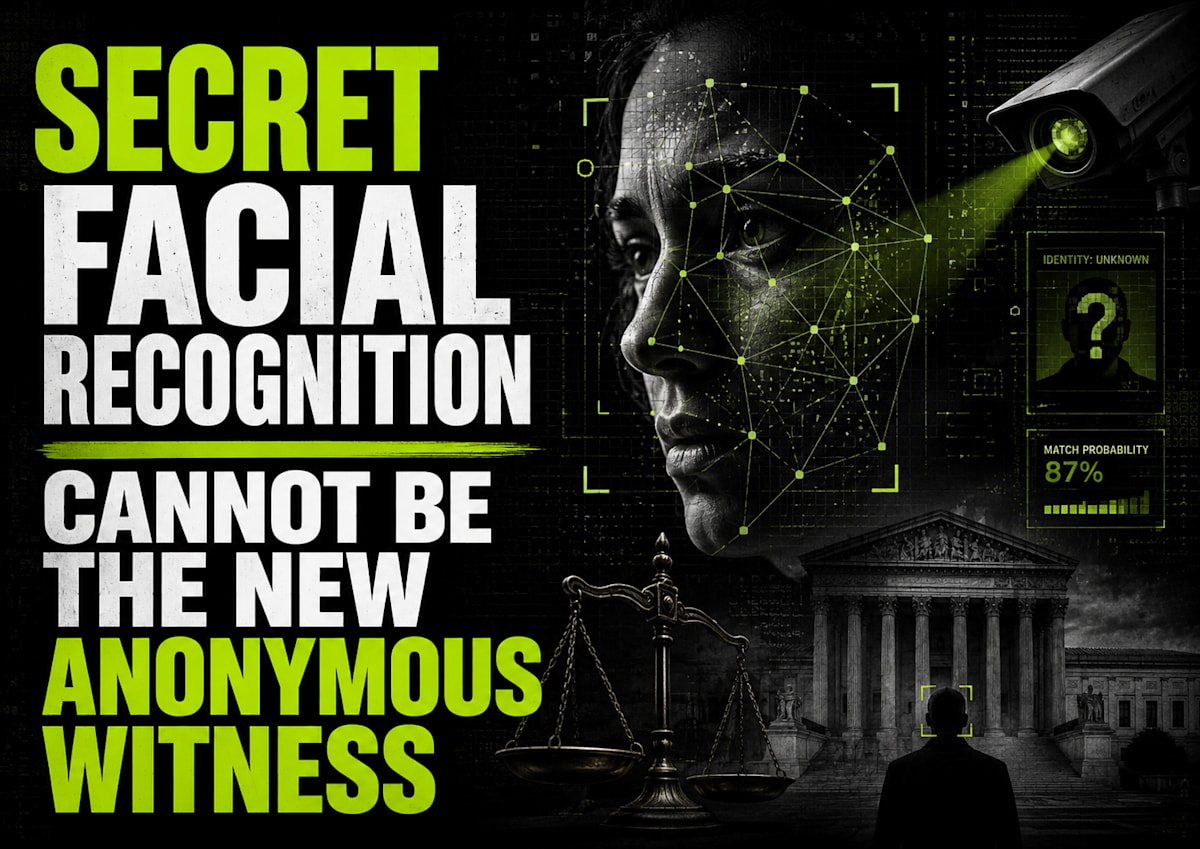
Secret Facial Recognition Cannot Be the New Anonymous Witness
goztcctrkmem4cmrgws7zoyu1nmb1.92 MBSecret Facial Recognition Cannot Be the New Anonymous Witness
New Jersey’s highest court just said defendants have a right to know how police facial recognition was used against them. New York should pay attention.
By Michele Evans New York City, New York 7,/1/2026
Category: Courts / Criminal Justice / Public Interest
NEW YORK CITY, NY - A criminal defendant cannot cross-examine an algorithm.
That is the human rights problem sitting underneath the New Jersey Supreme Court’s new facial recognition ruling. Prosecutors may want to call the technology a mere “investigative lead,” but if that lead puts a name in the hands of police, sends detectives toward a suspect, helps build a case, and changes the entire direction of an investigation, then it is not some harmless background tool.
It is part of the machinery of accusation.
In State of New Jersey v. Tybear Miles, the New Jersey Supreme Court ruled that criminal defendants must receive essential information about facial recognition technology used in police investigations, including what technology was used and how it was applied. The court stopped short of automatically requiring access to proprietary source code, unless the defense can show a particularized need. But the ruling still marks an important shift: police cannot hide behind the words “investigative lead” while using secret technology to point the finger at a human being.
That phrase, “investigative lead,” has become the comfort blanket of modern surveillance. It makes powerful tools sound casual. It suggests the technology did not really do anything decisive. It allows the state to benefit from the machine while shielding the machine from meaningful scrutiny.
But the person charged with a crime does not live inside a legal euphemism. They live inside a body. They sit in a courtroom. They face prison. Their family watches. Their name becomes searchable. Their life may be permanently altered because a system somewhere decided their face looked close enough.
That is not a small thing.
Facial recognition is not neutral magic. It is a data system built from images, assumptions, technical choices, error rates, thresholds, database quality, lighting conditions, camera angles, and human decisions about when to trust the result. If a defendant cannot learn how the tool was used, what image was searched, what database was used, what possible matches were returned, and how police moved from “possible match” to “this is our suspect,” then the defense is being asked to fight a ghost.
That should offend anyone who cares about due process.
This ruling also belongs in the same broad human-rights bucket as the United Kingdom’s “right to be forgotten” framework. The comparison is not exact. The UK right to erasure is a data protection right under the UK GDPR, and it is also known as the “right to be forgotten.” It allows people, in certain circumstances, to ask for personal data to be erased. It is not absolute.
But the moral concern is related.
The UK Information Commissioner’s Office says people may ask search engines to remove search results tied to their name when those results significantly affect privacy rights. The ICO looks at factors including whether information is outdated, whether it is being kept longer than necessary, whether it causes prejudice, whether it has a disproportionate negative impact on privacy, whether it puts someone at risk, and whether it relates to a criminal offense.
That is the same family of questions society must now ask about facial recognition.
How long should a person’s face live inside law enforcement systems?
Who gets to search it?
What happens when the match is wrong?
Who audits the tool?
Who explains the mistake?
Who repairs the damage after a person is arrested, charged, jailed, publicly named, or permanently marked by a technological accusation?
The right to be forgotten asks whether human beings should have any power over the digital traces that follow them forever. Facial recognition in criminal cases asks something even more urgent: whether the government can use those traces to accuse people while keeping the method hidden.
That is not just a technology issue. It is a human dignity issue.
A face is not contraband. A face is not a password. A face is not consent to be tracked, indexed, compared, flagged, and handed to police through a system the accused is not allowed to challenge.
The danger is not only wrongful conviction. The danger is wrongful suspicion becoming automated, normalized, and nearly impossible to unwind.
Once police have a name, confirmation bias can do the rest. Investigators may interpret ambiguous facts through the lens of the algorithm’s suggestion. Prosecutors may build a case around a person who never should have been in the frame. A judge or jury may never hear how fragile the original match was because the state insists the technology was only a lead.
But secret leads can still ruin lives.
New Jersey’s ruling does not solve the problem. It does not ban facial recognition. It does not give every defendant full access to source code. It does not answer every question about bias, accuracy, privacy, or surveillance creep. But it does establish a vital floor: when the state uses facial recognition to help target a person, the defense gets basic information needed to challenge the process.
That floor should exist everywhere.
New York should not wait for scandal, wrongful arrest, or a high-profile case to force the conversation. Courts, lawmakers, public defenders, prosecutors, and civil liberties groups should treat facial recognition like what it is: a powerful state surveillance tool with direct consequences for liberty.
If the government wants to use a machine to help accuse a person, the person must have the right to question the machine’s role.
Not someday.
Not after conviction.
Not only if the defense somehow guesses what happened behind the curtain.
Now.
Because human rights do not disappear just because the witness is software.
And justice cannot survive a courtroom where the state gets to say, “trust the technology,” while the accused is forbidden from asking how it worked.
*Michele Evansis an independent journalist, author, and former ESPN technical producer whose work has appeared in The New York Times.
Michele got her start in 2001 covering the NBA and NFL.
She now covers New York City courts, criminal-justice procedure, NYPD, FDNY, domestic-violence systems, media accountability, public safety, advocacy efforts, and New York civic life through courthouse observation, public records, legal analysis, and lived-experience reporting.