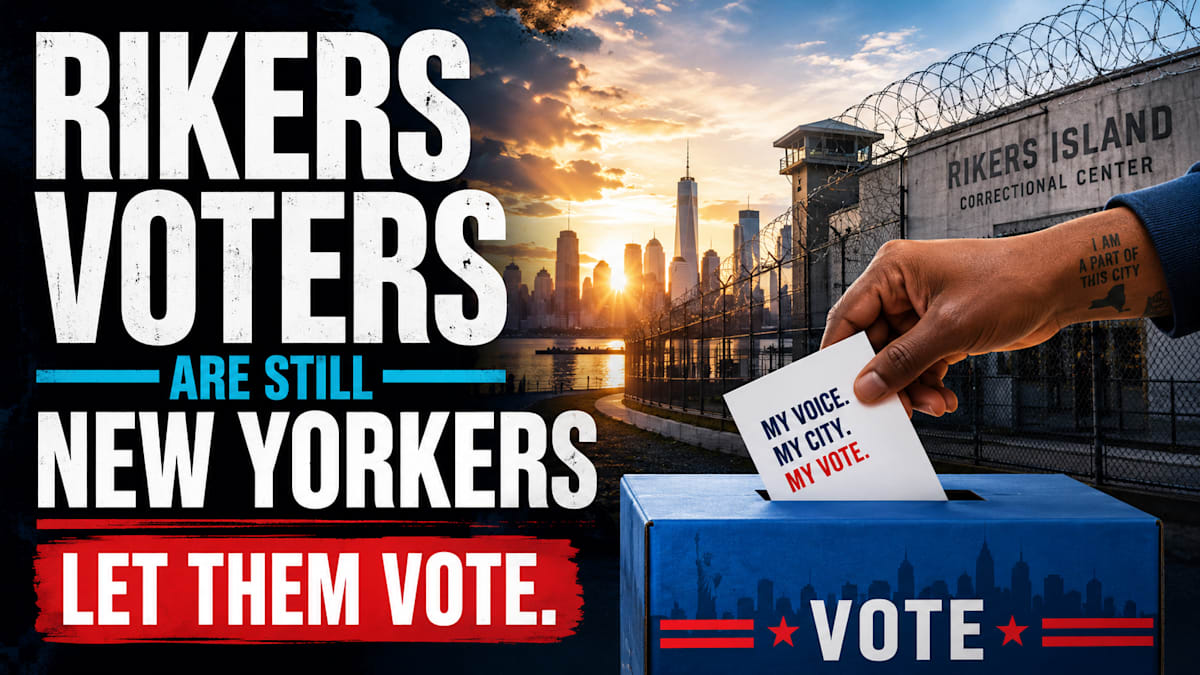
Rikers Voters Are Still New Yorkers. Let Them Vote Like It
1e4tfq6rf36pe0n9tpic8nixrkqc2.19 MBRikers Voters Are Still New Yorkers. Let Them Vote Like It
By Michele Evans New York City, New York 6/23/2026
Category: Courts / Rikers Island / City Hall
NEW YORK CITY, NY - There are few places in New York City where politics feels more personal than Rikers Island.
Not theoretical.
Not polite.
Not brunch-table civic engagement.
Personal.
Because when you are locked inside Rikers, you are living under the direct consequences of city government every single day. The mayor matters. The City Council matters. The judges matter. The Department of Correction matters. The Board of Elections matters.
And yes, the district attorney absolutely matters.
That is why the growing push to protect voting access for people detained in New York City jails is not some niche criminal justice issue. It is democracy with the volume turned all the way up.
A new op-ed from City Council Member Gale Brewer, Legal Aid attorney Rigodis Appling, and League of Women Voters leader Kai Rosenthal makes the point plainly: on June 13, there were 6,608 people detained on Rikers Island, and 5,598 of them were awaiting trial.
That means thousands of people on Rikers have not been convicted of the cases keeping them there.
Thousands are still legally eligible to vote.
Thousands are still New Yorkers.
And yet, every election cycle, jail becomes a wall between eligible citizens and the ballot box.
That should bother everyone.
Not because it is soft on crime.
Because it is basic democracy.
People love to talk about civic responsibility until the citizen is wearing jail greens. Then suddenly the same city that can count bodies for jail population reports, court production lists, commissary accounts, medical call-outs, housing movements, and disciplinary tickets somehow cannot reliably help eligible voters cast a ballot.
Nope.
Not good enough.
The Vote in NYC Jails Coalition has been pushing for a real solution: polling sites in city jails. Not a maze of paperwork. Not an absentee process that collapses under jail chaos. Not a “maybe somebody will bring the form around if the stars align” system.
A real voting system.
Because Rikers is not some separate planet floating outside Queens. It is part of New York City. The people detained there come from our neighborhoods, our families, our shelters, our hospitals, our schools, our courts, and our communities.
They are not outside democracy.
They are living inside the consequences of it.
I know this because I was there.
When I was detained on Rikers, I wanted to vote for Manhattan district attorney. Badly.
Not because I was bored.
Not because I suddenly became a civics nerd in jail.
Because my case was in Manhattan. Because the DA’s office had power over my life. Because prosecutors were making choices that affected my family, my freedom, my future, and my survival.
And because I wanted to vote against my own lawyer.
Yes. You read that correctly.
My lawyer had jumped the fence to the other side so hard it felt like watching Darth Vader turn around with the cape, the helmet, and the entire Death Star behind him.
One minute, defense.
Next minute, dark side.
And there I was, sitting in Rikers, fully understanding that elections were not abstract. The person running the DA’s office mattered. The culture of prosecution mattered. The policies mattered. The politics mattered.
The ballot mattered.
That is what people on the outside often miss.
Rikers does not make you less aware of government. It makes you painfully aware of it.
You learn fast which agencies function and which agencies fail. You learn how adjournments steal months. You learn how transportation failures can derail court dates. You learn how medical neglect becomes policy. You learn how paperwork errors become punishment. You learn how every elected official who looked away helped build the cage around you.
So yes, people detained on Rikers should vote.
They should vote because many are presumed innocent.
They should vote because misdemeanor convictions do not erase citizenship.
They should vote because pretrial detention is not a civic death sentence.
They should vote because the city still counts them when it wants funding, statistics, and control.
And they should vote because nobody has a bigger stake in jail policy than the people actually living inside the jail.
This is also an upbeat story, believe it or not.
Because the demand is not complicated.
It is hopeful.
It says people are still reachable. Still connected. Still citizens. Still part of the city. Still capable of participating. Still entitled to a voice.
A polling site on Rikers would send a message louder than any press conference:
You are still a New Yorker.
Your vote still counts.
Your voice did not disappear at intake.
That matters in a place designed to make people feel invisible.
And for a city currently debating the future of Rikers, court delays, jail population, public safety, and criminal justice reform, voting access is not a side issue. It is the center of the whole thing.
If New York City is serious about democracy, it cannot stop at the bridge to Rikers Island.
Bring the ballot box inside.
Let eligible people vote.
And maybe, just maybe, the people most impacted by the system will finally get a say in who runs it.
*Michele Evansis an independent journalist, author, and former ESPN technical producer whose work has appeared in The New York Times.
Michele got her start in 2001 covering the NBA and NFL.
She now covers New York City courts, criminal-justice procedure, NYPD, FDNY, domestic-violence systems, media accountability, public safety, advocacy efforts, and New York civic life through courthouse observation, public records, legal analysis, and lived-experience reporting.