Rikers Murals Come to Weeksville: Art, Memory, and the Lives We Refuse to Leave Behind
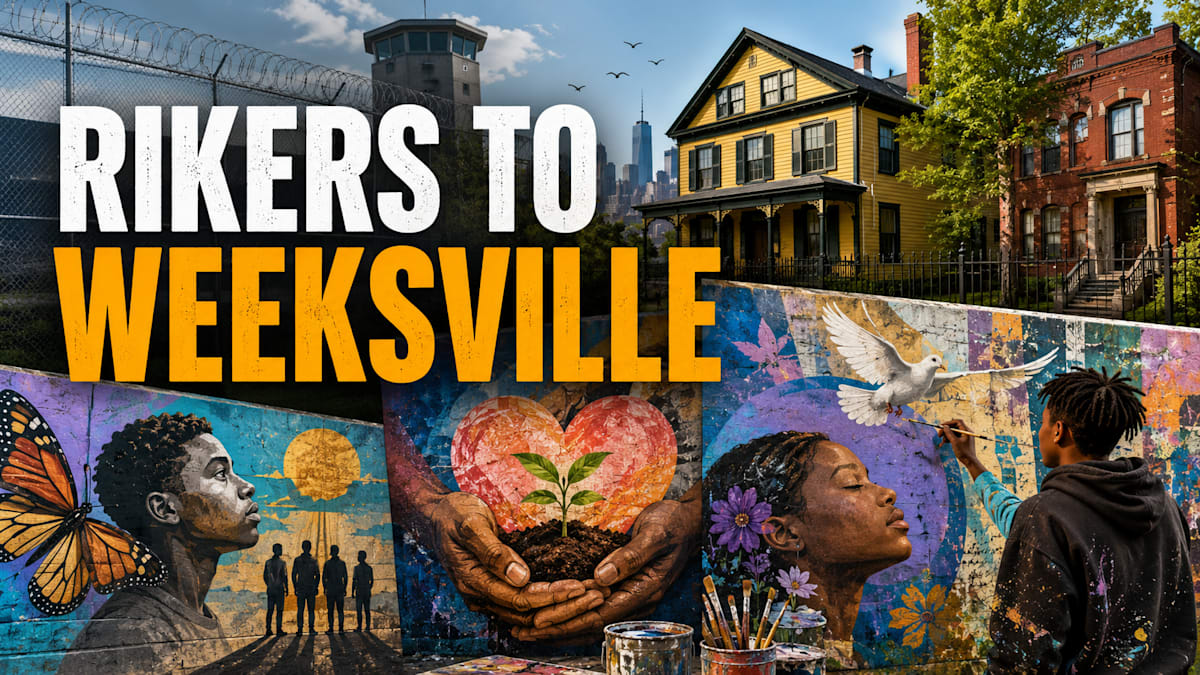
Rikers Murals Come to Weeksville: Art, Memory, and the Lives We Refuse to Leave Behind
By Michele Evans
New York City, New York
5/27/2026
Category: Courts / Criminal Justice / Advocacy
Brooklyn, New York - A new exhibition opening at Weeksville Heritage Center on June 3 will bring murals created inside Rikers Island into one of Brooklyn’s most important spaces for Black history, public memory, and community preservation.
The exhibition, “Peace in Destruction: Art from Rikers Island,” is presented by Groundswell, a local nonprofit focused on youth-based art and social justice. According to the Brooklyn Eagle, the exhibit features murals created between 2008 and 2019 by Groundswell with young people at Rikers Island. Most of the murals will be seen outside the jail for the first time, and the work explores incarceration, healing, and transformation through art. The opening reception is scheduled for Wednesday, June 3, from 6 to 8 p.m., and the exhibition will remain open through June 27.
That alone gives the exhibition civic weight.
But the location gives it even more power.
Weeksville is not just an exhibition space. It sits on the historic site of one of the largest free Black communities in pre-Civil War America. It is a place built around survival, self-determination, memory, preservation, and the refusal to let erased histories stay erased.
To bring visual records from Rikers Island into that space is to ask a larger public question: what happens when people whom institutions have tried to disappear are given walls, color, and public witness?
Rikers is too often discussed in numbers alone.
Deaths. Violence. Staffing. Federal monitors. Court orders. Closure deadlines. Budget fights. Medical failures. Political promises. Broken promises.
All of those belong in the public record. They are necessary. They are urgent. They are part of the political and legal fight over the future of the jail complex.
But they are not the whole record.
There is also the human record.
There are the children and young people who passed through the system. There are the families who waited for calls. There are the people who survived confinement and carried the damage back into the city. There are the people who tried to create beauty in a place designed to strip identity away. There are the images that remember what official reports often flatten.
Murals from Rikers do something court filings and city hearings cannot always do. They show feeling. They show imagination. They show survival. They show that even inside a jail complex known for brutality, neglect, and institutional failure, young people were still thinking, still making, still trying to be seen.
That turns this exhibition from an arts announcement into a public record.
I also have a personal connection to Weeksville. My own work has previously been exhibited there, and I know how meaningful it is to have a place like Weeksville hold space for stories that are too often dismissed, minimized, or buried.
Supporting Weeksville means supporting an institution that preserves history while also making room for living memory, community art, and public truth.
This exhibition arrives while New York is still debating what it means to close Rikers, what accountability should look like, and whether the city will treat incarcerated people as human beings or as problems to be managed out of public view.
Art does not replace policy.
It does not substitute for medical care, safety, legal accountability, housing, trauma recovery, or real decarceration work.
But art can do something policy often fails to do.
It can make the invisible visible.
It can turn a jail wall into a public record.
It can force people outside the system to confront the lives inside it.
And it can remind New Yorkers that the story of Rikers is not only about cages. It is also about the people who kept imagining freedom while trapped inside them.
That is the pressure point in this exhibition.
The murals are not merely objects to be viewed. They are evidence of interior lives. They are evidence of young people making meaning under conditions that should never have been normalized. They are evidence that even in places built to control and contain, people still reach for language, color, beauty, memory, and transformation.
New Yorkers should go see this exhibition.
Support Weeksville. Support Groundswell. Support the young artists whose work deserves to be seen beyond the walls where it was created.
Because when art from Rikers enters Weeksville, it does more than move murals from one place to another.
It moves memory into public view.
*Michele Evans is an independent journalist, author, and former ESPN technical producer whose work has appeared in The New York Times.
Michele got her start in 2001 covering the NBA and NFL.
She now covers New York City courts, criminal-justice procedure, NYPD, FDNY, domestic-violence systems, media accountability, public safety, advocacy efforts, and New York civic life through courthouse observation, public records, legal analysis, and lived-experience reporting.
Read more independent journalism by Michele Evans.
Follow Michele Evans on Facebook and Substack for new reporting, analysis, and updates.