Rikers Island Has Entered the Chat: The Jail So Infamous Even Hip-Hop Put It on Wax
zh7rwnpkhz1ycrb7zlvxe82a4w5c3.04 MBRikers Island Has Entered the Chat: The Jail So Infamous Even Hip-Hop Put It on Wax
By Michele Evans New York City, New York 7,/3/2026
Category: Courts / Criminal Jusice / public Rikers Island
NEW YORK CITY, NY - Rikers Island has many nicknames, none of them flattering.
It has been called notorious, broken, violent, impossible, overdue for closure, and, depending on who is talking, either a New York shame or a New York survival test.
But now we can add another title to the list:
Hip-hop landmark.
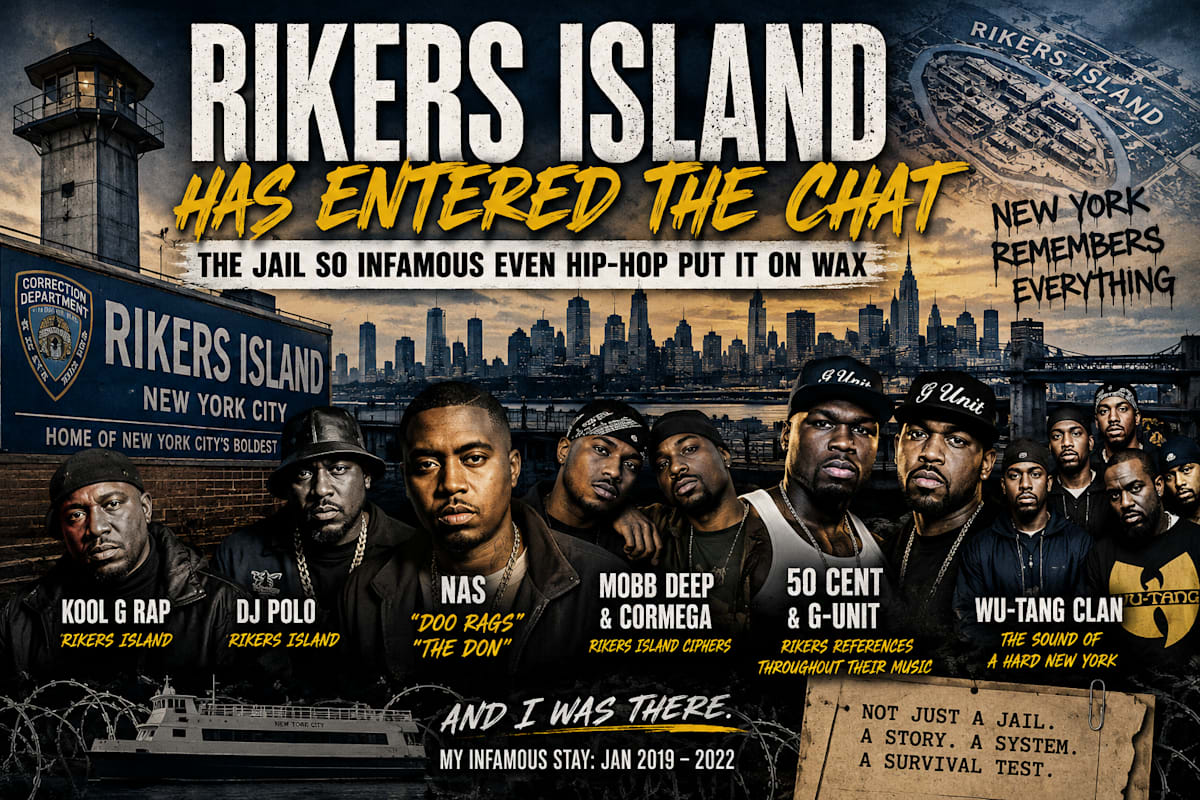
Hip-Hop Wired, republished by WEUP, recently rounded up rappers who have referenced Rikers Island in songs, including Kool G Rap & DJ Polo, Nas, Mobb Deep, 50 Cent, G-Unit, and Wu-Tang Clan. The list is a reminder that Rikers is not just a jail complex. It is a symbol, a shorthand, a threat, a memory, a punchline, and sometimes a whole verse worth of trauma packed into two words.
Kool G Rap & DJ Polo made Rikers the whole warning label. Their 1990 track treats the island like a place where the tough-guy act ends fast.
Nas used Rikers differently. In “Doo Rags,” he points to packed jail buses as part of the machinery of incarceration. In “The Don,” he turns the whole city into a metaphorical jail, making New York itself feel like one giant holding pen.
Mobb Deep and Cormega brought Rikers into the rap ecosystem itself, referencing “Rikers Island ciphers,” where even behind bars, reputation, rhythm, and survival still moved through the room.
50 Cent and G-Unit used Rikers the way New York rappers often do: as proof of proximity to the city’s hardest systems. The point is not romance. The point is survival credentials.
Wu-Tang Clan fits naturally into the Rikers conversation too. Their whole sound carried that gritty, cinematic New York pressure, the kind of energy where a jail reference never feels out of place.
And listen, as someone who had my own infamous extended stay from January 2019 into 2022, I have to admit:
Apparently, I was in culturally significant company.
Not good company, exactly.
But company.
Rikers has lived in rap for decades because the place itself carries a mythology New Yorkers understand instantly. You do not need a paragraph. You say “Rikers,” and the whole city hears the bus, the bridge, the phones, the visits, the court pens, the commissary hustle, the noise, the waiting, the stories, and the smell of institutional despair trying to pass itself off as procedure.
That is why the references land.
Rikers is not background scenery.
It is a character.
The city’s own closure plan says New York passed a law in 2019 to close the jail facilities on Rikers Island by 2027 and replace them with smaller borough-based jails. The Vera Institute has described the complex as the site of an ongoing human rights crisis, noting in a 2022 report that more than 80 percent of people confined there were not convicted of a crime.
So when rappers mention Rikers, they are not just name-dropping a location. They are tapping into one of New York City’s most loaded institutions.
Lil Wayne’s Rikers chapter belongs in the larger conversation too. He served time there in 2010, and even released music while incarcerated. Pitchfork reported that Wayne added a verse to Drake and Jay-Z’s “Light Up” from prison, proof that even behind bars, the bars did not stop.
That is the thing about Rikers and music:
The place tries to erase people, but people keep turning it into testimony.
For me, Rikers was not a lyric.
It was intake.
It was housing.
It was survival.
It was the women’s facility, court trips, strip searches, waiting for legal mail, commissary math, phones that could decide your whole mood, and trying to keep your spirit from being processed along with your property.
It was watching people disappear into a system that somehow manages to be both chaotic and boring at the same time.
And yes, it is strange to look back and realize the same place that tried to swallow my life has also been immortalized by some of the biggest names in hip-hop.
Nas said it.
Mobb Deep said it.
G-Unit said it.
Wu-Tang Clan said it.
Lil Wayne lived it too.
And so did I.
That does not make the experience glamorous. Nobody should romanticize Rikers. The island has a reputation for violence, abuse, neglect, and death for a reason.
But there is something darkly funny, and very New York, about realizing your worst chapter also sits inside a cultural reference file that includes rap legends, diss tracks, survival anthems, prison phone verses, and city mythology.
Some people get a souvenir hoodie.
I got trauma, court records, a book, a beat, and apparently a playlist.
Rikers Island is supposed to be closed by 2027, at least according to the city’s official plan. Whether New York actually gets there is another story entirely.
But even if the buildings come down, the references will stay.
The songs will stay.
The stories will stay.
The people who survived it will stay.
And if hip-hop has taught us anything, it is this:
New York remembers everything.
Even the places it wishes it could forget.
*Michele Evansis an independent journalist, author, and former ESPN technical producer whose work has appeared in The New York Times.
Michele got her start in 2001 covering the NBA and NFL.
She now covers New York City courts, criminal-justice procedure, NYPD, FDNY, domestic-violence systems, media accountability, public safety, advocacy efforts, and New York civic life through courthouse observation, public records, legal analysis, and lived-experience reporting.