Rikers Is Still Open. The City Is Still Cutting. And People Inside Are Still Paying the Price.
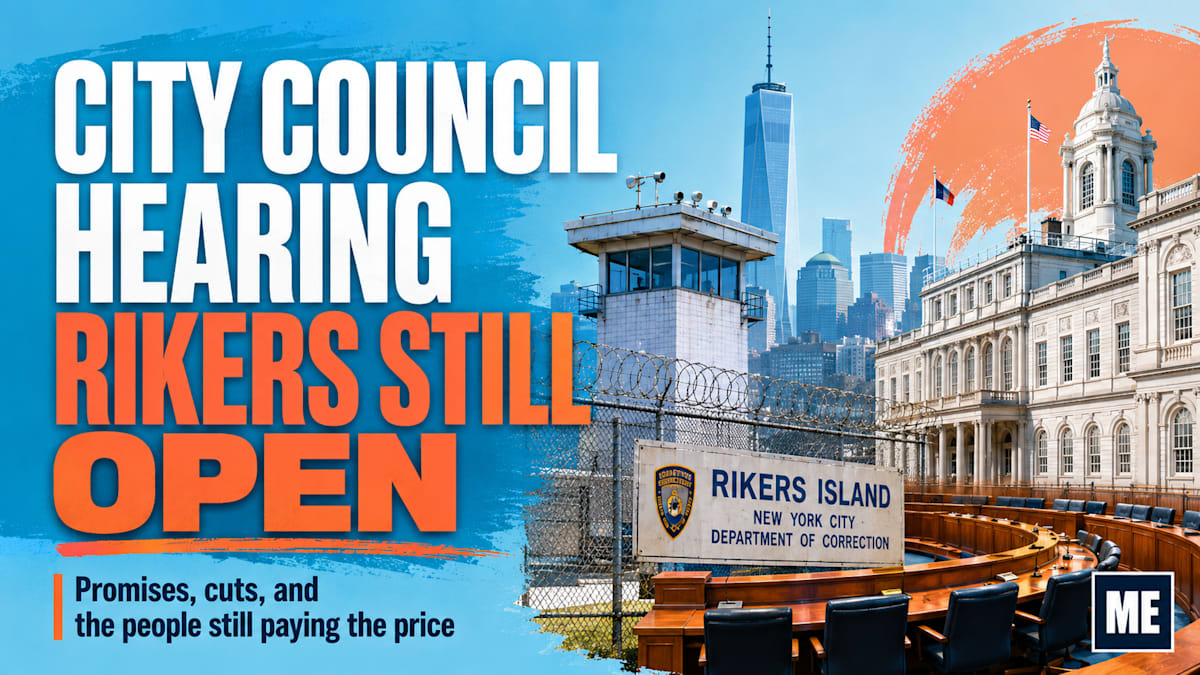
Rikers Is Still Open. The City Is Still Cutting. And People Inside Are Still Paying the Price.
By Michele Evans
New York City, New York
6/3/2026
Category: Rikers Island / City Council / Criminal Justice
New York City, New York - New York City has been promising to close Rikers Island for years.
In 2019 the city’s plan to shutter Rikers had taken another step forward. The proposal was supposed to replace the notorious jail complex with four smaller borough-based facilities. The promise was clear: Rikers would close, the city would move toward a smaller and more humane jail system, and New York would finally begin to turn the page on one of the most abusive correctional institutions in the country.
That was 2019.
It is now 2026.
Rikers is still open.
People are still inside.
People are still dying.
And this week, as the City Council examined the Department of Correction’s Fiscal Year 2027 budget, DOC Commissioner Stanley Richards defended a proposal to reduce the agency’s budgeted uniformed officer headcount by 586 vacant positions. The administration says no current officers are being terminated. DOC says the cut reflects positions the department has struggled to fill, not an immediate reduction in staff already working inside the jails.
But that explanation does not answer the larger question.
If Rikers is still operating, if thousands of people are still being held there, if people are still dying in city custody, if programming remains vulnerable, if services remain inadequate, and if the city is still years behind the moral promise it made when it committed to closing Rikers, then what exactly is New York funding?
Because the issue is not simply whether vacant officer positions stay on a spreadsheet.
The issue is whether the city is willing to fund survival.
I submitted testimony to the City Council Committee on Criminal Justice and Committee on Finance for the Fiscal Year 2027 Executive Budget Hearing on the Department of Correction because this budget cannot be treated as a routine agency funding question.
“Rikers is not a normal city facility,” I wrote. “It is a place where people are caged pretrial, exposed to violence, filth, humiliation, fear, medical neglect, and death. It is a place where people enter legally presumed innocent and leave changed forever, if they leave at all.”
That is the frame this budget hearing deserves.
The city cannot talk about DOC funding as if it is only moving numbers between columns. Every dollar that is cut, preserved, redirected, or withheld has a human consequence inside a jail complex the city has already admitted should not exist.
I know because I was there.
I was incarcerated on Rikers Island from January 2019 until June 2020. In 2021, I testified before the City Council about what I personally saw inside: cockroaches, rats, filth, cramped holding cells, barriers to reporting harm, and women whose survival had been criminalized after domestic abuse.
That earlier testimony set the stage.
Today’s budget testimony sharpened the demand.
“The Council should not accept a budget that cuts or underfunds the very programs that help keep people alive, connected, and stable inside,” I wrote.
That is the heart of the issue.
Programming is not decoration.
Programming is not a perk.
Programming is not something to cut when the numbers get tight.
“Inside Rikers, programming is a lifeline.”
It is often the only structured human contact people have that is not about control, discipline, search, count, punishment, or survival. It is where people process trauma, addiction, grief, rage, fear, shame, parenting, release anxiety, and the shock of being trapped in an environment designed to strip people down. It is where people remember they are still human.
When programming is cut, the damage is immediate.
Dorms become more volatile. People sit with nothing but fear, frustration, noise, tension, and waiting. Addiction recovery is interrupted. Mental health needs go unmet. Family connection weakens. Reentry planning falls apart. People who are already unstable become more isolated. People who are trying to change lose access to the very structure that helps them do it.
That does not make the jail safer.
It makes it more dangerous for everyone inside, including staff.
At Tuesday’s budget hearing, DOC defended the proposed reduction of vacant officer lines by saying the positions are not currently filled. But the Council should not allow the debate to stop there. If vacant positions are being cut, then the money should not simply disappear. It should be redirected into services that reduce harm and stabilize the people who remain trapped inside.
That means educational programming. Recovery meetings. Religious services. Creative programs. Trauma-informed groups. Parenting support. Conflict de-escalation. Vocational training. Reentry preparation. Mental health care. Family connection. Gender-responsive services. Sanitation. Independent oversight. Alternatives to incarceration.
As I wrote in my testimony, these are not soft services.
“They are violence prevention. They are suicide prevention. They are overdose prevention. They are reentry preparation. They are public safety.”
That is the budget argument the city keeps trying to avoid.
Public safety is not created by warehousing traumatized people in filthy, violent, unstable conditions while cutting the programs that help them hold on.
Public safety is not created by starving nonprofit providers, reducing access to family, interrupting recovery, and releasing people with no housing, no medication continuity, no documents, no treatment connection, no transportation, and no plan.
Public safety is not created by calling Rikers temporary while leaving people to survive it indefinitely.
Rikers is often called a gladiator school because of its entrenched culture of violence, fear, and survival. That phrase is not dramatic. It is accurate.
Inside Rikers, the body learns to scan constantly.
Who is angry?
Who is too close?
Where are the exits?
Is the dorm about to erupt?
What tone did that officer use?
What did that look mean?
That is not paranoia inside Rikers.
That is survival.
But survival has a cost.
“A person does not simply walk out of Rikers and become free,” I wrote. “The jail follows them.”
It follows people into sleep, crowds, relationships, work, health, and ordinary daily life. It follows them in the way they flinch at sudden sounds, sit with their back to the wall, mistrust authority, struggle with sleep, and carry shame from being searched, watched, exposed, and treated as disposable.
Rikers does not only punish people.
It injures them.
That is why programming matters. It is one of the few tools inside that can interrupt the damage.
The Council should also refuse to separate programming from sanitation. In my 2021 testimony, I spoke about working in the mess hall and killing cockroaches constantly. I spoke about rats. I spoke about filth. In my current budget testimony, I made clear that these are not minor complaints. Sanitation is a life-safety issue in a jail.
When people are locked in crowded dorms, sharing showers, toilets, phones, tables, sinks, air, and limited supplies, basic cleanliness becomes a public health and human dignity issue.
No jail housing unit should have rats, cockroaches, mold, sewage smells, unsafe showers, broken toilets, inadequate cleaning supplies, or people forced to live in filth. People in custody should not have to beg for soap, toilet paper, menstrual products, clean clothing, clean bedding, disinfectant, or functioning showers.
But clean floors alone will not fix Rikers.
“A jail where people are locked in clean cages with no meaningful programming is still a cage,” I wrote. “It is still deprivation. It is still despair.”
That is why this hearing matters as more than a fight over vacant officer lines.
The Council should ask DOC to account not only for staffing, but for the actual lived conditions inside every facility and housing unit. How many programs are being canceled? How often are services interrupted by lockdowns? Which providers are being blocked from access? How many people are actually receiving services? How often are people missing mental health care, medical care, recreation, visits, legal access, and religious services?
DOC should be required to publicly report programming cancellations, staffing shortages, lockdown-related interruptions, provider access problems, and the number of people actually receiving services by facility and housing unit.
The budget should not fund darkness.
It should require transparency.
It should also fund gender-responsive services for women, trans people, nonbinary people, and survivors of abuse.
The women’s jail is filled with people whose pathways into incarceration are often tied to domestic violence, poverty, coercion, substance use, mental health needs, and survival. Women in custody are also mothers, daughters, caregivers, and survivors. They need confidential ways to report abuse. They need access to services that understand trauma. They need support maintaining contact with children. Pregnant people need real medical care, doulas, midwives, and protection from shackling and humiliation. Trans and gender-nonconforming people need safe housing, medical continuity, hormone access, and protection from sexual violence and retaliation.
These are not abstract policy points.
They are the difference between surviving custody and being further destroyed by it.
If New York is serious about reducing deaths and improving conditions, it must also fund the off-ramp. The most humane condition at Rikers is not being sent there unnecessarily. Many people detained on Rikers are poor, legally presumed innocent, unable to afford bail, mentally ill, unhoused, or caught in crises that jail cannot solve.
That means the Council must fund alternatives to incarceration, supervised release, housing, treatment, community supervision, domestic violence survivor services, mental health care, substance-use treatment, and court-based alternatives.
The same city that promised in 2019 to close Rikers is now defending staffing cuts in 2026 while thousands of people remain trapped inside the facility that was supposed to be phased out. That contradiction is the story.
The city cannot say closure is coming while starving the people still living through the delay.
The city cannot say Rikers is too dangerous to remain open, then treat the people currently inside as if they can wait for dignity later.
The city cannot say it is reducing jail capacity while failing to fully fund the services that make decarceration possible.
And the city cannot continue to fund a jail system that produces death, trauma, and instability while underfunding the programs that prevent people from entering it in the first place.
I put it plainly in my testimony:
“I am not asking you to reward DOC failure. I am asking you to fund life-saving services while demanding accountability for every dollar.”
That is the balance the Council must strike.
Fund the services.
Demand the accountability.
Do not preserve the machinery of harm.
Do not cut the few stabilizing forces that exist inside one of the most unstable places in New York City.
Do not allow vacant staffing lines to become an excuse for disappearing money that should be redirected into programming, mental health care, family connection, sanitation, reentry, gender-responsive services, alternatives to incarceration, and independent oversight.
People are dying.
People are being damaged.
People are being released with injuries this city helped create.
No New Yorker should be sentenced to filth, neglect, violence, humiliation, isolation, or preventable death because they are poor, because they are awaiting trial, because they are mentally ill, because they survived abuse, or because the city has decided that people behind jail walls are easier to ignore.
Rikers has already taken too much from too many people.
This budget should not preserve the machinery of harm.
It should fund the programs, conditions, and accountability needed to reduce that harm now.
Because Rikers is still open.
And as long as it is, New York City remains responsible for every person inside.
*Michele Evans is an independent journalist, author, and former ESPN technical producer whose work has appeared in The New York Times.
Michele got her start in 2001 covering the NBA and NFL.
She now covers New York City courts, criminal-justice procedure, NYPD, FDNY, domestic-violence systems, media accountability, public safety, advocacy efforts, and New York civic life through courthouse observation, public records, legal analysis, and lived-experience reporting.
Read more independent journalism by Michele Evans.
Follow Michele Evans on Facebook and Substack for new reporting, analysis, and updates.