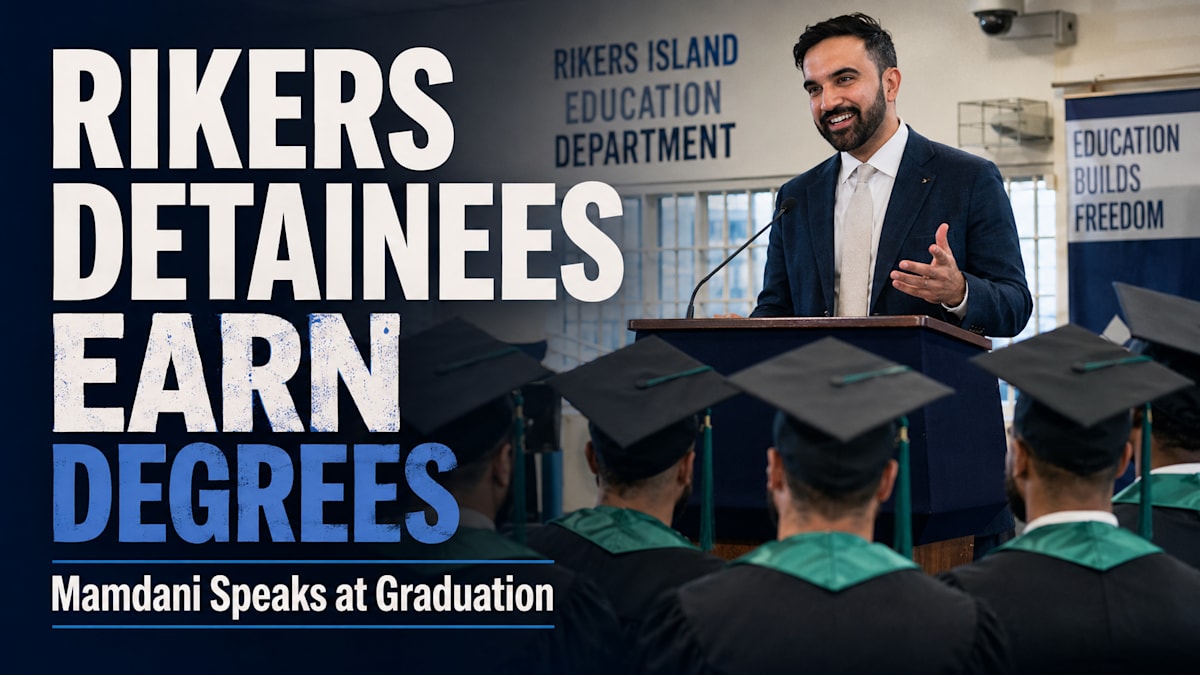
Rikers Detainees Earn Degrees as Mamdani Speaks at Graduation
wvg8eolxwztp4gdc9hk26i6r2l6a1.83 MBRikers Detainees Earn Degrees as Mamdani Speaks at Graduation, Highlighting the Programs New York Should Be Protecting
By Michele Evans New York City, New York 6/16/2026
Category: Courts / Criminal Justice / Rikers Island
Bronx, New York - Rikers Island had a graduation ceremony this week.
That sentence alone should stop New York in its tracks.
Inside a jail complex better known for violence, neglect, lawsuits, lockdowns, federal monitoring, staff shortages, death, despair, and political failure, young detainees put on caps and gowns and earned school degrees. Mayor Zohran Mamdani spoke at the graduation, bringing City Hall attention to a moment that deserves more than a quick photo opportunity.
It deserves a serious conversation about what actually helps people come home.
Graduation inside Rikers is not a small thing. It is not symbolic fluff. It is not a feel-good distraction from the crisis on the island. It is one of the few signs of what the system could be if New York invested in people with the same urgency it invests in punishment.
The students who graduated did it while living inside one of the most unstable jail systems in the country. They did it while awaiting court dates, dealing with fear, separation from family, housing uncertainty, trauma, facility disruptions, and the daily grind of being known by a number instead of a name.
And still, they studied.
That matters because education behind bars is not a luxury. Programming is not a luxury. A classroom inside Rikers can be the difference between a person spending the day spiraling in a housing unit and a person remembering they still have a future.
The school program is only one piece of a much larger picture. Rikers programming also includes vocational and reentry services that can teach real skills: culinary arts, barbering, cosmetology, café operations, construction safety, scaffold training, flagging, GED preparation, college courses, adult education, therapeutic horticulture, law library access, tablet-based learning, and other programs intended to help people prepare for life beyond the jail walls.
That is what public safety actually looks like.
Public safety is not only a jail bus, a locked door, or another speech about crime. Public safety is a person leaving custody with a high school equivalency, a food handling certificate, a barbering skill, a college credit, a résumé, a mentor, a trade, a script, a poem, a plan, and some reason to believe the world has not completely thrown them away.
New York loves to say it wants people to do better. Then it cuts the very programs that help them do better.
That is the contradiction.
Budget cuts have repeatedly threatened the kind of programming that gives people inside Rikers structure, purpose, and a path forward. Even arts programs have been vulnerable. Something as simple and powerful as an acting class can end up on the chopping block, despite the fact that programs like the Stella Adler Studio of Acting’s work on Rikers have reached incarcerated people through theater, writing, voice, movement, and performance.
People who have never been locked up may not understand how big that is.
Inside Rikers, a class is not just a class. It is oxygen.
A teacher calling you by your name is oxygen. A script in your hand is oxygen. A cooking class is oxygen. A cosmetology chair is oxygen. A barbering lesson is oxygen. A GED packet is oxygen. A college course is oxygen. A moment where someone asks you to think, speak, create, learn, or build instead of simply survive is oxygen.
I know what it means to be inside a jail where humanity is treated like contraband.
I also know how powerful it is when even one person inside that system sees you as more than your charge, more than your worst day, more than your DIN number, more than your housing unit, more than your trauma, more than the court file sitting somewhere outside the gates.
Programming does not fix everything. It does not erase the violence of Rikers. It does not erase court delays. It does not erase medical neglect, staff misconduct, locked-down housing areas, missed visits, broken phones, or the psychological damage that comes from being trapped in a place where chaos is normal.
But programming gives people something the jail often tries to take away.
Identity.
That is why graduation at Rikers should not be treated like a cute ceremony. It should be treated like evidence.
Evidence that people inside are capable of achievement.
Evidence that education can still reach people in the hardest conditions.
Evidence that the city knows how to create pathways when it chooses to fund them.
Evidence that rehabilitation is not some fantasy word used by advocates. It is a real thing that happens when human beings are given access, instruction, consistency, and respect.
The question now is whether New York is serious enough to protect it.
Because it is easy for elected officials to show up at a graduation. It is harder to defend the budget lines that made that graduation possible. It is easy to applaud detainees in caps and gowns. It is harder to make sure the next group has teachers, classrooms, escorts, materials, certificates, vocational slots, and uninterrupted access. It is easy to praise young people for changing their lives. It is harder to stop cutting the programs that help them do it.
Rikers is supposed to close. The city has said that for years. But people are still there today.
They are there this morning. They will be there tonight. They will be there tomorrow.
And while politicians argue over timelines, receivership, borough-based jails, staffing, contracts, court orders, and campaign slogans, the people inside still need education now. They need programming now. They need vocational training now. They need reentry support now.
A person does not stop being a student because they are detained.
A person does not stop being a future worker because they are detained.
A person does not stop being a parent, a child, a writer, a cook, a barber, a stylist, an artist, or a human being because they are detained.
That is the part New York keeps forgetting.
This week’s graduation at Rikers should be celebrated. Every graduate deserves that.
But celebration is not enough.
If New York can put a podium inside Rikers for a graduation speech, it can put money behind the classrooms, kitchens, salons, workshops, libraries, arts programs, and reentry services that help people leave Rikers with more than a MetroCard and trauma.
Graduation day showed what is possible.
Now City Hall has to decide whether it wants those possibilities to survive the next budget.
*Michele Evansis an independent journalist, author, and former ESPN technical producer whose work has appeared in The New York Times.
Michele got her start in 2001 covering the NBA and NFL.
She now covers New York City courts, criminal-justice procedure, NYPD, FDNY, domestic-violence systems, media accountability, public safety, advocacy efforts, and New York civic life through courthouse observation, public records, legal analysis, and lived-experience reporting.