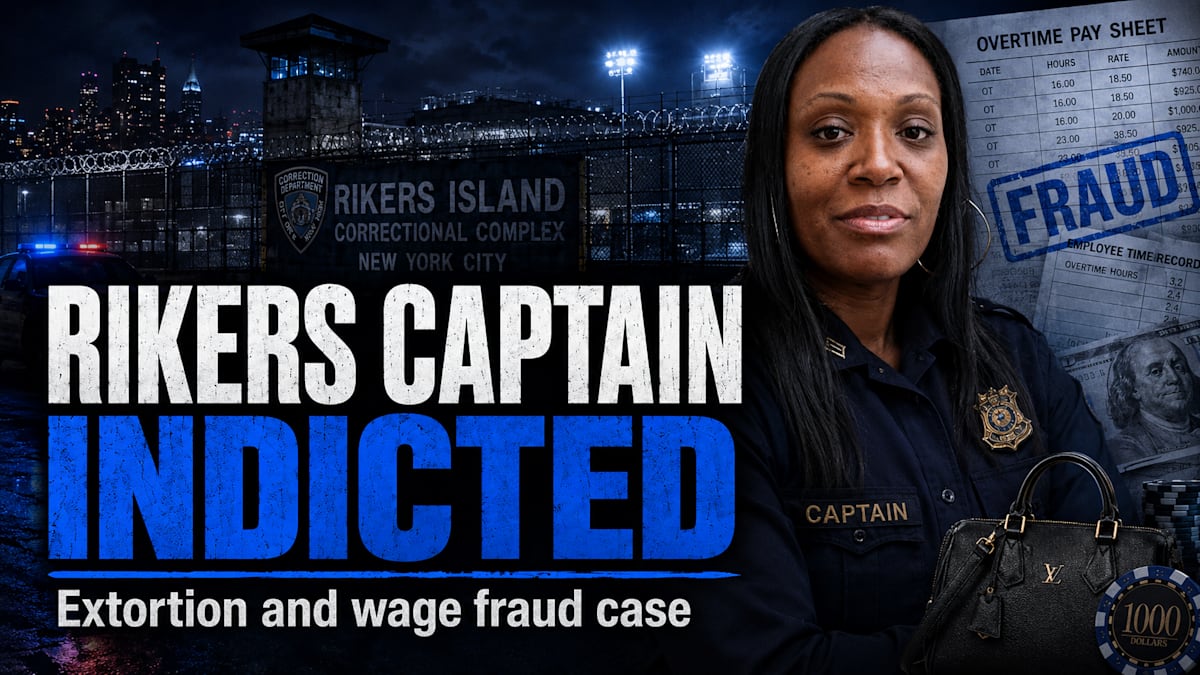
Rikers Captain Accused Of Turning Schedules Into A Shakedown
8ni35vi3n3jnc8mgriyh8zx3wqoz2.52 MB Rikers Captain Accused Of Turning Schedules Into A Shakedown
By Michele Evans New York City, New York 6/11/2026
Category: Courts / Criminal Justice / Rikers Island
New York City, New York - A Rikers Island captain was supposed to supervise staff inside one of New York City’s most troubled jail facilities.
Federal prosecutors say she turned that power into a personal hustle.
Latanya Brown, a 51-year-old New York City Department of Correction captain assigned to Rikers Island’s Otis Bantum Correctional Center, was indicted this week in federal court in Brooklyn on two counts of extortion and one count of fraudulently obtaining funds from a federally funded government agency.
The charges are allegations. Brown is presumed innocent unless and until proven guilty.
But the indictment lays out a picture familiar to anyone who has watched Rikers long enough: power concentrated in the wrong hands, oversight failing to catch it early, and public money allegedly draining into a system already drowning in scandal.
According to the U.S. Attorney’s Office for the Eastern District of New York, Brown allegedly exploited her supervisory position by demanding things of value from subordinate correction officers in exchange for favorable work schedules and overtime opportunities. Prosecutors say the alleged demands included luxury goods and personal favors.
The New York Post reported that prosecutors accused Brown of coercing underlings into providing items such as a Louis Vuitton handbag and even rides to a Yonkers casino. The paper also reported that Brown was allegedly seen at that casino on days when she had claimed to be working overtime.
That is the part that sounds almost cartoonish.
The rest is not funny.
Federal prosecutors say Brown allegedly fraudulently obtained compensation from the Department of Correction by claiming hours she did not work. The U.S. Attorney’s Office said the indictment charges her with fraudulently obtaining funds from a federally funded government agency. The New York Post reported that prosecutors are seeking restitution and alleged her pay, including overtime and salary, reached more than $400,000 across 2024 and 2025.
This is not just a “bad employee” story.
It is a Rikers story.
Rikers is a place where detainees are told every day that rules are rules, orders are orders, and disobedience has consequences. People held there can be written up, locked in, moved, searched, disciplined, denied privileges, or left to navigate danger because of decisions made by staff and supervisors.
So when a captain is accused of using schedule power over correction officers as leverage, the question cannot stop at whether one person broke the law.
The question is what kind of system allowed a supervisor inside Rikers to allegedly turn shifts, overtime, and workplace authority into a private economy.
Overtime at Rikers has long been more than a payroll issue. It affects staffing, housing areas, fatigue, security, detainee care, and accountability. When overtime is real, it can mean the jail is understaffed and stretched too thin. When overtime is allegedly fraudulent, it means public money is being pulled from a system already failing the people inside it.
Either way, the public deserves answers.
Who approved the overtime?
Who reviewed the hours?
Who tracked whether supervisors were actually present?
Who noticed patterns in schedule assignments?
Who was afraid to report it?
And how many people inside the Department of Correction knew something was wrong before federal prosecutors got involved?
The details alleged in the indictment are also a reminder of how power works inside a jail. People often think of corruption at Rikers only in terms of contraband, violence, or abuse against detainees. But corruption can also live in the staff chain of command. It can live in scheduling. It can live in overtime. It can live in who gets relief, who gets punished, who gets the better post, who gets the extra money, and who is expected to pay tribute to stay in favor.
That kind of workplace corruption does not stay neatly inside payroll records.
It shapes the culture of the jail.
A facility where staff believe power is transactional is not a facility where detained people can expect fairness. A facility where supervisors allegedly exploit subordinates is not a facility where accountability is healthy. A facility where overtime can allegedly be manipulated for personal gain is not a facility where taxpayers should trust the numbers without verification.
Brown’s case now moves through federal court. She has been charged, not convicted.
But even at the allegation stage, the indictment lands inside a much larger Rikers crisis: years of violence, deaths, federal monitoring, staffing failures, corruption cases, and repeated warnings that New York City’s jail system cannot police itself.
That is why this story matters beyond one captain, one handbag, one casino trip, or one overtime scheme.
Rikers does not just have a violence problem.
It has a power problem.
And every time another official is accused of turning that power into personal profit, New York City should stop pretending the rot is limited to the people behind bars.
*Michele Evansis an independent journalist, author, and former ESPN technical producer whose work has appeared in The New York Times.
Michele got her start in 2001 covering the NBA and NFL.
She now covers New York City courts, criminal-justice procedure, NYPD, FDNY, domestic-violence systems, media accountability, public safety, advocacy efforts, and New York civic life through courthouse observation, public records, legal analysis, and lived-experience reporting.