Question for Knicks fans
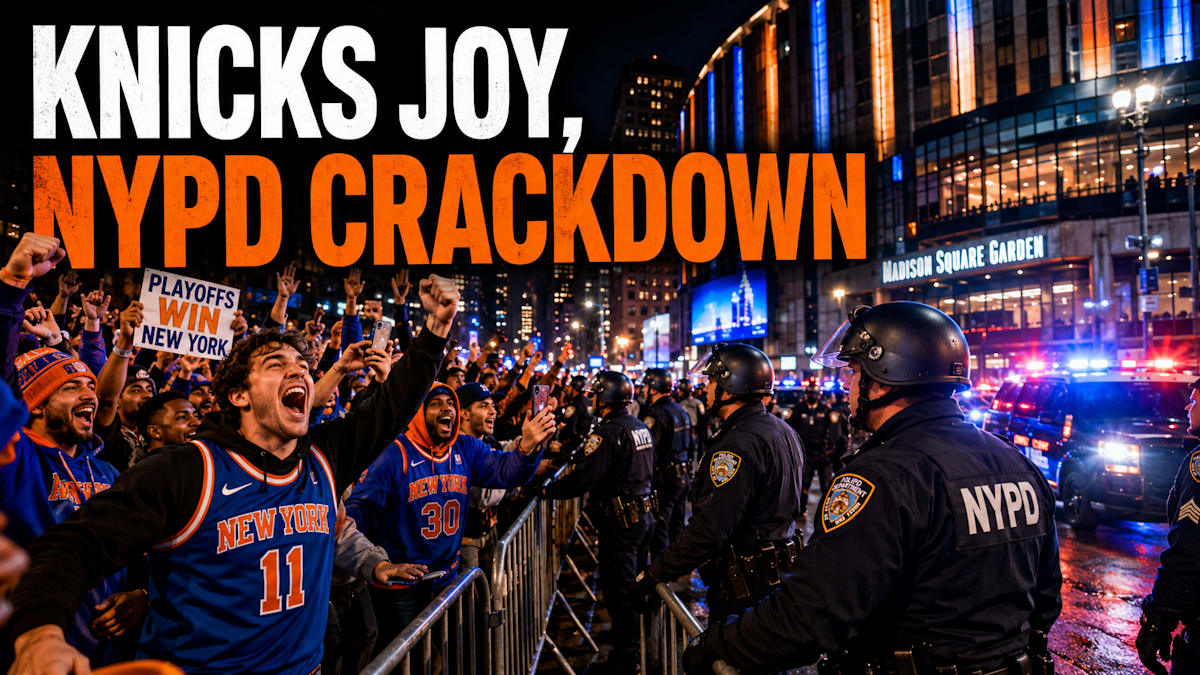
Question for Knicks fans: Did the NYPD overreact outside Madison Square Garden, or was this the only realistic way to keep the streets under control after the Knicks win?
By Michele Evans
New York City, New York
5/27/2026
Category: NYPD / Public Interest / Sports
New York City, New York - When Knicks Joy Meets NYPD Crowd Control, New York Has a Bigger Question to Answer
After a historic Knicks win, arrests outside Madison Square Garden turned celebration into a public-safety debate.
The Knicks gave New York the kind of moment this city waits decades for.
A playoff win. A roaring fan base. Madison Square Garden at the center of the city’s emotional weather system. Thousands of people pouring into the streets because, for Knicks fans, this was not just another game. It was release. It was identity. It was a city remembering what collective sports joy feels like.
Then came the other part of the New York story: barricades, police lines, arrests, crowd-control warnings, and an immediate debate over whether the NYPD was protecting the public or overcorrecting against a fan base doing what fan bases do when history breaks open.
That is the question now.
Did the NYPD overreact outside Madison Square Garden, or was this the only realistic way to keep the streets under control?
According to CBS New York, the NYPD said it would no longer support Knicks playoff watch parties directly outside Madison Square Garden after crowd-control issues during a gathering that drew about 6,000 people. Police said some attendees jumped barriers, threw objects, blocked vehicle traffic, climbed subway entrances, and drank publicly. Six people were arrested after that earlier watch-party crowd, according to the report.
FOX 5 New York reported the same basic city position: official watch parties outside MSG were halted after what police described as escalating crowd-control problems, while alternate locations, including SummerStage, remained under review.
That matters because this was never only about basketball.
It was about how New York manages spontaneous civic emotion.
Madison Square Garden is not a park. It is not a festival ground. It sits above Penn Station, beside major subway entrances, at one of the most congested pedestrian and transit choke points in the city. When thousands of people flood that area, the risk is not theoretical. A blocked street can become an emergency-access problem. A subway entrance packed with fans can become a fall hazard. A few bottles thrown into a dense crowd can change the atmosphere fast.
So the NYPD’s safety concern is not imaginary.
But neither is the public frustration.
New York is a city that routinely absorbs parades, protests, marches, street fairs, concerts, marathons, holiday crowds, and emergency deployments. If the city can plan for Times Square on New Year’s Eve, it should be able to think creatively about Knicks playoff crowds without defaulting to a message that sounds like: celebrate somewhere else.
That is the tension.
Public safety has to be real. But public joy also deserves planning.
City Councilmember Oswald Feliz, who chairs the Public Safety Committee, told CBS New York that safety must be a top priority, but that New York has enough resources to make major public events safe and successful at the same time. That is the frame the city should be using.
The question is not whether police should ignore dangerous behavior. They should not. People should not be climbing subway structures, blocking traffic, throwing objects, or creating hazards for everyone else. A small number of reckless people can ruin a public celebration for thousands.
But the question is also not whether Knicks fans should be treated like a public nuisance for showing up in force.
The Knicks are not just a team right now. They are a civic event.
This is the moment where city government, the NYPD, Madison Square Garden, transit officials, and elected leaders should be planning for controlled celebration zones, not simply reacting after crowds gather. The city needs designated spaces, clear pedestrian corridors, visible emergency lanes, public bathrooms, sanitation planning, subway-access protection, and crowd-management staffing that separates dangerous conduct from ordinary celebration.
Because if the Knicks keep winning, this problem does not get smaller.
It gets bigger.
And if the city only responds with shutdowns and arrests, the story shifts away from the Knicks and toward the police response. That is bad for fans, bad for public safety, and bad for New York.
A better approach would acknowledge both truths at once: the city cannot allow chaos outside one of its busiest transit hubs, and it also should not act surprised when Knicks fans flood the streets after a historic win.
New York needs a plan that is bigger than barricades.
The Knicks gave the city a reason to gather. Now the city has to decide whether it can manage joy without smothering it.
*Michele Evans is an independent journalist, author, and former ESPN technical producer whose work has appeared in The New York Times.
Michele got her start in 2001 covering the NBA and NFL.
She now covers New York City courts, criminal-justice procedure, NYPD, FDNY, domestic-violence systems, media accountability, public safety, advocacy efforts, and New York civic life through courthouse observation, public records, legal analysis, and lived-experience reporting.
Read more independent journalism by Michele Evans.
Follow Michele Evans on Facebook and Substack for new reporting, analysis, and updates.