Category: New York Prisons / Correction Accountability / Public Safety / Criminal Justice / State Oversight
NEW YORK CITY, NY - New York has another prison accountability report on its hands. The question now is whether state officials will treat it as a warning flare or another file to be shelved after the headlines fade.
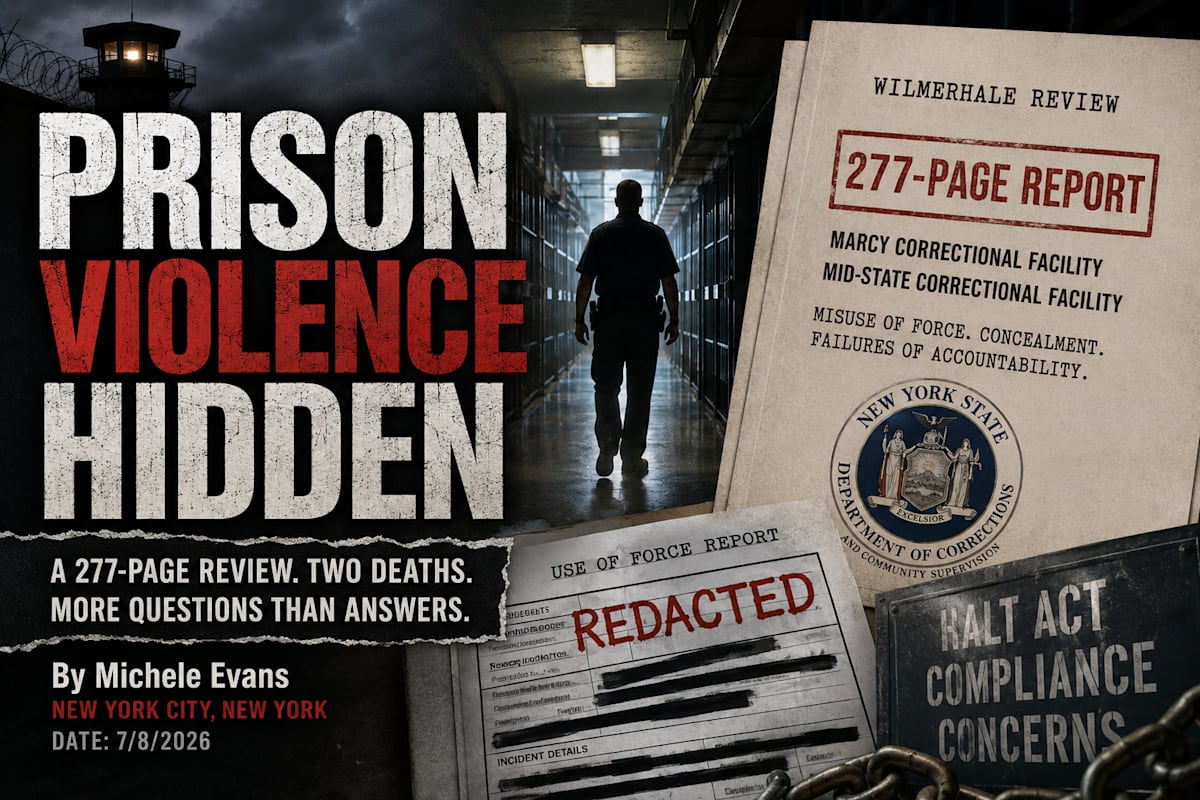
The Albany Times Union reported July 7 that a 277-page WilmerHale review commissioned by the New York State Department of Corrections and Community Supervision found misuse of force and efforts to conceal it at Marcy and Mid-State Correctional Facilities. The review followed the deaths of Robert Brooks Sr. in December 2024 and Messiah Nantwi in March 2025, both of whom the Times Union reported were fatally beaten by officers.
That distinction matters. This is not only a story about individual officers accused of violence. It is a story about what a prison system allegedly allowed to become routine, what supervisors missed or tolerated, and what paperwork may have been used to hide from the public.
The Times Union reported that investigators documented abuse, falsified reports, and failures of accountability involving correction staff, supervisors, and medical personnel. The report also raised concerns about compliance with the HALT Act, New York’s law meant to limit long-term solitary confinement.
When force is misused inside a closed institution, the victim usually cannot call a press conference. Families wait outside. Lawyers fight for records. Advocates read through state language that often turns human suffering into procedure. That is why concealment allegations are so serious. The cover story can become part of the injury.
DOCCS has said it has started implementing reforms from the review. The Times Union reported that the WilmerHale report includes 77 recommended reforms. Those recommendations may matter, but only if the public can track what changes, who is disciplined, what policies are rewritten, and whether incarcerated people are actually safer.
The state also has to answer a harder question: why did it take deaths, public outrage, and an outside review to confirm what incarcerated people, families, and legal advocates have warned about for years?
Correction unions have pointed to staffing shortages and unsafe prison conditions. Those concerns cannot be dismissed. A prison system in crisis can endanger everyone inside it, including staff. But staffing pressure does not explain away violence, falsified reports, or alleged concealment. A dangerous workplace still requires lawful force, honest documentation, and real supervision.
The public-interest issue is not whether New York can produce another reform list. It is whether the state can prove that prison violence will not be investigated only after someone dies.
For families, the word “accountability” cannot mean a report alone. It has to mean answers, public tracking, discipline where warranted, criminal prosecution where supported by evidence, protection for people who report abuse, and a record system that does not reward silence.
New York’s prisons are state institutions. The people inside them are in state custody. That makes their safety a state responsibility, not an internal management issue.
Michele Evans is an independent journalist, author, and former ESPN technical producer whose work has appeared in The New York Times.
Michele got her start in 2001 covering the NBA and NFL. She now covers New York City courts, criminal-justice procedure, NYPD, FDNY, domestic-violence systems, media accountability, public safety, advocacy efforts, and New York civic life through courthouse observation, public records, legal analysis, and lived-experience reporting.
Read more independent journalism by Michele Evans.
Follow Michele Evans on Facebook and Substack for new reporting, analysis, and updates.