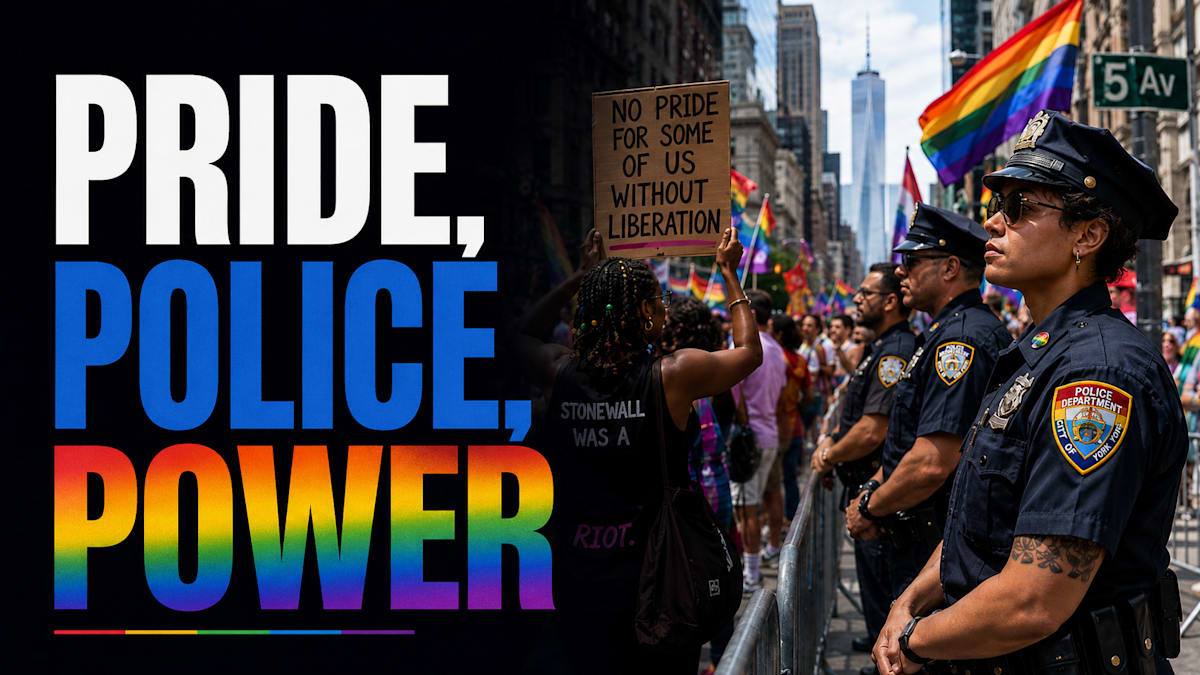
Pride Was Built After a Police Raid. That Is Why This NYPD Fight Still Cuts Deep.
bkl5tk4romlssp06b6iez6syil1q1.98 MBPride Was Built After a Police Raid. That Is Why This NYPD Fight Still Cuts Deep
By Michele Evans New York City, New York 6/29/2026
Category: NYPD / Public Interest
NEW YORK CITY, NY - New York City Pride ended with the same unresolved question it has carried for years:
Who gets to define safety?
On Sunday, NYPD Commissioner Jessica Tisch stood with LGBTQ officers who were not permitted to march in the main NYC Pride March in full uniform while armed. The dispute is not new. NYC Pride organizers have restricted uniformed, armed law enforcement participation since 2021, citing the history of policing and the trauma many LGBTQ people still associate with armed police presence at Pride events.
That history is not abstract.
Pride traces its roots to Stonewall, a rebellion that began after a police raid on a gay bar in Greenwich Village. The modern parade was born from resistance, not permission. So when organizers say armed police in uniform change the emotional meaning of the march, they are not inventing conflict. They are pointing to the origin story.
But there is another side to this, and ignoring it makes the story too easy.
LGBTQ officers are not outsiders to the community simply because they wear a badge. Many of them have spent their lives fighting for space in two institutions that did not always welcome them: law enforcement and LGBTQ public life. To those officers, being told they cannot fully march in uniform can feel like being asked to split themselves in half.
That is the tension.
For organizers, the uniform and weapon represent state power at an event rooted in resistance to state violence.
For LGBTQ officers, the uniform can represent survival, visibility, service, and a hard-won place inside a department with its own complicated history.
Both things can be true.
The problem is that New York keeps trying to flatten the issue into a culture-war headline: Pride bans cops. NYPD slams Pride. Activists exclude gay officers. Police demand inclusion.
But the real story is not inclusion versus exclusion.
The real story is power.
A parade is not just a party. It is a political space. Every uniform, banner, sponsor, float, barricade, and police line tells the public who belongs, who is protected, and who is expected to adjust.
That is why this fight keeps returning. It is not only about whether LGBTQ officers can march. It is about whether Pride remains a protest, becomes a civic celebration, or tries to be both while satisfying no one.
New York City wants Pride to be safe. That part is not controversial.
The harder question is safe for whom, and on whose terms?
If Pride is for all of us, then “all” cannot mean pretending history did not happen. It also cannot mean erasing LGBTQ people who serve in uniform.
Somewhere between those two truths is a harder, more honest conversation than the one New York is having.
Because Pride was never just about being seen.
It was about being seen without surrendering the story.
*Michele Evansis an independent journalist, author, and former ESPN technical producer whose work has appeared in The New York Times.
Michele got her start in 2001 covering the NBA and NFL.
She now covers New York City courts, criminal-justice procedure, NYPD, FDNY, domestic-violence systems, media accountability, public safety, advocacy efforts, and New York civic life through courthouse observation, public records, legal analysis, and lived-experience reporting.