Press Credentials Are for Reporting, Not Murder Fandom
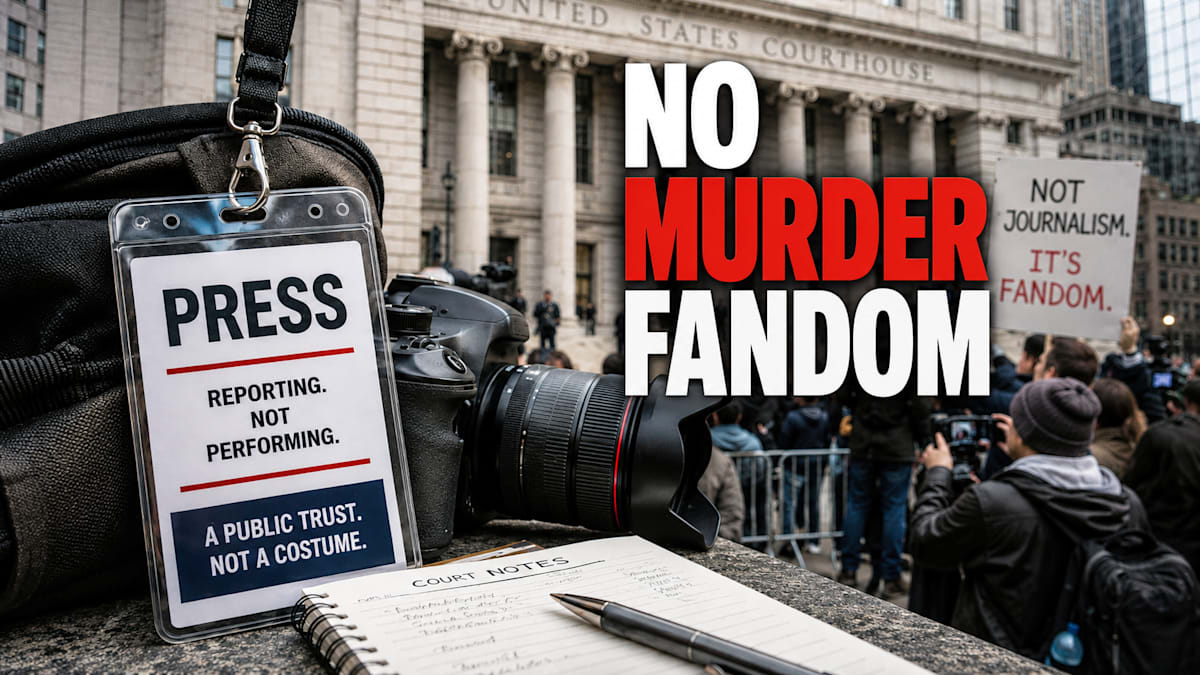
Press Credentials Are for Reporting, Not Murder Fandom
By Michele Evans
New York City, New York
5/20/2026
Category: Courts / Criminal Justice / Advocacy / Media Accountability
New York City, New York - New York City’s press-pass controversy should not become a referendum on independent journalism. Independent journalists, freelancers, community reporters, photographers, documentarians, and public-interest writers all have a legitimate place in the press ecosystem.
But that does not mean every person with a camera, blog, livestream, or social media account is entitled to official press access.
The question raised by the recent Luigi Mangione courthouse controversy is not whether independent media should exist. Of course it should. The question is whether people who publicly celebrate an alleged murder, mock the victim, or suggest that a slain man’s children are “better off without him” should be treated by the City of New York as members of the press.
They should not.
According to published reports, several Mangione supporters appeared outside Manhattan Criminal Court wearing city-issued press credentials while making inflammatory comments about Brian Thompson, the UnitedHealthcare CEO who was killed in 2024. Mayor Zohran Mamdani reportedly acknowledged that the credentials likely should not have been issued, while City Hall said it would review the process.
That review is necessary. But it must be handled carefully.
New York City should not respond by closing the door on independent reporters. The city’s own rules recognize that a “member of the press” can include a self-employed newsperson who gathers and reports news through digital media, including the Internet. The Standard Press Card process requires applicants to submit six or more published works from the prior 24 months showing that they covered qualifying events in person, on separate days, in one of the five boroughs.
That standard makes sense. It protects real newsgathering outside traditional institutions. It allows freelancers, community journalists, and independent public-interest reporters to do work that legacy outlets may ignore.
But press access is not just a badge. It is a public trust.
A City of New York press card can allow a journalist to cross police or fire lines, access restricted areas, and attend city-sponsored events open to members of the press. The city’s own website makes clear that press cards exist for newsgathering access, not for status, spectacle, or personal performance.
That distinction matters.
Courthouses are not fan conventions. Murder trials are not content farms. Victims are not props. Families of the dead should not have to watch people use press credentials as costume jewelry while praising or minimizing the killing of their loved one.
There is a difference between covering public anger at the health-care industry and cheering an assassination. There is a difference between reporting on a defendant’s case and turning the defendant into a folk hero. There is a difference between documenting public reaction and becoming part of a spectacle that dehumanizes the victim.
Journalism can be critical. Journalism can be confrontational. Journalism can expose corruption, cruelty, institutional failure, and abuse of power. It can cover unpopular ideas and controversial defendants. It can question prosecutors, corporations, judges, police, prisons, politicians, and billion-dollar industries.
But journalism does not require the city to credential people whose public posture appears to celebrate homicide.
That is not a content-neutral objection to viewpoint. It is a standards objection to conduct and purpose. A person can criticize the health-insurance industry without praising murder. A person can cover the Mangione case without mocking Brian Thompson’s death. A person can report on public outrage without behaving as though a homicide is a brand opportunity.
New York City’s press credentialing system should protect independent journalism while drawing a bright line between reporting and advocacy for violence.
The answer is not to return to a system where only legacy media can gain access. That would harm freelancers, community reporters, and independent journalists who often do the most persistent public-interest work. It would also disadvantage people who do not have institutional backing but still gather facts, attend proceedings, publish original work, and serve the public.
The better answer is a stronger, clearer review process.
Applicants should have to show actual published newsgathering. They should have to demonstrate that their work is connected to reporting, not merely fandom, harassment, propaganda, or spectacle. They should have to show that they understand the limited purpose of a city-issued press card: access for public-interest coverage, not personal clout.
And if someone uses that credential to legitimize rhetoric that celebrates murder, the city should have the authority to revisit whether that person still qualifies.
This is especially important in a city where courtroom access matters. New York courts handle cases involving public corruption, police misconduct, domestic violence, jail deaths, wrongful convictions, terrorism, political power, celebrity defendants, and ordinary people whose lives are changed forever by the legal system. The public needs journalists in those rooms. It also needs the people wearing press credentials to understand the seriousness of the work.
Independent journalism is not weakened by standards. It is strengthened by them.
The public should not have to choose between gatekeeping and chaos. New York can defend independent press access while refusing to credential people who appear to treat an alleged murder as entertainment.
A press pass should not be a reward for outrage. It should not be a costume for courthouse performance. It should not be a shortcut to proximity in a case someone has turned into a fandom.
It should be what the city says it is: a tool for members of the press to gather and report news.
And people who publicly suggest that murder was deserved have shown, by their own conduct, that they are not there to report the story.
They are there to become part of it.
*Michele Evans is an independent journalist, author, and former ESPN technical producer whose work has appeared in The New York Times.
Michele got her start in 2001 covering the NBA and NFL.
She now covers New York City courts, criminal-justice procedure, NYPD, FDNY, domestic-violence systems, media accountability, public safety, advocacy efforts, and New York civic life through courthouse observation, public records, legal analysis, and lived-experience reporting.
Read more independent journalism by Michele Evans.
Follow Michele Evans on Facebook and Substack for new reporting, analysis, and updates.