NYC Heat Emergency Tests Who Gets Relief First
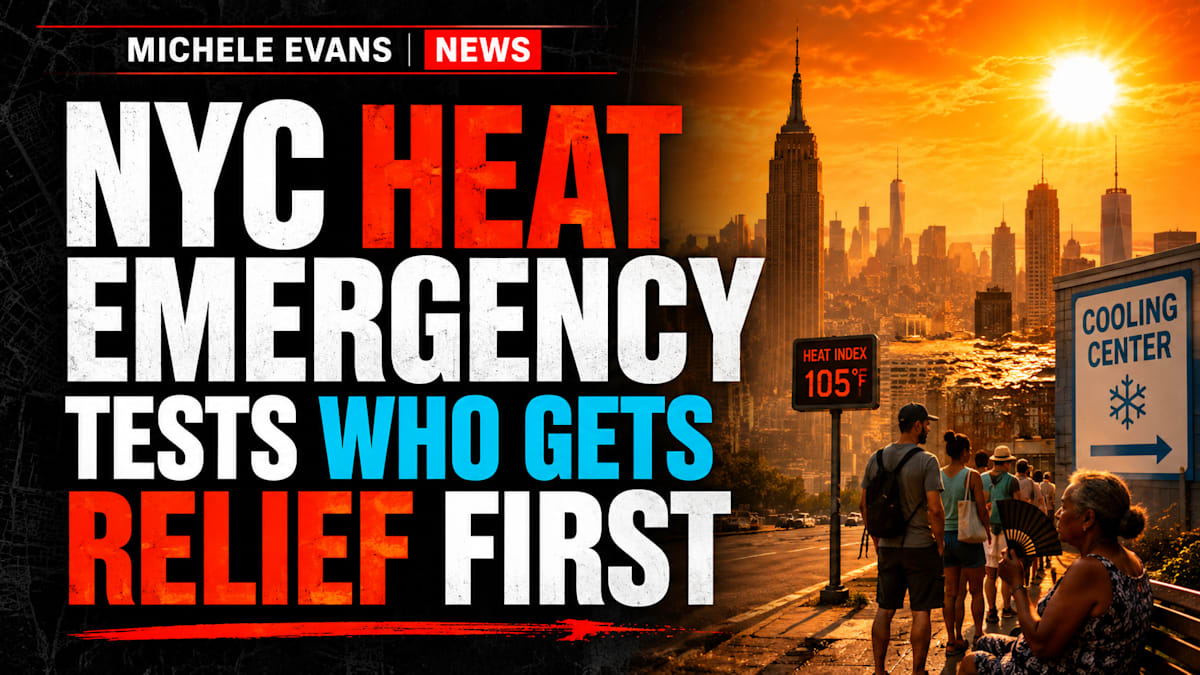
NYC Heat Emergency Tests Who Gets Relief First
By Michele Evans
New York City, New York
7,/2/2026
Category: Public Safety / Heat Emergency / NYC Emergency Management / Civic Life
NEW YORK CITY, NY - New York City is calling this a heat emergency. That sounds clinical until you remember who usually carries the risk.
The city says temperatures may feel as hot as 112 degrees during the historic holiday weekend heat wave, with additional cooling centers, extended pool hours, outreach teams, COOL vans, and wellness checks activated across the five boroughs. Officials are also asking businesses to set thermostats to 78 degrees and urging New Yorkers to conserve energy during peak demand.
This is not just weather. This is public safety.
Heat kills quietly. It does not always look like a dramatic emergency at first. It looks like an older person staying inside a hot apartment because the elevator is broken or the electric bill is too high. It looks like a home health aide trying to get across town. It looks like a delivery worker on a bike, a construction worker on asphalt, a person sleeping outside, a child on a crowded platform, a tenant with no working air conditioner, or a family choosing between cooling and cost.
The city’s expanded response matters. Cooling centers, LinkNYC directions, COOL vans, pop-up worker cooling stations, longer pool hours, and street outreach are real tools. The question is whether those tools reach the people most at risk before the emergency becomes visible.
New York knows how to build plans. What matters in a heat emergency is execution.
Can a person without internet find the nearest cooling center? Can an older adult get there? Are the centers open late enough for people who work during the day? Are unhoused New Yorkers being reached block by block or only in places already easy to see? Are workers being protected by employers before symptoms appear? Are public-health warnings reaching people in the languages they actually use at home?
Those are not soft questions. They are survival questions.
The Fourth of July weekend adds pressure. Crowds, transit delays, road closures, outdoor events, fireworks viewing, emergency response, and power demand all collide with heat. The city says it has deployed more than 600 outreach workers and expanded relief options. That is good. Now New Yorkers need to know where those resources are, how late they are open, and whether anyone is checking on people who cannot reach them.
Extreme heat exposes the city’s hidden infrastructure: apartments without air conditioning, neighborhoods with less shade, workers without control over their schedules, older adults living alone, and people with medical needs who cannot simply “stay cool.”
The strongest heat plan is not the one with the best press release. It is the one that finds the person no one else remembered to check on.
If New York City is going to call this a historic heat emergency, then the test is simple: no one should be left to survive it alone.
*Michele Evans is an independent journalist, author, and former ESPN technical producer whose work has appeared in The New York Times.
Michele got her start in 2001 covering the NBA and NFL.
She now covers New York City courts, criminal-justice procedure, NYPD, FDNY, domestic-violence systems, media accountability, public safety, advocacy efforts, and New York civic life through courthouse observation, public records, legal analysis, and lived-experience reporting.
Read more independent journalism by Michele Evans.
Follow Michele Evans on Facebook and Substack for new reporting, analysis, and updates.