No Privacy at Rikers Is Not an Inconvenience. It Is Abuse
byg9mq4izlmov3ocpri50qrozwsu1.93 MBNo Privacy at Rikers Is Not an Inconvenience. It Is Abuse
By Michele Evans New York City, New York 7/4/2026
Category: Rikers Island / Criminal Justice / Public Interest
BRONX , NY - There is no privacy at Rikers Island.
Not in the dorms. Not in the showers. Not in the bathrooms. Not even in the most basic moments when a human being should be allowed to retain dignity.
The public talks about Rikers in numbers: deaths, assaults, stabbings, missed court dates, federal monitors, closing deadlines. But inside the walls, the cruelty is often quieter and more constant. It lives in the everyday humiliation of being forced to exist with no private space, no personal boundary, and no control over your own body.
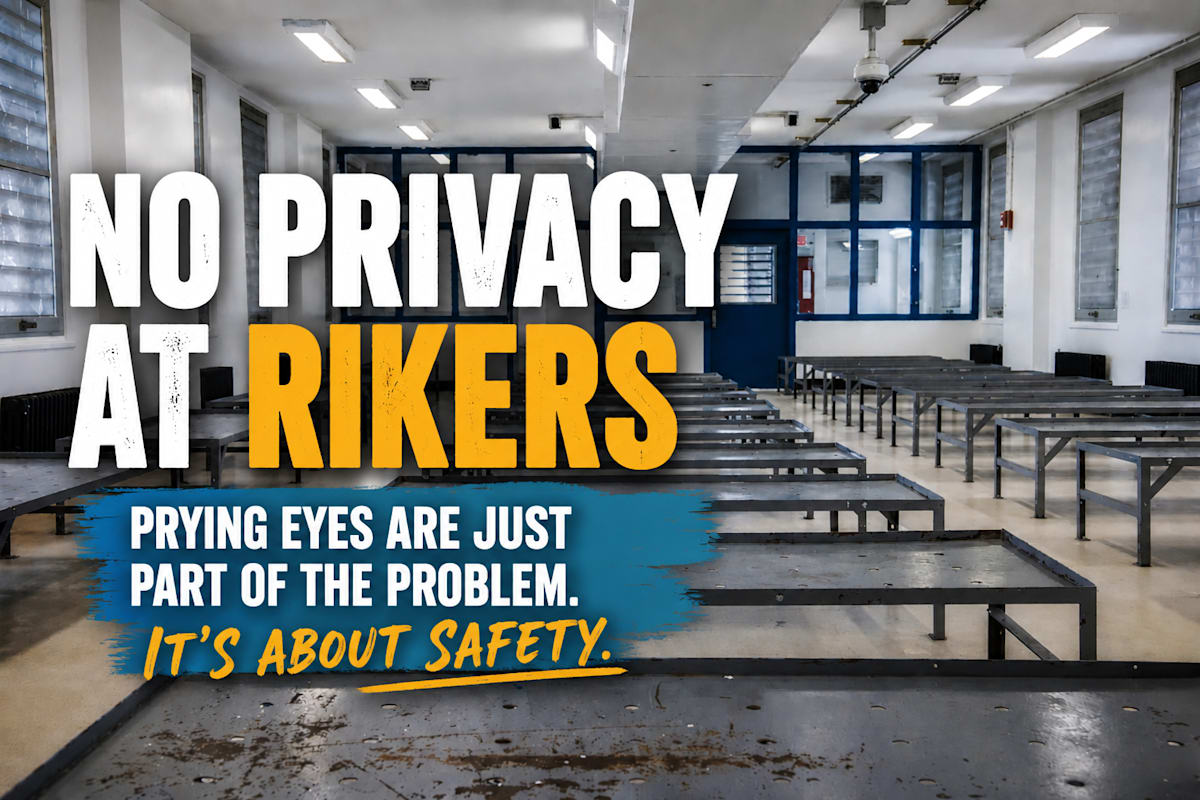
The dorms are open. The beds are lined up in rows. The bathrooms are communal. Shower areas are exposed. Bathroom stalls have no doors. Women are expected to wash, bleed, change, clean themselves, and manage their menstrual cycles in spaces where everyone can see, hear, comment, judge, or attack.
That is not correction. That is degradation.
Women at Rikers have to handle their periods out in the open. They have to dispose of pads and tampons with no dignity. They have to deal with blood on toilet seats, blood in shared spaces, and the constant arguments that follow.
“Who left blood on the toilet seat?”
That kind of fight does not happen because women are careless. It happens because the facility strips away privacy, supplies, sanitation, and basic human respect, then forces people to live inside the consequences.
It is inhumane. It is degrading. It is abusive.
And when COVID hit, the absurdity became even more obvious. Signs went up about social distancing, as if people packed into open dorms with rows of beds and shared bathrooms could somehow protect themselves by reading a poster. Social distancing at Rikers was a joke. The signs were not safety. They were liability management.
You cannot tell people to stay six feet apart while housing them in open dormitories. You cannot preach hygiene while denying privacy and clean, humane bathroom conditions. You cannot claim safety while forcing women to menstruate in public view.
Privacy is not a luxury. It is part of safety.
Without privacy, people are exposed. They are vulnerable to harassment, shame, conflict, sexual humiliation, and violence. A bathroom stall with no door is not just embarrassing. It is dangerous. An open shower is not just uncomfortable. It is a loss of bodily autonomy.
Life in an open dorm means there is almost no opportunity to cool down after a disagreement.
With dozens of women living shoulder to shoulder, sleeping only a few feet apart, even the smallest conflict can escalate because there is nowhere to go, nowhere to be alone, and no personal space to decompress. I once found myself in an argument over something as trivial as milk. Afterward, a captain quietly pulled me aside and warned me to be careful.
Her message was simple: people can come after you while you're sleeping. Think about that. An argument over a carton of milk carried enough weight that a correction captain felt the need to warn me about being attacked in my sleep. That is what happens when human beings are forced to live in overcrowded dorms without privacy, without space, and without any meaningful sense of safety. The constant tension isn't created by the people alone—it's created by the environment they're forced to survive in.
Yes, Rikers Island includes both dormitories and individual cells. However, not every detainee may be housed in a cell. Detainees assigned a white floor card are prohibited from placement in a cell under DOC housing rules, making dormitory housing mandatory for those detainees.
Rikers does not simply detain people. It breaks boundaries on purpose. It normalizes humiliation until the public forgets that the people inside are still human beings.
No one should have to beg for a door.
No one should have to bleed in public.
No one should have to survive jail by surrendering their dignity first.
*Michele Evansis an independent journalist, author, and former ESPN technical producer whose work has appeared in The New York Times.
Michele got her start in 2001 covering the NBA and NFL.
She now covers New York City courts, criminal-justice procedure, NYPD, FDNY, domestic-violence systems, media accountability, public safety, advocacy efforts, and New York civic life through courthouse observation, public records, legal analysis, and lived-experience reporting.