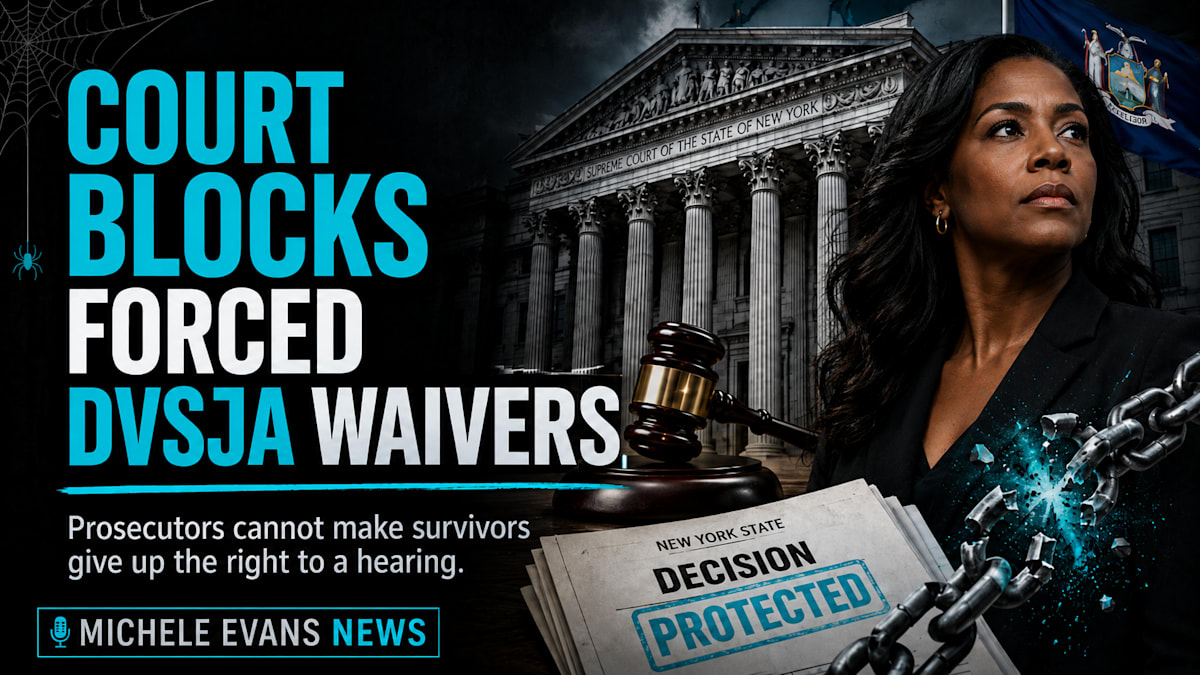
New York’s Top Court Says Prosecutors Cannot Force Survivors to Waive DVSJA Hearings
p23dwpeflu4vmfpiyy9ny8z90csi2.06 MBNew York’s Top Court Says Prosecutors Cannot Force Survivors to Waive DVSJA Hearings
Nicole Hudson’s case exposed a brutal truth: a survivor’s right to be heard should never have been treated like a bargaining chip.
By Michele Evans New York City, New York 6/23/2026
Category: Courts / Criminal Justice / Public Interest
NEW YORK CITY, NY - New York’s highest court has drawn a line prosecutors should never have crossed.
In a landmark ruling for criminalized domestic violence survivors, the New York Court of Appeals held that prosecutors cannot make a survivor waive a Domestic Violence Survivors Justice Act hearing as a condition of a plea agreement.
That may sound procedural. It is not.
It is the difference between a survivor being seen by a judge, and a survivor being pushed through the machinery before her abuse history ever reaches the courtroom in the way the Legislature intended.
It is the difference between a law meant to correct systemic injustice, and a prosecutor using plea leverage to make that law disappear.
The case, captioned People v. N.H. and publicly identified by the Court as People v. Hudson, asked a direct question: can the state offer a plea deal only if a domestic violence survivor gives up the very hearing designed to let a judge consider how abuse shaped her conduct?
The Court of Appeals answered no.
That answer matters because the DVSJA was not passed as a decorative reform. It was passed because New York finally recognized that the criminal legal system has repeatedly punished domestic violence survivors without adequately considering the abuse, coercion, trauma, and survival responses that led them into court in the first place.
A DVSJA hearing is where that history is supposed to be heard.
It is where a judge may consider whether the survivor was subjected to substantial abuse, whether that abuse significantly contributed to the offense, and whether a standard sentence would be unduly harsh. It is where testimony, records, expert evidence, and lived reality can finally enter a process that too often reduces survivors to charges, plea sheets, and sentencing exposure.
That hearing is not a luxury.
It is the doorway into the law.
And Nicole Hudson was told to give it up.
According to the Court of Appeals decision, Hudson sought a reduced sentence under the DVSJA or, at minimum, a hearing to establish her eligibility. The prosecution then offered a plea bargain that required her to waive that hearing. The trial court accepted the waiver. The Appellate Division upheld it.
The Court of Appeals reversed.
In doing so, the Court recognized the central danger: if prosecutors can condition plea offers on giving up DVSJA hearings, then the people with the most power in the case can pressure survivors to surrender the one procedure designed to check that power.
That is not compassion.
That is coercion with paperwork.
I Knew Nicole Hudson Inside the System
I was not watching the DVSJA from a distance. I lived inside the system with the women it was meant to protect.
One of those women was Nicole Hudson.
Nicole and I were incarcerated together during a volatile, historic flashpoint. We were living in the dorms at Rikers Island when Layleen Polanco died in a solitary cell, a tragedy of systemic neglect that exposed the fatal reality of the facility to the world.
Surviving an environment like that binds you to people.
Nicole and I carried that heavy history from the jail cells of New York City to Albion Correctional Facility. We were housed in three separate dorms together across both facilities. We walked the yard together, talking about our cases, our children, our survival, and the impossible machinery we were trapped inside.
Then COVID-19 hit.
Suddenly, survival did not just mean navigating a broken legal system. It meant trying to get out alive before the virus reached us. The facilities became viral traps. We were locked in close quarters with an invisible executioner, fighting to escape the terror before the virus did the sentencing for us.
The system weaponized everything it could to keep people caged.
Nicole’s Assistant District Attorney monitored her facility phone calls, listening to her private conversations and using her own words as ammunition to fight against her release. It was a vicious tactic by the state to maintain control even as a pandemic raged.
But Nicole was relentless.
She fought back. She prevailed against her prosecutor. Ultimately, both of us broke through the machinery and secured our release from that nightmare.
We were both domestic violence survivors with cases that should have been examined through the lens of trauma and abuse.
Instead, we became opposite sides of the same DVSJA betrayal.
Nicole was pressured into giving up her right to a DVSJA hearing entirely. I was pushed through one under circumstances where I was silenced, isolated, and steered through a plea I did not understand.
She was pushed away from the hearing.
I was pushed through one.
Different doors, same cage.
Same system, same refusal to truly center the survivor.
The Law Was Supposed to Make Judges Listen
The Domestic Violence Survivors Justice Act was enacted in 2019 to give judges discretion to impose reduced sentences when domestic violence was a significant contributing factor to a survivor’s criminal conduct and a standard sentence would be unduly harsh.
The law was supposed to create space for context.
That context matters because domestic violence is not always neat. It does not always fit the simple courtroom story prosecutors prefer. Abuse can involve years of threats, violence, strangulation, stalking, coercive control, financial domination, sexual violence, isolation, manipulation, and terror.
By the time a survivor is arrested, the courtroom often sees only one snapshot: the charged act.
The DVSJA was supposed to widen the lens.
But a law cannot protect survivors if prosecutors can force them to sign it away before a judge ever hears the evidence.
That was the danger in Hudson’s case.
A survivor facing serious sentencing exposure may accept almost anything that promises a faster return to her child, her family, or basic safety. That is not abstract. The Court itself noted that Hudson’s acceptance of the plea likely hastened her reunion with her young child.
That is the pressure point.
That is why this ruling matters.
When the state tells a survivor, “Give up your DVSJA hearing or lose your plea deal,” the state is not merely negotiating. It is exploiting the survivor’s fear, exhaustion, family separation, and desperation.
The Court of Appeals has now said that practice cannot stand.
This Ruling Does Not Give Back the Time
This decision is a victory.
It is also not enough.
It does not give Nicole Hudson back the time stolen from her. It does not give her child back the years spent without a mother. It does not erase the fear of being caged during COVID. It does not undo the pressure placed on a survivor who should have had her abuse history heard before sentencing.
The ruling cannot repair every wound.
But it does strip one weapon from the hands of prosecutors who misused plea bargaining against survivors.
No prosecutor should ever again be allowed to say to a domestic violence survivor: give up your right to be heard, or lose your plea deal.
That was never justice.
That was a threat dressed up as an offer.
The Second Half of the Question
Nicole Hudson’s case proved that prosecutors cannot force survivors to waive their DVSJA rights.
My case raises the necessary second half of that question: what happens when a survivor is pushed through that same process without her voice, her witnesses, and her informed consent truly being protected?
That question still matters.
Because survivor justice does not end with access to a hearing. A hearing is only meaningful if the survivor can participate fully, present evidence, call witnesses, understand the plea structure, and have counsel who actually protects the survivor’s rights instead of steering her through a process she cannot meaningfully control.
The DVSJA was meant to correct a systemic failure.
Hudson makes clear that prosecutors cannot bargain the hearing away.
Now courts, defense attorneys, advocates, and reporters have to confront the next problem: whether the hearings themselves are being conducted in a way that truly centers criminalized survivors, or whether the system has simply found new ways to process them while calling it reform.
Nicole Hudson fought one side of that betrayal.
I lived another.
And every survivor who comes after us deserves more than a law on paper.
She deserves to be heard before the system decides what her survival is worth.
*Michele Evansis an independent journalist, author, and former ESPN technical producer whose work has appeared in The New York Times.
Michele got her start in 2001 covering the NBA and NFL.
She now covers New York City courts, criminal-justice procedure, NYPD, FDNY, domestic-violence systems, media accountability, public safety, advocacy efforts, and New York civic life through courthouse observation, public records, legal analysis, and lived-experience reporting.