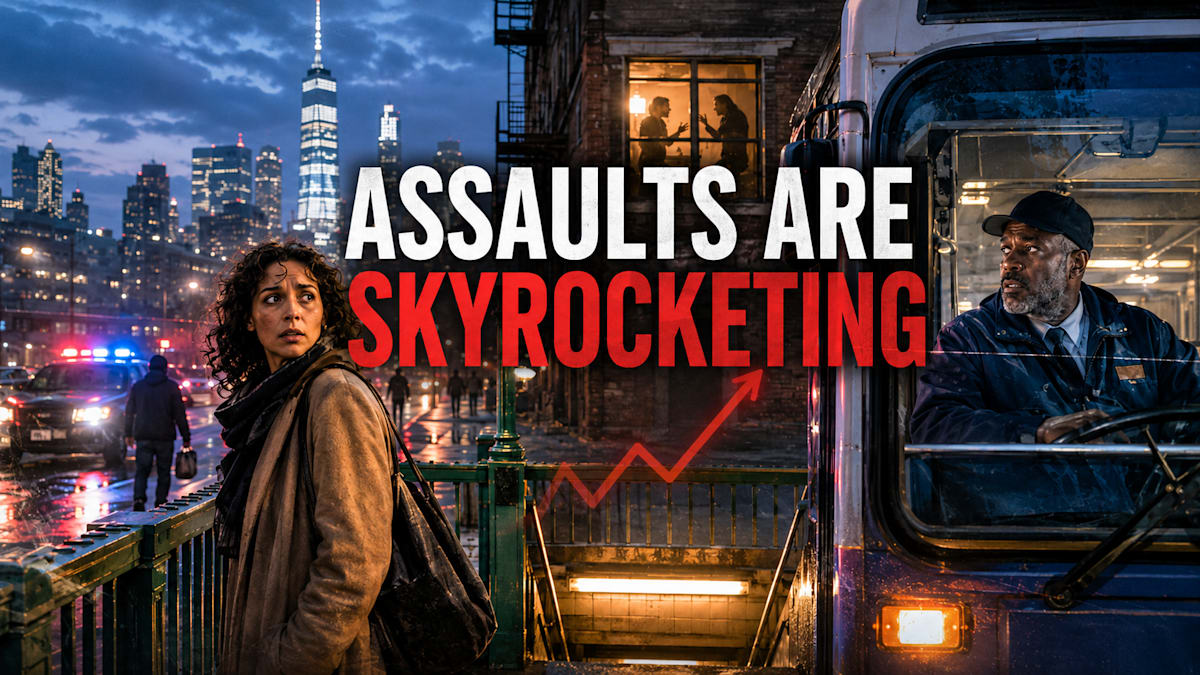
New York’s Assault Problem Is the Warning Sign Behind the Safer-City Headlines
wh52z0lxjct4fxm4b4yco8s562pf2.35 MBNew York’s Assault Problem Is the Warning Sign Behind the Safer-City Headlines
By Michele Evans New York City, New York 5/25/2026
Category: Criminal Justice / NYPD
New York City, New York - Murders and shootings are down, but felony assaults remain stubbornly high. The question is not whether New York looks safer on paper. The question is who is still getting hurt.
New York City officials have had plenty of reasons to celebrate recent public safety numbers. Murders are down. Shootings are down. Gun violence has fallen to record lows. That is real progress.
But it is not the whole story.
A new City Journal piece by Charles Fain Lehman argues that New York has another violent-crime problem hiding underneath the city’s better murder and shooting numbers: assaults. His central point is simple and worth taking seriously. A city can become less deadly while still becoming more physically volatile. Murder may be down, but people are still being punched, beaten, threatened, attacked, and injured in numbers that should make policymakers pause.
That distinction changes the frame because a falling murder rate can create a false sense of closure. It allows officials to say the city is safer while sidestepping the forms of violence that do not always end in death, but still destabilize homes, workplaces, transit systems, shelters, schools, neighborhoods, and courts.
According to the NYPD’s January 2026 year-end announcement, New York City recorded its safest year ever for gun violence in 2025, with the fewest shooting incidents and shooting victims in recorded history. The same announcement said felony assault increased slightly, from 29,684 to 29,792, and identified domestic violence and assaults on public-sector employees as major drivers. Domestic violence incidents accounted for 41 percent of recorded felony assaults, while assaults on public-sector employees increased by roughly 25 percent.
That is the buried story.
When domestic violence accounts for more than two out of every five recorded felony assaults, the city cannot talk honestly about public safety without talking about survivor safety. It cannot reduce violence simply by celebrating fewer shootings. It also has to ask why people remain unsafe inside their homes, why victims struggle to access shelter, why systems fail before the first serious injury becomes the final headline, and why intervention often arrives only after harm has already escalated.
This is where the public-safety conversation usually narrows too quickly. Crime is treated as something that happens on the subway platform, on the street corner, or in front of a police camera. But some of the city’s most dangerous violence happens behind apartment doors, inside relationships, and in the gap between a victim asking for help and the system deciding whether that help is available.
That is not soft-on-crime framing. It is more precise framing.
If domestic violence is helping drive felony assault numbers, then shelter policy is public safety policy. Hotline access is public safety policy. Family court access is public safety policy. Police response training is public safety policy. Prosecutorial charging decisions are public safety policy. Housing is public safety policy.
The city cannot arrest its way out of domestic violence while refusing to fully fund the escape routes that help victims leave before violence escalates.
The same is true for assaults on public workers. City Journal notes that assaults on public workers, including police officers, accounted for about 10 percent of incidents last year, citing Vital City. These are not abstract numbers. They involve the people who keep the city moving: bus drivers, transit workers, hospital staff, school personnel, sanitation workers, shelter staff, police officers, and other public-facing employees who absorb the city’s social breakdown in real time.
When a bus driver is attacked, that is not only an individual crime. It is a signal about the condition of public space. When a domestic violence survivor is assaulted again after trying to seek help, that is not only a private tragedy. It is a warning about the weakness of the safety net. When a person is punched on a subway platform after an ordinary encounter turns violent, that is not only a tabloid story. It is a sign that casual aggression has become too easy.
The danger in leaning too hard on murder statistics is that murder is the final stage of violence, not the beginning. A city that waits until violence becomes fatal has already failed too many people.
That is why assault deserves its own public conversation. Not as a scare tactic. Not as a political weapon. Not as a lazy “New York is out of control” headline. But as a more honest measure of whether people feel safe enough to live ordinary lives without being hit, grabbed, stalked, threatened, shoved, followed, or trapped.
The Brennan Center has also noted that, while murders, shootings, and transit crime have dropped sharply since pandemic-era peaks, persistent challenges remain. Its 2025 analysis pointed to felony assault as a category requiring continued attention, including the role of domestic violence. Vital City likewise emphasized that, beyond murders and shootings, many crime categories remain above pre-pandemic levels, especially assaults.
So the question is not whether New York City has made progress. It has.
The question is whether officials are willing to look beyond the numbers that make the cleanest press releases.
Public safety cannot be measured only by how many people were not murdered. It also has to be measured by how many people were injured, how many victims were ignored before injury became inevitable, how many workers were left exposed, how many survivors were told to call back later, how many cases were downgraded, how many warnings were missed, and how many people learned that the city’s protection depends on where they are standing when violence happens.
New York’s current crime story is complicated. That is exactly why it deserves better than slogans.
Murders are down. Shootings are down. That is good news.
But assault numbers show a city still struggling with everyday violence: violence in homes, violence against workers, violence in public spaces, violence that may not always make the front page unless someone dies.
That is where the public-interest question begins.
Not whether New York can claim a safer year.
Whether New York can build a safer city for the people still getting hurt.
*Michele Evansis an independent journalist, author, and former ESPN technical producer whose work has appeared in The New York Times.
Michele got her start in 2001 covering the NBA and NFL.
She now covers New York City courts, criminal-justice procedure, NYPD, FDNY, domestic-violence systems, media accountability, public safety, advocacy efforts, and New York civic life through courthouse observation, public records, legal analysis, and lived-experience reporting.