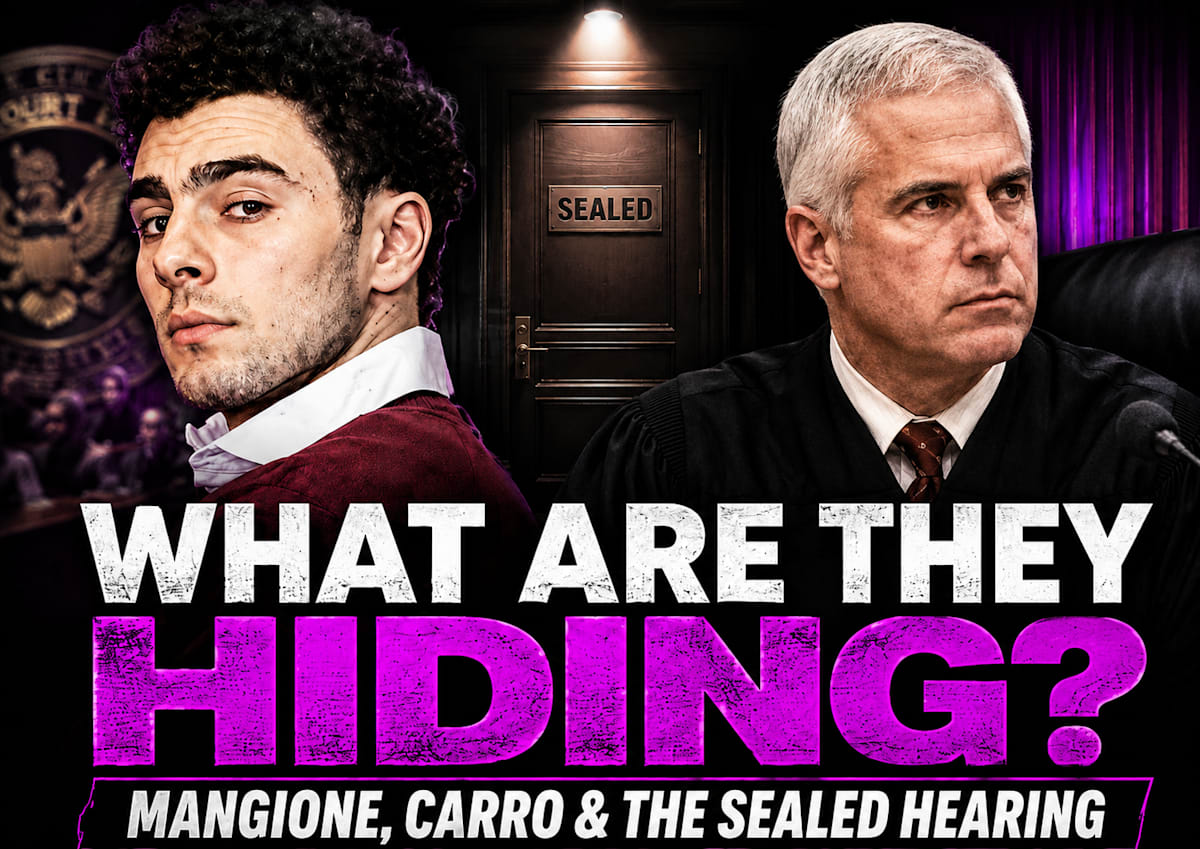
Mystery Sealed Hearing in the Luigi Mangione Case Is Exactly Why New York Courts Need More Sunlight
bb0yjy87p1t0ua9uvuci8lqbwehc2.32 MBMystery Sealed Hearing in the Luigi Mangione Case Is Exactly Why New York Courts Need More Sunlight
By Michele Evans New York City, New York 6/3/2026
Category: Courts / Criminal Justice / Advocacy
New York City, New York - Just when New York thought the Luigi Mangione case could not get any more charged, the courthouse door closed.
According to the New York Daily News, Judge Gregory Carro held a mystery sealed hearing in the state murder case against Luigi Mangione, the man accused of killing UnitedHealthcare CEO Brian Thompson outside a Manhattan hotel in December 2024.
That phrase alone should stop people cold: mystery sealed hearing.
Not because every sealed proceeding is improper. Courts do sometimes seal matters for legitimate reasons: witness safety, protected evidence, security concerns, sensitive legal issues, or information that could prejudice a jury pool.
But in a case already carrying national attention, political pressure, class rage, health care fury, public fascination, and dueling state and federal prosecutions, secrecy cannot just be brushed off as courthouse housekeeping.
This is not a quiet calendar call.
This is one of the most watched criminal cases in America.
And when a judge closes the door in a case like this, the public is allowed to ask why.
Carro Knows How to Control a Room
I have been around Justice Gregory Carro for four years. I have watched his patterns. I have watched the way he manages a courtroom, controls tempo, narrows the frame, and decides when the public gets a view and when the machinery of the court moves behind institutional walls.
That does not mean I know what happened inside this sealed hearing. I do not.
That is exactly the problem.
The public does not know either.
And in a case this important, that absence becomes part of the story.
Carro is not some background judge who stumbled into a headline. He has presided over serious, high-profile criminal matters. He knows the weight of a courtroom. He knows the optics. He knows what happens when a case becomes bigger than the indictment.
That is why this sealed hearing deserves scrutiny.
Because when a judge with that much power, in a case with this much public attention, holds a closed proceeding without the public understanding the reason, it raises a basic civic question:
What part of this case is the public not being allowed to see?
Mangione’s Case Is Already a Fight Over What the Jury Gets to Know
This case has already been shaped by battles over evidence, search and seizure, statements to police, writings, backpack searches, and whether certain items will ever reach a jury.
Carro recently issued a split ruling. He suppressed some items taken from Mangione’s backpack during the initial search at the McDonald’s in Altoona, Pennsylvania, while allowing prosecutors to use evidence recovered later during an inventory search at the police station, including the alleged gun and notebook.
That ruling alone shows how much of this case turns on procedure.
Not just what happened.
Not just what prosecutors say happened.
Not just what the public thinks happened.
But what the court allows the jury to see.
That is why a sealed hearing is not a side issue. In a case built around suppression fights, admissibility, statements, evidence, and competing prosecutions, closed-door proceedings can shape the trial long before opening statements ever begin.
A case can be won or lost in moments the public never hears.
The Public Has a Right to Watch Power Move
The justice system loves to tell the public to trust the process.
But trust is not the same thing as silence.
Trust is built when the public can see the process, question the process, and understand why decisions are being made.
This is especially true in a case where the defendant has become a symbol far beyond the courtroom. To some, Mangione is the accused killer of a husband, father, and CEO. To others, he has become a dark vessel for public anger at the health insurance industry. To prosecutors, he is a murder defendant. To the defense, he is a man facing overlapping state and federal prosecutions that raise constitutional questions.
Those competing realities do not cancel each other out.
They make transparency more important.
When the court seals a proceeding in that kind of atmosphere, the public should not be left with a shrug.
Was the hearing about evidence?
Witnesses?
Security?
Jury contamination?
Federal-state coordination?
Protected filings?
Something related to Mangione’s conditions of confinement?
Something prosecutors do not want exposed yet?
Something the defense argued must stay out of public view?
We do not know.
And when the answer is, “We do not know,” journalism has a job to do.
This Is Bigger Than Luigi Mangione
The Mangione case is not only about one defendant or one victim. It is about how New York handles a criminal case when the whole country is watching.
It is about whether courts become more transparent under pressure or more closed.
It is about whether high-profile defendants get a process the public can inspect or a process the public is asked to accept on faith.
It is about whether judges explain their use of secrecy with enough clarity to preserve confidence in the proceeding.
And for me, this is personal in another way.
I have been inside New York’s criminal court system. I have sat in rooms where decisions were made with a speed and certainty that outsiders rarely understand. I have watched how much power one judge can hold over the direction of a case, the emotional temperature of a room, and the record the public eventually gets to read.
So when I see a mystery sealed hearing in front of Justice Carro, I do not see a small procedural footnote.
I see a pressure point.
I see a judge who knows exactly how to manage the public-facing and hidden parts of a case.
I see a proceeding where the public deserves more than a locked door and a headline.
Secrecy May Be Legal. That Does Not Make It Above Scrutiny.
To be clear: a sealed hearing can be lawful. There may be a legitimate basis. There may be sensitive material that cannot be aired publicly without harming the fairness of the trial.
But lawful secrecy is still secrecy.
And secrecy in a criminal case should always be narrow, justified, and treated as an exception, not a habit.
Especially here.
Mangione has pleaded not guilty. He is presumed innocent. Brian Thompson is dead. His family deserves a serious prosecution. The public deserves a fair process. The defense deserves constitutional protections. The jury deserves an untainted record. And New Yorkers deserve a court system that does not hide more than it must.
That is the balance.
That is the test.
And that is why this sealed hearing deserves attention.
Because in a case this visible, the hidden parts of the record may become as important as the public ones.
Justice cannot just happen inside the room.
The public has to be able to see enough of it to know whether justice is actually being done.
*Michele Evansis an independent journalist, author, and former ESPN technical producer whose work has appeared in The New York Times.
Michele got her start in 2001 covering the NBA and NFL.
She now covers New York City courts, criminal-justice procedure, NYPD, FDNY, domestic-violence systems, media accountability, public safety, advocacy efforts, and New York civic life through courthouse observation, public records, legal analysis, and lived-experience reporting.