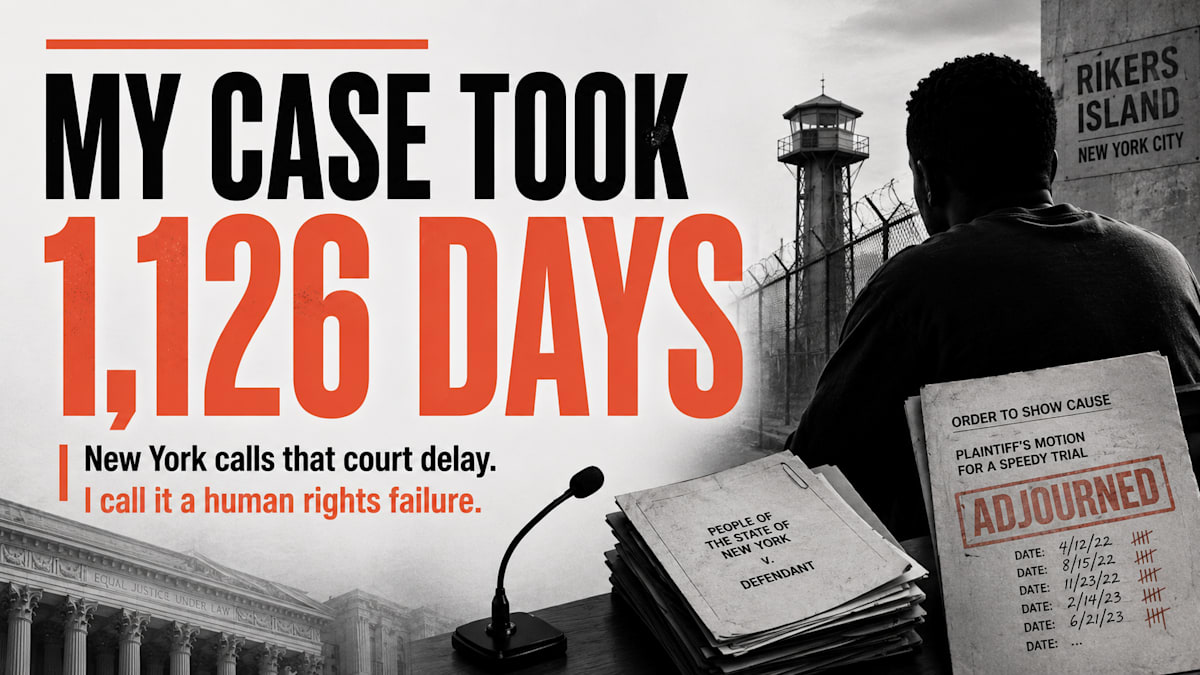
My Case Took 1,126 Days. New York Calls That Court Delay. I Call It a Human Rights Failure.
qwed80cnge0tbn91k3n759bpxym82.07 MBMy Case Took 1,126 Days. New York Calls That Court Delay. I Call It a Human Rights Failure.
By Michele Evans New York City, New York 6/26/2026
Category: Courts / Criminal Justice / NYPD / Rikers Island
NEW YORK CITY, NY - My case took 1,126 days to resolve.
That is not an administrative backlog. That is a human rights failure.
When I testified before the New York City Council about court delays, discovery access, Rikers Island, and the human cost of pretrial detention, what I said in person was only the tip of the iceberg. There is only so much a person can fit into a few minutes at a public hearing.
But the reality is much bigger than a soundbite.
I am an independent journalist, author of Rikers Island: Criminalized Survivor, a domestic violence survivor sentenced under the Domestic Violence Survivors Justice Act, and a formerly incarcerated woman who survived Rikers Island and New York State custody.
I am also a former software engineer with approximately 20 years of experience working on high-profile, large-scale systems across media, sports, healthcare, telecommunications, and enterprise technology.
So when government officials blame discovery delays, court delays, data-sharing failures, and technology breakdowns on “vendors,” I know exactly what I am hearing.
I am hearing excuses.
At the hearing, court and discovery delays were repeatedly attributed to vendor problems, vendor capacity, or outside technology limitations. As someone who spent two decades building and supporting large systems where failure was not an option, I do not find that acceptable.
Not when liberty is at stake.
If a vendor cannot reliably support criminal court infrastructure, discovery exchange, electronic filing, or data-sharing systems, then the government has a duty to fix the architecture, replace the vendor, build internal capacity, and protect the people harmed by those failures.
Court delay caused by bad technology is still court delay.
Discovery delay caused by bad technology is still discovery delay.
A defendant should not lose months or years of their life because agencies outsourced responsibility and then pointed at the vendor when the system failed.
EDDS Should Not Accept Filings Criminal Court Does Not Honor
One current example is EDDS.
The Supreme Court Criminal Term does not accept EDDS filings, even though the system accepts the filing, sends a confirmation, and identifies the filing as a Supreme Court Criminal filing.
That creates confusion and prejudice. A person can believe they successfully submitted a filing, receive confirmation, and then later learn the office does not use or honor that system.
That is unacceptable.
If the system accepts the filing and sends confirmation, the court should honor it. If the court does not accept EDDS filings, the system should not accept them, should not issue misleading confirmations, and should not create the false appearance of a completed filing.
This is not complicated.
Criminal Court must either honor electronic filing systems or stop misleading the public into believing those systems are functional.
It is 2026. There is no excuse for this level of technology failure in the criminal legal system.
And no, this is not rocket science.
New York City has software engineers, systems engineers, database engineers, cybersecurity professionals, and technology workers capable of building and maintaining reliable in-house systems. If the current systems are failing, the city and state should hire the people necessary to fix them.
Technology failures are not minor administrative problems. In criminal court, they can mean missed filings, delayed discovery, missed motions, prolonged detention, wrongful pleas, and years of harm.
Discovery Reform Means Nothing If Defendants Cannot Review Discovery
Discovery access was also central to my testimony because I lived what happens when discovery reform exists on paper but fails in reality.
In my own case, I was denied access to a laptop to review discovery while incarcerated.
That should never happen.
Discovery is not meaningful if the defendant cannot actually review it. A person cannot assist counsel, evaluate evidence, identify errors, or make informed legal decisions without real access to the material being used against them.
Discovery access must include practical technology access.
Incarcerated defendants should have reliable access to laptops, digital discovery review tools, and the ability to meaningfully review the evidence in their own cases.
Anything less turns discovery reform into a promise on paper instead of a functioning right.
I Was at Rikers When Reform Was Passed. We Had Hope.
I was incarcerated at Rikers Island when many of the reforms now described as implemented, but still not working as promised, were passed or coming into effect.
DVSJA.
Bail reform.
Discovery reform.
Women inside Rikers talked about those reforms with real hope. We believed the system might finally be changing.
But that hope turned into despair.
Because reforms on paper do not mean much when people are still sitting in cages waiting for the system to function.
In my own case, I was not released because the system worked.
I was bailed out of the Rose M. Singer Center in June 2020, shortly after COVID hit, because an outside organization stepped up and posted $30,000 cash bail for me.
If that organization had not trusted me to return to court, I would have remained on Rikers Island from January 2019 until February 2022.
That is not justice.
That is luck.
I was fortunate someone believed I would show up. Many people do not have that. Many people are left sitting on Rikers not because they have been convicted, not because they are a danger, and not because there is no alternative, but because no one with resources steps forward at the right moment.
I Had an ATI Program Ready. The Court Still Said No.
Before I was bailed out, I requested release to a program that had already accepted me.
That program was a recognized Alternative to Incarceration.
My request was supported by the Women’s Prison Association and other advocates. There was literally a line of women at my defense table advocating for my release.
The judge denied it.
Instead of recognizing the clear community support, the existence of an accepted ATI placement, and my status as a domestic violence survivor, the judge admonished me in open court and said words to the effect of: “That man right there is listening to every word you say and will use it against you.”
The comment was inappropriate and unnecessary. It came across as belittling to the women standing with me by identifying the ADA as “that man,” as though the presence of a male prosecutor should intimidate or silence us.
I was a domestic violence survivor.
The judge knew that.
The court knew that.
There was no legitimate reason I should not have been released to the program. I had been accepted. Advocates were present. The Women’s Prison Association supported my release. The court was aware of my domestic violence history.
Yet I was kept incarcerated.
That was unconscionable.
And it did not end there.
Despite my history as a domestic violence survivor, despite the facts that eventually supported sentencing relief under the Domestic Violence Survivors Justice Act, an ATI was not offered or meaningfully pursued at sentencing either.
By the time I was sentenced, the court was aware of my domestic violence history. Yet incarceration remained the outcome instead of treatment, stabilization, or community-based support.
That failure changed the course of my life.
Plea Pressure Is Coercive Control
My case languished from January 2019 into 2020 while I was held pretrial.
During that time, the pressure to plead was enormous.
New York uses coercive control against defendants by stacking absurdly lengthy minimums and maximums against them, then using the threat of decades in prison to force pleas.
This pressure does not only impact guilty people.
It pressures innocent people, overcharged people, mentally exhausted people, traumatized people, and people desperate to escape Rikers Island.
When almost nobody goes to trial, that is not proof the system is working.
It is proof the plea system has become the system.
The combination of long pretrial delays, Rikers conditions, denied discovery access, poor communication, technology failures, ineffective counsel, and extreme sentencing exposure creates a coercive environment where pleas are often not truly voluntary.
They are survival decisions.
Reform Is Not Real If People Are Still Trapped
My case illustrates why reforms on paper are not enough.
Bail reform, discovery reform, DVSJA, and ATI expansion cannot be treated as symbolic victories while judges, prosecutors, defense counsel, and court systems continue operating in ways that defeat the purpose of those reforms.
A reform is not real if the person it was designed to help is still left sitting in a cage.
A reform is not real if a domestic violence survivor with an accepted ATI placement is denied release.
A reform is not real if discovery exists on paper but the defendant cannot access the digital evidence.
A reform is not real if EDDS accepts a filing and sends confirmation, but the criminal court does not honor it.
A reform is not real if people are still forced to plead guilty because the alternative is remaining at Rikers for months or years while their case slowly moves.
I lived the gap between reform language and courtroom reality.
That gap destroys people.
Kalief Browder Cannot Be Treated Like History
I also appreciated that the City Council hearing began with the story of Kalief Browder.
I recently met Kalief Browder’s brother at Tribeca, and I appreciated that Council recognized the tragedy of Kalief’s story.
But Kalief’s story cannot be treated as history while the same conditions continue to exist.
People are still sitting at Rikers pretrial.
People are still being damaged by delay.
People are still being pressured into pleas.
People are still being held in conditions that damage the body, mind, and spirit.
I was also at Rikers Island when Layleen Polanco died in solitary confinement.
Her death shook the women’s facility. People were grieving, scared, and furious. We were told change would come. We were told things would be fixed.
They have not been fixed.
People are still dying.
Deaths in custody are unacceptable. Solitary confinement is unacceptable. Delays that keep people trapped in those conditions are unacceptable.
The Council Must Act
I submitted supplemental written testimony because this cannot be reduced to a few minutes at a microphone.
The City Council should act with urgency.
Council should require clear, reliable, mandatory electronic filing access in criminal cases, including Supreme Court Criminal Term.
It should prohibit court technology systems from accepting filings and sending confirmations where the court does not actually honor those filings.
It should investigate and publicly report how vendor failures have contributed to discovery delays, court delays, electronic filing failures, and data-sharing problems.
It should invest in in-house public technology infrastructure instead of continuing to blame outside vendors.
It should guarantee incarcerated defendants meaningful access to digital discovery, including laptops and secure review systems.
It should require courts to document when defendants are brought to court but denied entry into proceedings.
It should expand and fund Alternatives to Incarceration.
It should pass the Treatment Not Jail Act.
It should address coercive plea practices driven by excessive sentencing exposure and prolonged pretrial detention.
It should require courts and defense counsel to document whether ATI was considered at both pretrial release hearings and sentencing, especially in cases involving domestic violence survivors, mental health, trauma, disability, or other treatment needs.
And it should treat deaths, solitary confinement, medical neglect, and preventable harm in custody as urgent government failures, not isolated incidents.
New York cannot continue to call itself a leader while operating criminal courts with outdated technology, inaccessible discovery, coercive plea pressure, and jail conditions that have already taken too many lives.
Nothing about this is inevitable.
It can be fixed.
It should have been fixed already.
And the people most harmed by these failures should not have to keep paying the price while government agencies blame vendors, paperwork, staffing, or bureaucracy.
*Michele Evansis an independent journalist, author, and former ESPN technical producer whose work has appeared in The New York Times.
Michele got her start in 2001 covering the NBA and NFL.
She now covers New York City courts, criminal-justice procedure, NYPD, FDNY, domestic-violence systems, media accountability, public safety, advocacy efforts, and New York civic life through courthouse observation, public records, legal analysis, and lived-experience reporting.