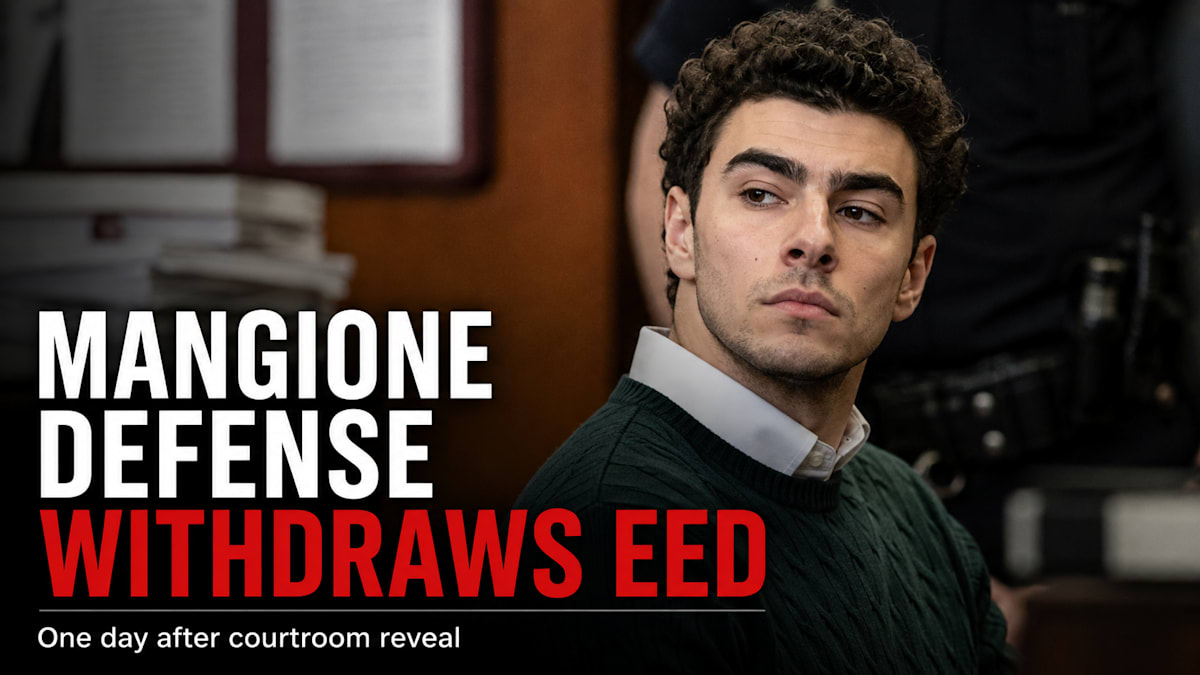
Mangione Defense Abruptly Withdraws EED Strategy One Day After Courtroom Reveal
5tw020d36it3ezrykn41b8gm9dhn1.74 MBMangione Defense Abruptly Withdraws EED Strategy One Day After Courtroom Reveal
A psychiatric-defense notice became the headline on Wednesday. By Thursday, it was gone.
By Michele Evans New York City, New York 6/18/2026
Category: Courts / Criminal Justice / Advocacy
New York City, New York - One day after Luigi Mangione’s defense team appeared to open the door to an Extreme Emotional Disturbance defense in Manhattan Supreme Court, the strategy abruptly vanished from the case docket.
In a brief filing Thursday, the defense withdrew its CPL § 250.10 psychiatric-defense notice “at this time,” reversing course less than 24 hours after Wednesday’s hearing before Judge Gregory Carro. The move instantly turned yesterday’s courtroom headline into today’s legal whiplash.
Mangione, accused in the killing of UnitedHealthcare CEO Brian Thompson, has pleaded not guilty in both his state and federal cases. His New York state trial is currently scheduled for September 8, with a separate federal trial expected to follow in October.
The withdrawal matters because EED is not an insanity defense. It does not argue that a defendant was unable to understand right from wrong. In New York homicide law, Extreme Emotional Disturbance is an affirmative defense that can reduce murder to manslaughter if a jury finds the defendant acted under an overwhelming emotional disturbance for which there was a reasonable explanation or excuse.
In plain English: it is not a “not guilty” defense. It is a mitigation defense.
That made Wednesday’s courtroom development significant. If pursued, EED would have shifted the case away from a pure guilt-or-innocence posture and toward a battle over mental state, emotional collapse, motive, and whether the charged conduct, if proven, fit murder or manslaughter.
By Thursday, that lane was closed, at least for now.
The phrase “at this time” is doing work. It leaves some ambiguity. The defense did not issue a public explanation laying out whether EED is permanently abandoned, strategically paused, or being reshaped into something that does not rely on defense psychiatric evidence.
But the timing is impossible to ignore.
The withdrawal came after Judge Carro had addressed the psychiatric-defense issue in open court and after sealed material connected to the defense strategy became a point of dispute. According to current reporting, Carro rescinded an order to unseal a prior hearing transcript, though some information had already reached the media.
That sequence creates the obvious question: did the defense retreat from EED because the strategy was exposed too soon, because the cost of psychiatric discovery became too high, or because the team decided the defense was more dangerous than useful?
CPL § 250.10 is the procedural rule at the center of the issue. It requires notice when a defendant intends to offer psychiatric evidence connected to defenses such as lack of criminal responsibility or Extreme Emotional Disturbance. Once that door opens, the prosecution may seek its own examination and supporting material. That can turn a defense theory into a discovery fight.
For a defendant facing both state and federal prosecution, that risk is amplified. A psychiatric strategy in one courtroom can create consequences in another, especially when the federal case does not necessarily provide the same legal pathway for EED-style mitigation.
That may explain why the defense pulled back so quickly.
It also does not necessarily mean the concept of emotional disturbance is dead forever. New York case law recognizes a narrow distinction between offering psychiatric evidence and asking for an EED charge based on evidence already introduced at trial. In other words, a defendant may sometimes argue for an EED instruction without presenting their own psychiatric expert or mental-health records, depending on what evidence comes in through the prosecution’s case.
That is a much thinner path. But it is a path.
For now, however, the defense has withdrawn the formal psychiatric notice. That means no full-blown EED psychiatric presentation is currently on the table.
The practical result is that Mangione’s trial posture shifts again. Instead of a clear mitigation strategy, the defense may focus more heavily on attacking the prosecution’s proof, challenging searches and evidence, fighting the terrorism framing, disputing intent, or managing the collision between the state and federal cases.
Wednesday’s hearing already had the feel of a case being shaped in real time. There was the discussion of psychiatric evaluation, the Rikers-to-Bellevue route, the discovery disputes, and the sense that every procedural move was being made under a microscope.
Thursday confirmed it.
This case is no longer just about what the prosecution says happened. It is also about what the defense can afford to reveal, what it must keep sealed, and how much legal strategy can survive once it becomes public.
Yesterday, EED was the headline.
Today, the withdrawal is the story.
And in a case where every filing becomes national news, that reversal may say as much as the defense itself.
*Michele Evansis an independent journalist, author, and former ESPN technical producer whose work has appeared in The New York Times.
Michele got her start in 2001 covering the NBA and NFL.
She now covers New York City courts, criminal-justice procedure, NYPD, FDNY, domestic-violence systems, media accountability, public safety, advocacy efforts, and New York civic life through courthouse observation, public records, legal analysis, and lived-experience reporting.