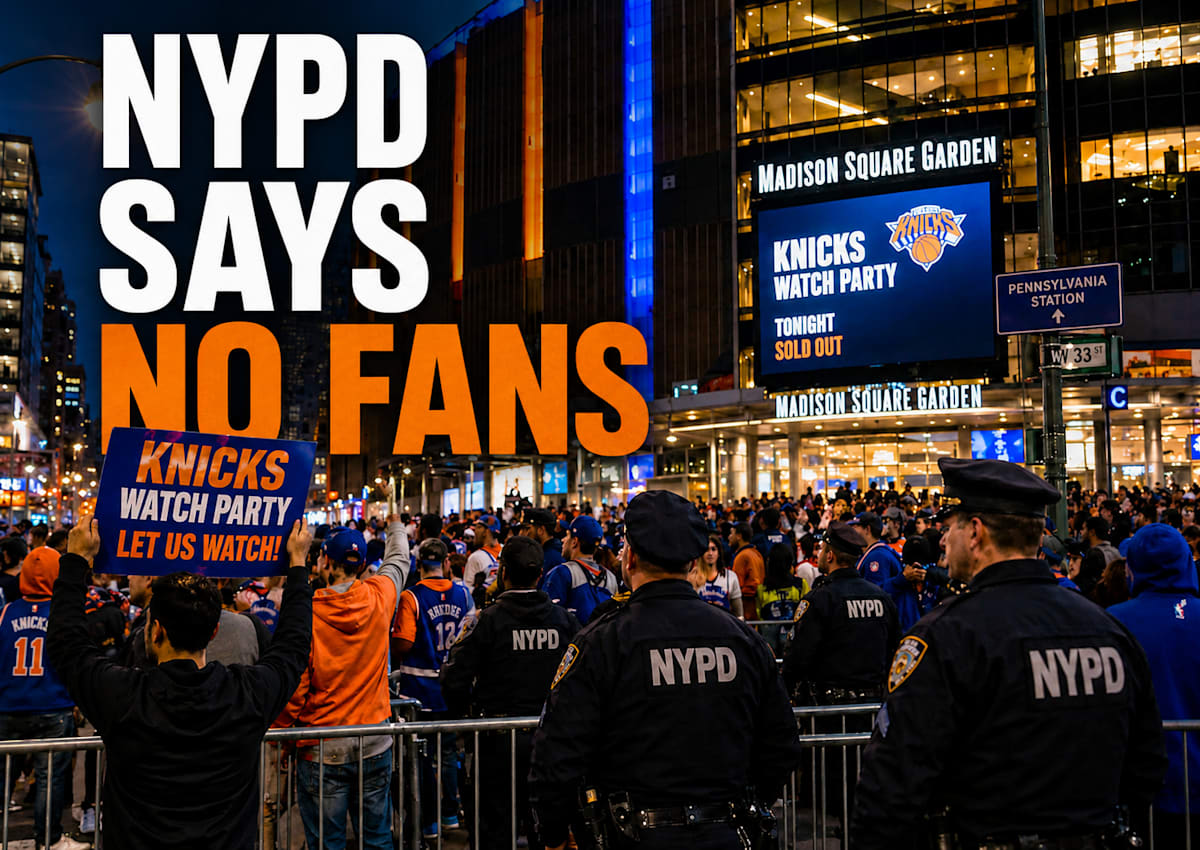
Knicks Fever Meets Crowd Control: NYPD Shuts Down MSG Watch Parties Outside the Garden
z9adgvhzsjse1g8cwm5fp3hw1b9f2.13 MBKnicks Fever Meets Crowd Control: NYPD Shuts Down MSG Watch Parties Outside the Garden
By Michele Evans New York City, New York 5/24/2026
Category: NYPD/ Public Interest/ Sports
New York City, New York - The Knicks are winning, New York is buzzing, and Madison Square Garden has once again become the center of the city’s emotional weather system.
But outside the Garden, the celebration has now run into a familiar New York problem: what happens when public joy gets too big for the sidewalk?
According to the New York Daily News, the NYPD denied permits for Madison Square Garden Knicks watch parties after police described the crowds outside the arena as “huge” and “very rough.” The reported concerns included unruly behavior, public drinking, crowd-control problems, and safety risks around one of the busiest transit and entertainment corridors in the city.
That is the immediate story.
The larger one is more complicated.
Madison Square Garden is not just a sports arena. It sits on top of Penn Station, surrounded by commuter traffic, subway entrances, tourists, office workers, police, street vendors, ticket holders, pedestrians, and the permanent congestion of Midtown Manhattan. It is one of the few places in New York where a basketball game can spill instantly into a transportation issue, a public safety issue, and a civic identity issue.
Knicks fans are not simply watching basketball right now. They are experiencing something New York has waited years to feel again: a team that feels alive, dangerous, relevant, and capable of pulling the whole city into its orbit.
That kind of playoff run changes the temperature of a city. It gives strangers something to shout about together. It gives the subway a soundtrack. It turns orange and blue into a temporary civic uniform.
But the NYPD’s decision shows the tension between celebration and control.
Public watch parties can be a gift to a city. They allow fans who cannot afford playoff tickets to participate in the moment. They turn sports into shared civic life instead of a private luxury product. In a city where tickets to major events are often priced far beyond ordinary working people, outdoor gatherings can become the people’s version of Madison Square Garden.
That is the pressure point: the Knicks are not just playing inside the Garden. Their success belongs emotionally to the whole city.
Still, police and city officials have to manage the reality on the ground. A crowd of thousands outside one of the busiest transit hubs in America is not the same as a crowd inside a controlled arena. Glass bottles, blocked streets, subway entrances, fights, and street drinking create real risks. One bad surge near a subway entrance or traffic lane can turn celebration into injury fast.
The question is whether cancellation is the only answer.
New York knows how to manage major crowds. It manages parades, protests, marathons, New Year’s Eve in Times Square, championship celebrations, concerts, and rallies. The city has experience building temporary public spaces with barricades, sanitation, medical access, traffic plans, alcohol restrictions, exit routes, and police presence.
So the harder question is not whether the NYPD had legitimate safety concerns. Based on the reported crowd conditions, it did.
The harder question is whether New York should be better at building safe public celebration zones before the city’s excitement gets pushed into unmanaged streets.
If thousands of fans are going to gather anyway, the choice may not be between a watch party and no watch party. The real choice may be between a planned gathering and an improvised one.
That is especially true around Madison Square Garden, where crowd pressure is predictable. When the Knicks are this good, people will come. They will gather whether the city invites them or not. They will gather because sports are one of the last forms of mass public emotion New Yorkers are still allowed to share without explanation.
The NYPD’s move may prevent dangerous overcrowding outside MSG in the short term. But it also exposes a civic gap.
New York has no shortage of police presence. It has no shortage of barricades. It has no shortage of corporate venues. What it often lacks is a humane middle ground between private entertainment and public disorder.
A city that can host global events should be able to create safer ways for ordinary fans to watch their team together.
That does not mean ignoring bad behavior. Fans throwing bottles, blocking traffic, fighting, or climbing onto subway entrances are not just “celebrating.” They are creating danger for everyone around them. Public joy does not excuse public recklessness.
But public recklessness also should not erase the legitimate desire for public celebration.
The Knicks are giving New York something rare: a reason to gather with hope. The city’s job is to make that gathering safer, not smaller.
Madison Square Garden may be called “the world’s most famous arena,” but when the Knicks are winning, the arena is never just the building. It is Seventh Avenue. It is Penn Station. It is the bar down the block. It is the person in a Brunson jersey yelling across the platform. It is the city remembering that it still knows how to feel something together.
The NYPD may have shut down the watch parties outside MSG.
But Knicks fever is not going to stay indoors.
And that is where the public-interest question begins: when a city’s joy becomes too large for the sidewalk, does New York suppress it, or does it learn how to hold it?
*Michele Evansis an independent journalist, author, and former ESPN technical producer whose work has appeared in The New York Times.
Michele got her start in 2001 covering the NBA and NFL.
She now covers New York City courts, criminal-justice procedure, NYPD, FDNY, domestic-violence systems, media accountability, public safety, advocacy efforts, and New York civic life through courthouse observation, public records, legal analysis, and lived-experience reporting.