Judge Carro Was My Judge Too. That Is Why I Am Watching the Mangione Trial Closely.
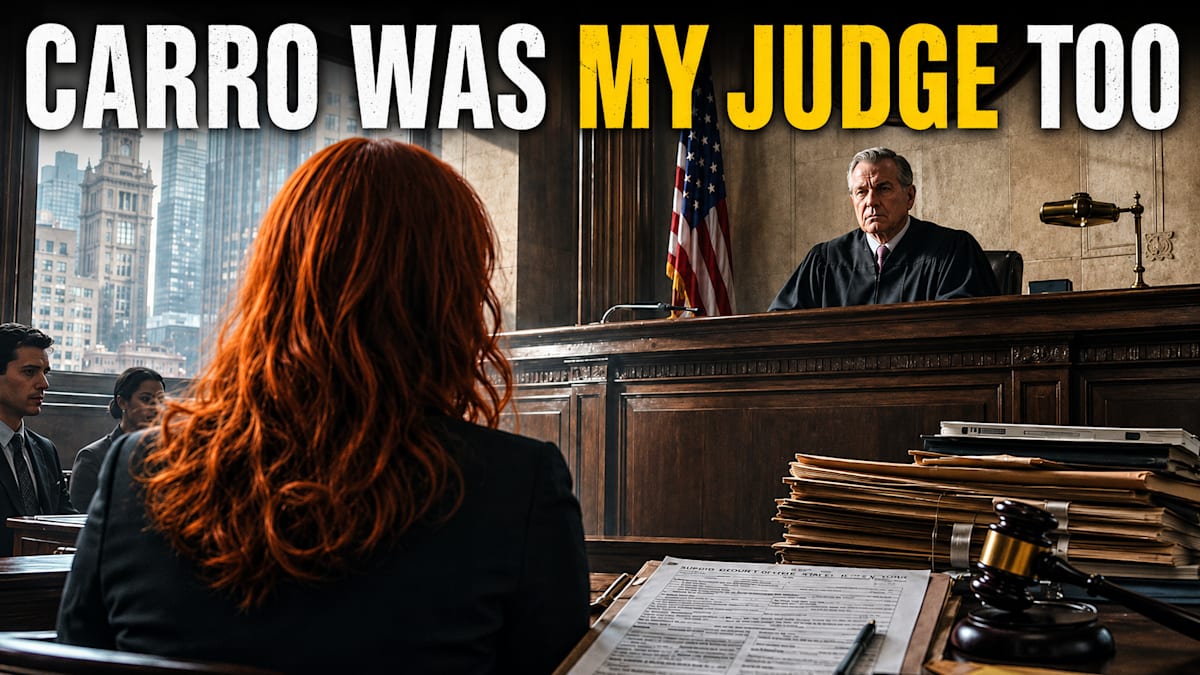
Judge Carro Was My Judge Too. That Is Why I Am Watching the Mangione Trial Closely
By Michele Evans
New York City, New York
5/20/2026
Category: Courts / Criminal Justice / Advocacy
New York City, New York - When I saw that Justice Gregory Carro had been assigned to preside over Luigi Mangione’s state murder case, I felt something deeper than ordinary journalistic interest.
Judge Carro was my judge too.
That does not mean Mangione’s case is mine. It is not. Mangione has pleaded not guilty, and he is entitled to the presumption of innocence. But I know what it feels like to stand in front of Judge Carro with your liberty on the line. I know what it feels like when the person in the robe controls the pace, the tone, the risks, and the exits. I know what it feels like to believe that one wrong move could cost you years of your life.
And that is why I will be covering the Mangione trial from an insider’s perspective.
Not from inside Mangione’s defense. Not from inside the prosecution. From inside the machinery.
I have lived through the way a high-stakes criminal courtroom can look orderly on paper while feeling very different in real life. I have seen how legal reforms can be spoken aloud while the person they are supposed to protect still feels cornered. I have seen how much power a judge has not only over a case, but over the emotional reality of the person standing before the court.
Justice Gregory Carro is now presiding over one of the most watched criminal prosecutions in America. Mangione is accused in the December 2024 killing of UnitedHealthcare CEO Brian Thompson. His case has already drawn national attention, not only because of the allegations, but because of the political, cultural, and institutional tensions surrounding it.
That is why the judge matters.
Carro is not a newcomer to the bench. He comes from a prominent legal family. His father, retired Justice John Carro, was the first Puerto Rican appointed to the New York Appellate Division and became a major figure in New York legal history. Gregory Carro has served for decades in New York criminal courts and is widely understood as an experienced, tough criminal-court judge.
That background matters because he is not learning the system.
He is the system.
My own experience with Judge Carro began long before Mangione became a national name. I was a domestic violence survivor facing catastrophic exposure in a criminal case. I was also trying to be heard under New York’s Domestic Violence Survivors Justice Act, known as the DVSJA.
The law was supposed to recognize that abuse changes the context of survival. It was supposed to give courts a way to consider domestic violence, trauma, coercion, and fear before imposing punishment.
In theory, it was exactly the kind of reform survivors had long needed.
In practice, my experience felt very different.
One of the moments that has stayed with me came when Judge Carro said, in substance, “Obviously she knows how to fill out a police report.”
That remark was deeply inappropriate.
For a domestic violence survivor, it landed like more than an aside. Survivors are constantly judged for how they seek help. Report too soon, and you are dramatic. Report too late, and you are not credible. Report too much, and you are manipulative. Report too little, and you are blamed for staying silent.
The suggestion that knowing how to fill out a police report could somehow count against me felt chilling. It turned help-seeking into suspicion.
That matters.
Because when a survivor enters a courtroom, the judge’s words do not just float harmlessly in the air. They shape the room. They tell the person standing there whether she is being seen, doubted, dismissed, or understood.
I tried to get away from Judge Carro.
He would not let me go.
And then, on the same day he refused to let me get away from him, he turned around and offered me a path: if I pleaded guilty, he would grant me a DVSJA hearing.
To someone outside the system, that might sound like an opportunity.
To someone facing 25 years, it felt like pressure.
That is the part people often miss about criminal court. Pressure does not always announce itself as pressure. Sometimes it sounds like an option. Sometimes it sounds like a deal. Sometimes it sounds like the only door in a room where every other door has been closed.
When the same judge who has refused to release the case then offers the one possible route to be heard under a survivor statute, the choice is not simple.
It is loaded with fear.
What happens if you say no? What happens if you go to trial and lose? What happens if the judge believes you rejected the court’s offer and wasted everyone’s time? What happens when the person offering you a way forward is also the person who may sentence you if everything goes wrong?
Those questions are not theoretical when your life is on the line.
I could not risk upsetting him.
That is why I felt bad for Mangione when I saw that he had landed Judge Carro.
Again, I am not comparing the facts of my case to his. I am not claiming to know what happened in Mangione’s case. I am not saying how Judge Carro will handle every moment of the trial. But I do know what it feels like to be in front of him with the stakes impossibly high.
I have also heard that same sense of invisibility from another woman who appeared before him. She told me Carro would not even look at her. That was her experience to describe, not mine to prove, but it stayed with me because I understood the feeling immediately: being physically present in a courtroom while somehow unseen.
That is a devastating feeling.
It is especially devastating for women whose cases involve trauma, violence, fear, or survival.
Courtrooms often describe themselves as neutral spaces. But neutrality can become cruelty when the system refuses to understand the human context of the person standing before it.
This is why the Mangione trial matters beyond the headlines.
The public conversation around Mangione is already loud, emotional, and politically charged. Some people see the case through the lens of health-care rage. Others see the killing of a corporate executive and father. There will be supporters, critics, influencers, activists, journalists, prosecutors, defense lawyers, and political voices all trying to define what the case means before a jury ever hears the evidence.
But inside the courtroom, the real questions will be procedural, constitutional, and human.
What evidence comes in? What evidence stays out? How are jurors questioned? How does the judge manage public pressure? How does he speak to the defendant? How much space does he give the defense? How carefully does he protect the record? What happens in the moments most people never see?
Those are the questions I will be watching.
Because I know how easily the formal language of criminal court can hide the human pressure inside the room.
A coerced choice can be called a plea.
A survivor’s fear can be called consent.
A judge’s offer can be called an opportunity.
A defendant’s terror can become invisible.
That is why I will cover the Mangione trial differently.
I am not entering this coverage as someone impressed by the robe, the marble walls, or the ritual choreography of criminal court. I am entering it as someone who has stood there, frightened and exposed, trying to understand whether the system was offering me justice or simply processing me.
Judge Carro was my judge too, from 2019 - 2022.
That history does not decide Mangione’s case. It does not tell us what the verdict should be. It does not erase the seriousness of the charges or the grief of Brian Thompson’s family.
But it does give me a lens most commentators do not have.
I know what it means when a judge controls the room.
I know what it means when a defendant feels unable to say no.
I know what it means when the person with the power to punish you is also the person offering you the only path that looks survivable.
And when the Mangione trial begins, I will be watching not only what the court says it is doing.
I will be watching what the courtroom actually does.
Because justice is not proven by the performance of procedure.
Justice is proven by whether the person standing before the court is truly heard before the system decides what to call them afterward.
*Michele Evans is an independent journalist, author, and former ESPN technical producer whose work has appeared in The New York Times.
Michele got her start in 2001 covering the NBA and NFL.
She now covers New York City courts, criminal-justice procedure, NYPD, FDNY, domestic-violence systems, media accountability, public safety, advocacy efforts, and New York civic life through courthouse observation, public records, legal analysis, and lived-experience reporting.
Read more independent journalism by Michele Evans.
Follow Michele Evans on Facebook and Substack for new reporting, analysis, and updates.