I Testified to the New York City Council About Rikers. The Record Is Still There.
I Testified to the New York City Council About Rikers. The Record Is Still There
By Michele Evans
New York City, New York
5/21/2026
Category: Courts / Criminal Justice / Advocacy
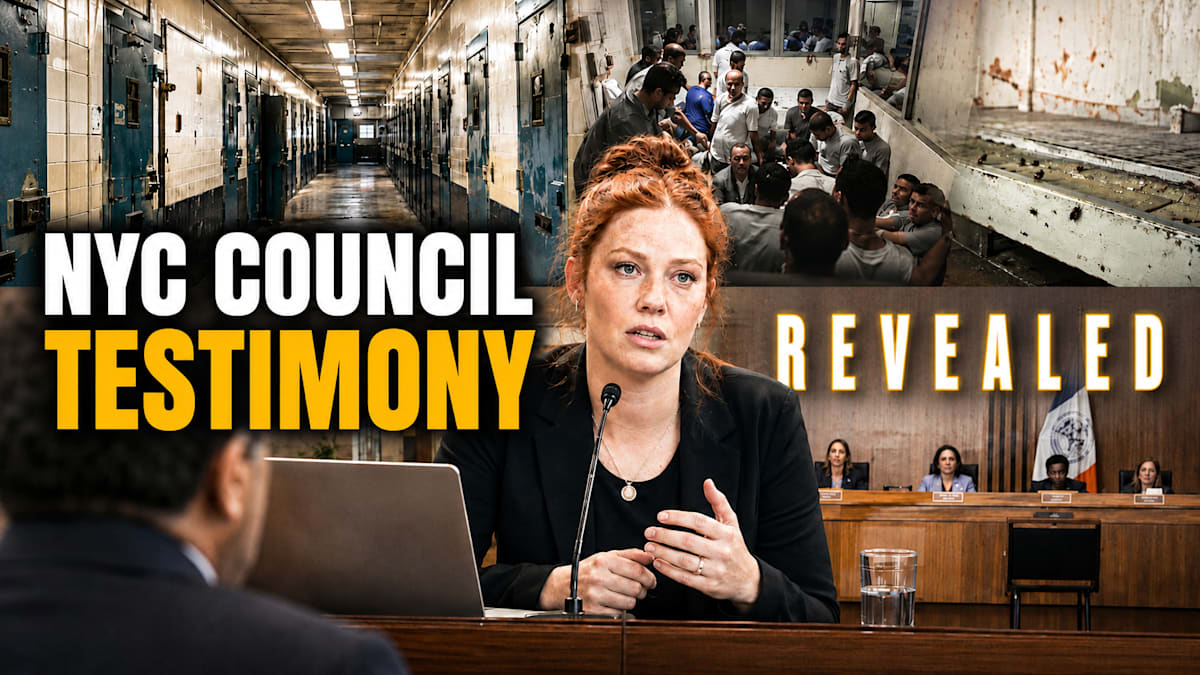
New York City, New York - On April 27, 2021, I testified before the New York City Council about what I witnessed inside Rikers Island.
The hearing was convened by the Committee on Criminal Justice jointly with the Committee on Women and Gender Equity. The subject was women’s experiences in New York City jails, including sexual abuse, pregnancy, family separation, COVID, and the conditions inside the Rose M. Singer Center.
By the time I was called, the hearing had already stretched for hours. Then Committee Counsel said: “Next, we'll hear from Michele Evans.” A sergeant announced: “Clock is running.”
That is how survivors are often invited into public record: after hours of official testimony, with a clock already counting down.
“I’m Michele Evans and I was incarcerated in Rikers from the beginning of January 2019 until June of 2020. What I experienced there won’t leave me. It’s not something that can leave a person.”
That was the truth then.
It is still the truth now.
“There Are Cockroaches All Throughout the Place”
I started with what I called “the simple little things,” because those are often the first signs that a system has stopped seeing people as human.
“There are cockroaches all throughout the place. I worked in the mess hall and my job was to kill cockroaches constantly. That’s just not acceptable. Rats, there are rats. The place is filthy.”
That testimony was not metaphor. It was not exaggeration. It was daily life.
When the city controls where you sleep, where you eat, when you move, when you shower, and whether you can leave, sanitation is not a minor issue. Filth becomes part of the punishment. It tells you exactly how much your body is worth to the institution holding it.
The Courthouse Holding Cells
Then I spoke about the Manhattan Supreme Court holding cells.
“The Supreme Court in Manhattan holding cells are extremely small. They stuff about six of us in there with a cell that’s maybe the size for two.”
I told the Council I had to lie on the floor next to another person, pressed into a space where bodily boundaries disappeared.
“You shouldn’t have to have your body pushed up to somebody else’s body unwillingly, and that’s what was happening in those cases.”
That is one of the hidden indignities of court production. The public sees the courtroom. It does not see the holding cells behind it, the hours of waiting, the crowding, the exhaustion, the fear, or the way the system strips people down before they ever reach the judge.
The Empty Promise of the Maternity Ward
I also testified about the maternity ward.
Because I worked in the mess hall, I delivered meals throughout the facility. That gave me a view most people outside Rikers never get.
“The ACS won’t allow women to have their children in the maternity ward.”
Then I explained what I saw:
“In that year and a half that I was there, I can count on my one hand the number of times that I delivered a meal to that maternity ward.”
That should have raised alarms.
A program can exist on paper and still fail in practice. A mother-baby unit can be cited as proof of care while remaining nearly empty. If mothers cannot actually access the space, then the space becomes a symbol, not a solution.
The city cannot point to a maternity ward as evidence of humanity if women inside say they are not allowed to have their babies there.
“Their Survival Is Criminalized”
The final point I made may have been the most important.
“There’s a problem with reporting anything to the police. Once you are in Rikers, there is absolutely no way for you to file a police report.”
Then I said what many women inside already knew:
“Many women are in there because of domestic abuse and their survival is criminalized and they are not given an opportunity to have both sides held responsible for what’s going on.”
That was the heart of my testimony.
Women enter Rikers carrying histories of abuse, coercion, poverty, family separation, trauma, and fear. The system knows this. The Council knew it too. At the beginning of the hearing, Chair Keith Powers acknowledged that many incarcerated women’s pathways into jail involve poverty, sexual and physical abuse, substance abuse, and mental health issues.
But knowing that is not the same as acting on it.
If a woman is criminalized after surviving abuse, and then cannot meaningfully report abuse once she is inside, the system has not merely failed her. It has trapped her inside one official version of events.
Then the Clock Ran Out
Right after I said that women’s survival is criminalized, the sergeant cut in:
“Time expired.”
I managed to add only one more sentence:
“That was appalling to me.”
And it was.
It was appalling that women were living with cockroaches and rats.
It was appalling that courthouse holding cells were so crowded that bodies were forced against each other.
It was appalling that a maternity ward could exist while mothers were still separated from their babies.
It was appalling that women inside Rikers had no meaningful way to file police reports.
It was appalling that survival itself could be criminalized.
The Record Was There
My testimony was short, but it was official. It was delivered to the New York City Council and preserved in the transcript.
That matters.
I was not whispering into the void. I was testifying in a public hearing. I told the city what I had seen. I told the city what stayed with me. I told the city that what happened inside Rikers does not leave a person.
The City Heard Me
The question is what the city did with it.
A hearing is not accountability. A transcript is not reform. A clock running out is not the end of the truth.
I testified because what happened inside Rikers should never be normalized.
I am writing about it now because the record already exists.
And I am done letting women’s testimony sit buried in transcripts no one reads.
*Michele Evans is an independent journalist, author, and former ESPN technical producer whose work has appeared in The New York Times.
Michele got her start in 2001 covering the NBA and NFL.
She now covers New York City courts, criminal-justice procedure, NYPD, FDNY, domestic-violence systems, media accountability, public safety, advocacy efforts, and New York civic life through courthouse observation, public records, legal analysis, and lived-experience reporting.
Read more independent journalism by Michele Evans.
Follow Michele Evans on Facebook and Substack for new reporting, analysis, and updates.