I Saw For Venida, For Kalief at Tribeca. Deion Browder’s Words Are Still With Me.
I Saw For Venida, For Kalief at Tribeca. Deion Browder’s Words Are Still With Me
By Michele Evans
New York City, New York
5/21/2026
Category: Courts / Criminal Justice / Advocacy
New York City, New York - When I watched For Venida, For Kalief, I did not experience it as a distant documentary about a famous case.
I experienced it as a Rikers survivor.
That is what I wrote in the viewer response survey after the screening. Asked how the film made me feel, my answer was one word, followed by the truth underneath it:
Rollercoaster.
I am a Rikers survivor too.
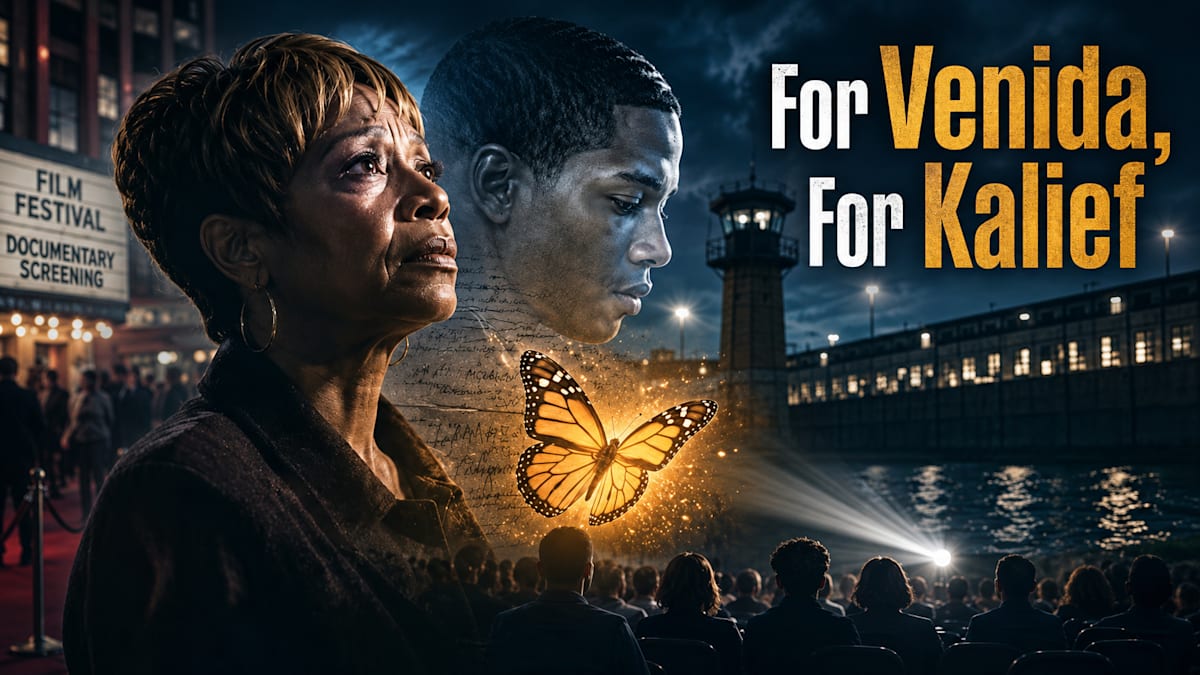
The film, directed by Sisa Bueno, premiered at the 2025 Tribeca Festival in the U.S. Documentary Competition. It tells Kalief Browder’s story through the poetry of his mother, Venida Brodnax Browder, while connecting his life, his death, and his family’s grief to the continuing movement to close Rikers Island.
The timing of the premiere carried its own devastating weight. The film premiered on June 6, 2025, ten years to the exact day after Kalief Browder died on June 6, 2015.
That is not just a date. It is a public memory marker.
Kalief Browder was sixteen years old when he was sent to Rikers after being accused of stealing a backpack. He spent years jailed without trial, much of that time in solitary confinement and brutal conditions, before the charges were dismissed. He died by suicide after his release.
Venida Browder did not simply mourn him. She fought for him. She carried his story into the public square. She spoke, advocated, grieved, and wrote.
That is why For Venida, For Kalief lands differently than a standard criminal justice documentary. It does not treat Kalief as a symbol detached from a family. It does not treat Venida as a grieving figure in the background. It gives her language, her poetry, her motherhood, and her suffering central weight.
And for me, the film became personal before the screening even began.
I met Kalief's brother, Deion Browder, at Tribeca before the premiere. When I told him I was a Rikers survivor too, he embraced me wholeheartedly and gave me a big hug. It was not a polite festival greeting. It felt like recognition.
He told me that after Kalief died, the city told his mother, "Rikers did not kill your son."
That sentence stayed with me before I ever saw a frame of the film.
Because that is what institutions so often do. They separate the wound from the weapon. They separate the death from the conditions. They separate the body from the system that broke it.
Rikers did not have to put its hands around Kalief Browder’s neck in order to be part of what killed him.
A jail can kill slowly. It can kill through isolation. It can kill through delay. It can kill through beatings, humiliation, medical neglect, fear, indifference, and years of official denial. It can kill by sending someone home alive but not whole.
Deion wanted to meet up after the screening to hear what I thought of the film. I am sorry we did not get to connect afterward, because what I would have told him is this: the film reached me deeply.
And one of the parts that moved me most was Venida’s butterfly poem.
The butterfly stayed with me because survivors understand transformation differently. We know the difference between a body that has merely exited a cage and a life that has actually been freed. We know what it means to appear changed on the outside while still carrying the conditions that tried to destroy us.
That is what For Venida, For Kalief captures so powerfully. It is not only about a son who was stolen by a jail system. It is about a mother who tried to turn grief into testimony, poetry, and public memory.
According to the film team’s January 2026 newsletter, 2025 was the year of “arrival” for For Venida, For Kalief. The world premiere at Tribeca was the culmination of an eight-year journey that began with filmmaker Sisa Bueno’s vision and the trust of Venida and the Browder family.
The newsletter also credits producers David Felix Sutcliffe and Paola Gadala Maria, along with Jasmine Mans, whose narration of Venida’s poetry the team described as extraordinary.
That matters because poetry is not decoration in this film. It is the structure of memory. It is how Venida’s voice continues to move through the room.
The film’s festival run began in fall 2025 and is continuing into 2026. According to the newsletter, For Venida, For Kalief has already screened in the deep South, the Midwest, and on the West Coast, with more screenings still unfolding. The team wrote that the film is resonating with audiences through post-screening panels, poetry workshops, and community conversations.
That is how this work should move: not as content to consume and forget, but as testimony that keeps gathering witnesses.
The newsletter also notes that the film team is looking ahead to an international premiere in 2026. That is fitting. Rikers is a New York institution, but the questions raised by Kalief and Venida’s story are not only New York questions. They are global questions about detention, state violence, solitary confinement, grief, public memory, and whether governments ever fully admit what their systems have done.
The newsletter also connects the film’s ongoing relevance to the fight over solitary confinement in New York City jails. The team celebrated the announcement that Mayor Zohran Mamdani’s administration would no longer block Local Law 42, the approved anti-solitary confinement law explored in For Venida, For Kalief. The newsletter describes that reversal as a major win for advocates featured in the film.
That development matters because Kalief Browder’s story is inseparable from solitary confinement.
It is not enough for officials to say his name. It is not enough to cite him after the fact. If the city invokes Kalief, it has an obligation to confront the conditions that helped destroy him.
In the viewer survey, I was asked whether I consider myself someone impacted by the criminal justice system. I answered yes.
Asked whether I personally know someone currently incarcerated, I answered: more than I can count.
Asked whether my loved ones have been affected by abuse in a carceral space, such as poor living conditions, excessive violence, and solitary confinement, I answered: I have dealt with all of those.
Asked what needs to change so people can stay better connected to incarcerated loved ones, I wrote that communication is taken away as a form of punishment, and that needs to stop.
That is the part many policy conversations flatten. Rikers is not only a place on a map. It is a machine that keeps producing witnesses.
And witnesses remember.
I remember Deion Browder hugging me before the premiere.
I remember him telling me what the city told his mother.
I remember sitting through a film that made Venida’s poetry feel like testimony.
I remember the butterfly.
And I remember thinking that New York cannot build its way out of this history unless it tells the truth first.
The film’s upcoming 2026 screenings show that this story is still moving. The newsletter lists a February screening at Scribe Video Center in Philadelphia, a March event at Cardozo Law School, and a June 6 screening at The People’s Forum in New York. That June 6 date matters too. It is another anniversary of Kalief’s death, another opportunity for public memory, and another reminder that the story did not end when the headlines faded.
The film team also acknowledged the broader public media ecosystem that helped make the documentary possible, including ITVS, PBS, and the Corporation for Public Broadcasting. That detail matters because stories like this require support. They require filmmakers, funders, artists, advocates, families, and survivors willing to keep telling the truth even when institutions would rather move on.
For Venida, For Kalief is not only asking whether Rikers should close.
It is asking whether New York is capable of telling the truth about what happened there.
It is asking whether a mother’s grief can be heard before it is sentimentalized.
It is asking whether a son’s suffering can be remembered without being flattened into a slogan.
It is asking whether survivors are allowed to be more than evidence after the damage is done.
I hope Deion Browder knows I heard him.
I hope the film team knows the work reached someone who has lived part of the story from the inside.
And I hope the city understands this: it does not get to say Rikers did not kill Kalief Browder simply because the final act happened somewhere else.
Rikers is still on the record.
Venida is still on the record.
Kalief is still on the record.
And so are the rest of us.
*Michele Evans is an independent journalist, author, and former ESPN technical producer whose work has appeared in The New York Times.
Michele got her start in 2001 covering the NBA and NFL.
She now covers New York City courts, criminal-justice procedure, NYPD, FDNY, domestic-violence systems, media accountability, public safety, advocacy efforts, and New York civic life through courthouse observation, public records, legal analysis, and lived-experience reporting.
Read more independent journalism by Michele Evans.
Follow Michele Evans on Facebook and Substack for new reporting, analysis, and updates.