I Said After Day One Trump Was Getting Convicted. The Courtroom Told the Story Before the Verdict Did.
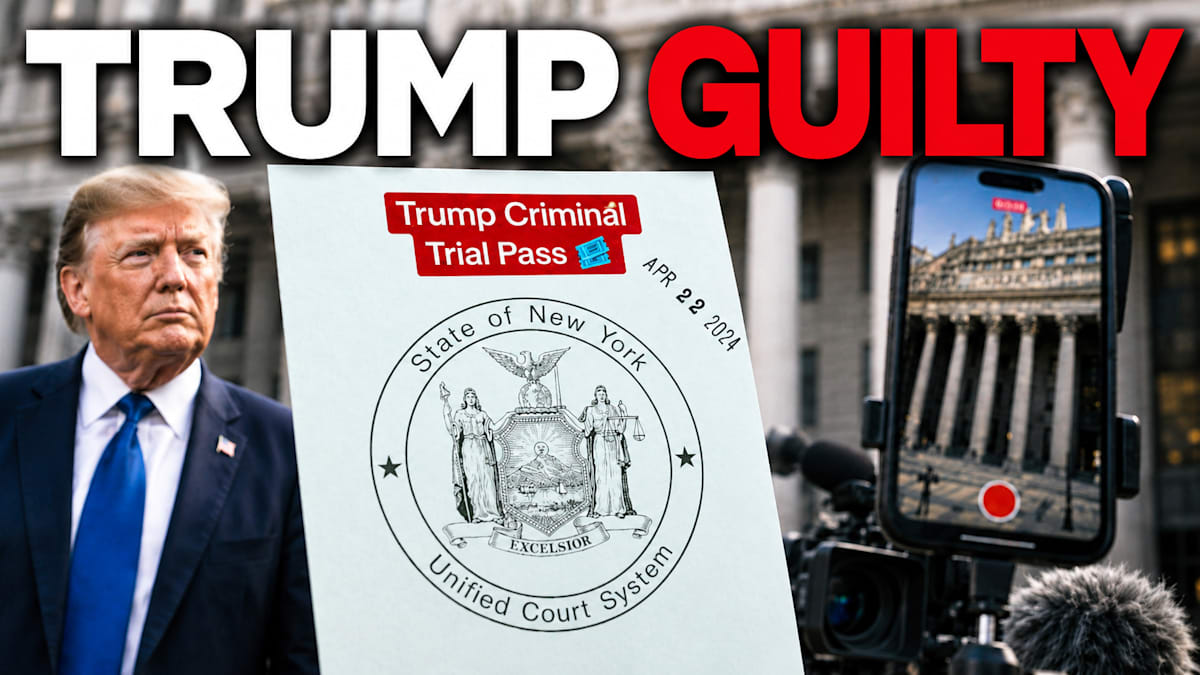
I Said After Day One Trump Was Getting Convicted. The Courtroom Told the Story Before the Verdict Did
By Michele Evans
New York City, New York
5/10/2026
Category: Courts / Criminal Justice / Advocacy / Media Accountability
New York City, New York - On April 22, 2024, I walked out of Manhattan Criminal Court holding a pass that I joked I might need to frame someday.
It felt historic even then.
Not because I knew exactly what the verdict would be. Not because I had studied every filing or followed every legal argument. I had not. I was not there as a partisan. I was not there as someone who had invested months into investigating Donald Trump’s criminal case.
I was there because I understand New York courtrooms.
And after one day inside that building, I said what a lot of people were not ready to hear yet:
Trump was done.
That day marked the beginning of opening statements in People v. Donald J. Trump, the Manhattan criminal case involving 34 felony counts of falsifying business records. Prosecutors told jurors the case involved a scheme to influence the 2016 election by suppressing damaging information and then disguising records connected to the reimbursement of Michael Cohen. Trump denied wrongdoing, and his lawyers framed the case as weak, politically motivated, and dependent on unreliable witnesses. But inside the courtroom, the case did not feel weak. It felt structured. It felt organized. It felt like prosecutors knew exactly what story they needed to tell.
After I left court, I recorded a short TikTok. I was not trying to deliver a polished legal segment. I was reacting in real time.
“So I just got back from the Trump trial,” I said. “It was craziness. I just got to say, he’s not even aware of what he has gotten himself into. He’s done. He’s done. He’s not getting through this system. No way, no how.”
I had been there before court. I was only a couple feet away from Trump when he spoke to the media. I was also inside the courtroom. The whole thing was surreal: the press, the security, the crowd, the politics, the spectacle.
But inside the courtroom, the spectacle started to fall away.
That is what people miss.
A criminal courtroom is not a rally. It is not a cable-news panel. It is not a TikTok comment section. It is a machine. Once the jury is seated, the lights and cameras outside do not matter the same way. What matters is the record. The witnesses. The judge. The rulings. The elements. The story prosecutors are building one admissible piece at a time.
That was what I saw.
And when people pushed back in my comments after that first video, I made another point: I was not going to argue with strangers about whether Trump was guilty or innocent. That was not what my reaction was about.
“I stated that he’s done,” I said, “and that comes from my experience with the Manhattan DA and the way things work in New York City. It’s just what I’ve seen and what I’ve observed. It has nothing to do with whether he did anything, whether he didn’t. I don’t know.”
That distinction matters.
My reaction was not about proving the case myself.
It was about recognizing the system.
I spent a year and a half on Rikers Island. I know people who have been through the Manhattan criminal court system. I have seen how that system can move once it decides where it is going. I have seen how truth, narrative, leverage, pressure, paperwork, and institutional momentum can become very different things inside a criminal courthouse.
That is why being there was triggering for me.
I left because I knew the feeling.
Trump seemed to still be operating as if public performance could overpower courtroom procedure. But Manhattan criminal court does not move like a media cycle. It moves like a process. And once you are inside it, the outside narrative can become almost irrelevant.
That was the reason I said he had no idea what he was up against.
In my own experience, I have seen how little the system can care about the truth when it is inconvenient. I said it plainly in the video: “They do not care about the truth.”
That may sound harsh to people who have never been through it. But I was speaking from lived experience. In my case, I watched statements and arguments get made that were so disconnected from my reality that they felt absurd. I said in the video that they claimed I did not even know someone I had dated off and on for 15 years and whose name I had tattooed on my neck.
That kind of thing changes how you hear a prosecutor’s theory.
It changes how you watch a defendant walk into court.
It changes how you understand the gap between what the public thinks a trial is and what the system actually does.
So when I watched Trump that day, I was not thinking, “This is good for Democrats” or “This is bad for Republicans.”
I was thinking: he does not understand where he is.
On April 22, prosecutors began presenting the case as more than a hush-money story. Their theory connected the alleged concealment to the 2016 election and to business records created after the election. Former National Enquirer publisher David Pecker became the first witness, and his testimony helped introduce the “catch-and-kill” framework prosecutors used to explain how damaging stories were allegedly suppressed.
That mattered because the public conversation often reduced the case to Stormy Daniels, sex, politics, or paperwork. But the courtroom story was more specific. Prosecutors were building a record around falsified business documents, intent, concealment, campaign context, and corroborating evidence. After the conviction, the Manhattan District Attorney described the trial evidence as including invoices, checks, bank statements, audio recordings, phone logs, text messages, and testimony from 22 witnesses.
That is the difference between the spectacle and the system.
The spectacle is loud.
The system is methodical.
The spectacle asks who is winning the news cycle.
The system asks what can be admitted, what can be proven, what jurors hear, and how the record is built.
That is why the pass felt worth saving.
At the time, I joked that maybe I should frame it because it might be historic someday. Looking back, that instinct was right. It was a small piece of paper from a day that became part of American legal history: the first criminal trial of a former United States president to reach a jury.
On May 30, 2024, the jury found Trump guilty on all 34 felony counts. He became the first U.S. president convicted of a crime after the jury found him guilty of falsifying business documents connected to covering up a payment before the 2016 election.
The verdict did not surprise me.
The first day told me where the case was going.
Not because verdicts are guaranteed. They are not. Juries can surprise everyone. Witnesses can fall apart. Judges can make rulings that reshape a trial. Defense lawyers can create reasonable doubt. Anything can happen in court.
But courtroom energy is real.
So is structure.
So is institutional momentum.
And so is the difference between a defendant playing to the public and a prosecution building a record for twelve people in a jury box.
That was what I saw on April 22.
That was why I said, “He’s not getting through this system. No way, no how.”
And he didn’t.
*Michele Evans is an independent journalist, author, and former ESPN technical producer whose work has appeared in The New York Times.
Michele got her start in 2001 covering the NBA and NFL.
She now covers New York City courts, criminal-justice procedure, NYPD, FDNY, domestic-violence systems, media accountability, public safety, advocacy efforts, and New York civic life through courthouse observation, public records, legal analysis, and lived-experience reporting.
Read more independent journalism by Michele Evans.
Follow Michele Evans on Facebook and Substack for new reporting, analysis, and updates.