Category: Housing / Tenant Rights / City Hall / Public Accountability / New York Civic Life
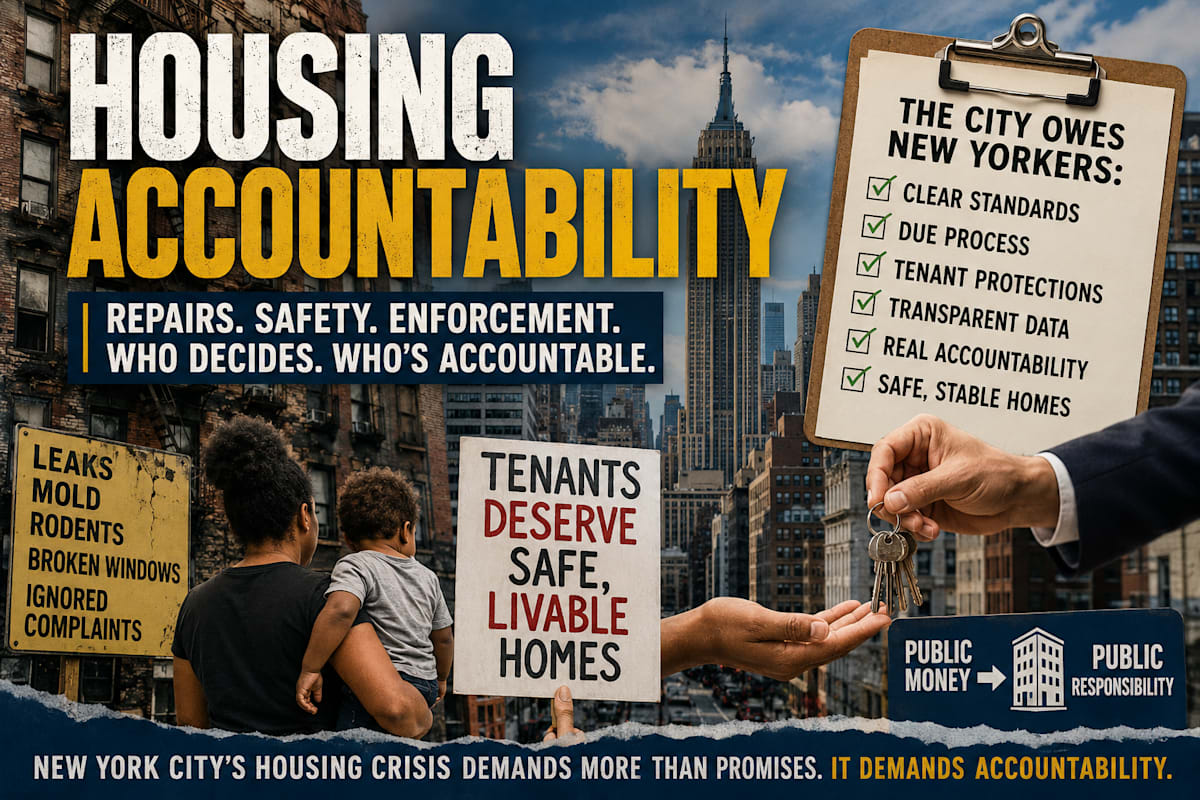
NEW YORK CITY, NY - New York’s housing crisis is not just about rent. It is about power, repairs, safety, enforcement, and whether tenants living with leaks, mold, rodents, broken windows, and fear can make City Hall respond before a building becomes unlivable.
A tenant group connected to Mayor Zohran Mamdani’s housing agenda is pushing to use public money to move some distressed rent-stabilized housing into tenant, nonprofit, or community land trust control. The proposal sits inside a broader housing fight over Mamdani’s Block by Block plan, which calls for stronger action against negligent landlords and more aggressive use of city enforcement tools.
The idea is politically explosive. Supporters frame it as tenant protection for buildings where owners fail to provide safe housing. Critics frame it as government overreach that could destabilize small property owners and make an already fragile rent-stabilized market worse.
Both sides are arguing over the same broken reality. Too many tenants live in apartments where complaints do not produce fast enough repairs. Too many small owners say rising insurance, taxes, maintenance costs, and rent limits leave them unable to keep buildings stable. The city cannot solve one side by pretending the other does not exist.
That is why the public-interest question is not whether bad landlords should be held accountable. They should. The question is what standard the city will use, who decides when a building crosses the line, what due process exists, how tenants are protected during a transition, and whether the promised new stewards have the money, management skill, and repair capacity to do better.
Housing policy becomes real in the hallway. It becomes real when a tenant smells mold, when a child has asthma, when an elevator fails, when a landlord ignores a violation, when a court case drags on, or when a building’s finances collapse and everyone inside pays the price.
Mamdani’s plan includes legal action against negligent owners and managers, and that city officials previously struggled to define what would trigger intervention in chronically neglected buildings. That missing definition matters. A policy this powerful needs clear thresholds, transparent data, and public reporting.
New York should not tolerate abusive housing conditions. It also should not build a housing enforcement system so vague that families, tenants, small landlords, and neighborhoods have to guess what happens next.
If the city wants to use public money to change who controls distressed housing, it owes New Yorkers a plain answer: which buildings, what evidence, what process, what protection, what budget, and what accountability if the new system fails.
Tenant power can be a public good. So can stable ownership. The city’s job is not to turn pain into ideology. It is to turn unsafe housing into repaired housing, with rules everyone can see.
Michele Evans is an independent journalist, author, and former ESPN technical producer whose work has appeared in The New York Times.
Michele got her start in 2001 covering the NBA and NFL.
She now covers New York City courts, criminal-justice procedure, NYPD, FDNY, domestic-violence systems, media accountability, public safety, advocacy efforts, and New York civic life through courthouse observation, public records, legal analysis, and lived-experience reporting.
Read more independent journalism by Michele Evans.
Follow Michele Evans on Facebook and Substack for new reporting, analysis, and updates.