Category: Domestic Violence / Public Accountability / New York State / Survivor Safety
NEW YORK CITY, NY - A domestic-violence hotline is supposed to be the place where danger meets a live human being.
A new state audit says New York did not always deliver that basic promise.
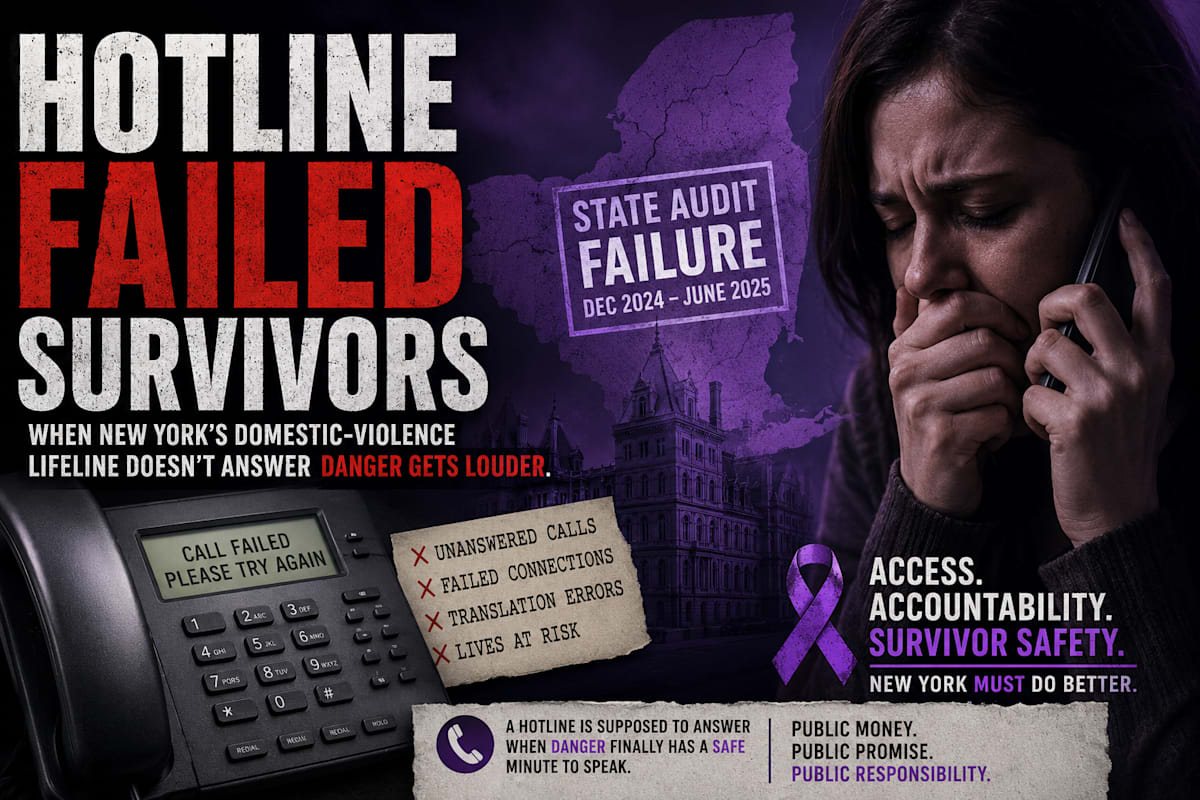
According to reporting on the New York State Comptroller audit, test calls and messages to the statewide domestic and sexual violence hotline exposed unanswered calls, failed connections, and translation problems during a review period between December 2024 and June 2025. The hotline is not a symbolic program. It is a crisis pathway for people who may be trapped, monitored, threatened, injured, isolated, or trying to leave.
The audit findings matter because timing matters. In domestic violence, a delayed response can be the difference between a survivor trying again and a survivor going silent. When the state tells victims to call, text, or chat for help, the system has to be ready when the victim finally gets a safe minute.
The reported failures were specific. The Times Union reported that auditors found 20 percent of 25 test phone calls never connected to a representative. A review of call logs found about 6 percent of calls failed to connect. Auditors also found the hotline’s 20-second answer requirement was undermined by an automated greeting that took about that long before a caller could even reach the next step.
The language-access findings are just as serious. The report described test messages where languages were misidentified or mistranslated, including Urdu being handled as Arabic and Chinese being answered in Japanese. For a survivor trying to ask for help in the middle of fear, mistranslation is not a technical glitch. It can turn a lifeline into confusion.
The hotline is operated by Unity House of Troy under state contract, according to the report. The Office for the Prevention of Domestic Violence agreed that stronger oversight was needed and said monitoring practices and quality assurance reviews had been strengthened. Unity House also said it was upgrading phone and text systems.
Those responses matter, but they do not erase the public-interest question: who was watching the lifeline before the audit forced the issue?
Domestic violence systems often fail quietly. They fail in a missed call, a wrong translation, a case note, a shelter bed that does not exist, a judge who does not understand lethality, or a public agency that treats crisis access like paperwork. Survivors are then blamed for not leaving, not reporting, not following through, or not trusting the system.
This audit should be treated as more than an administrative finding. It is a warning about access, oversight, language justice, and state responsibility.
A hotline cannot save everyone. But when New York funds one, contracts one, advertises one, and points survivors toward one, it has an obligation to make sure the line actually answers.
*Michele Evansis an independent journalist, author, and former ESPN technical producer whose work has appeared in The New York Times.
Michele got her start in 2001 covering the NBA and NFL.
She now covers New York City courts, criminal-justice procedure, NYPD, FDNY, domestic-violence systems, media accountability, public safety, advocacy efforts, and New York civic life through courthouse observation, public records, legal analysis, and lived-experience reporting.