Hochul Should Sign the SAFE Shelter Act Now. Survivors Should Not Be Harmed Because They Need Shelter Alone.
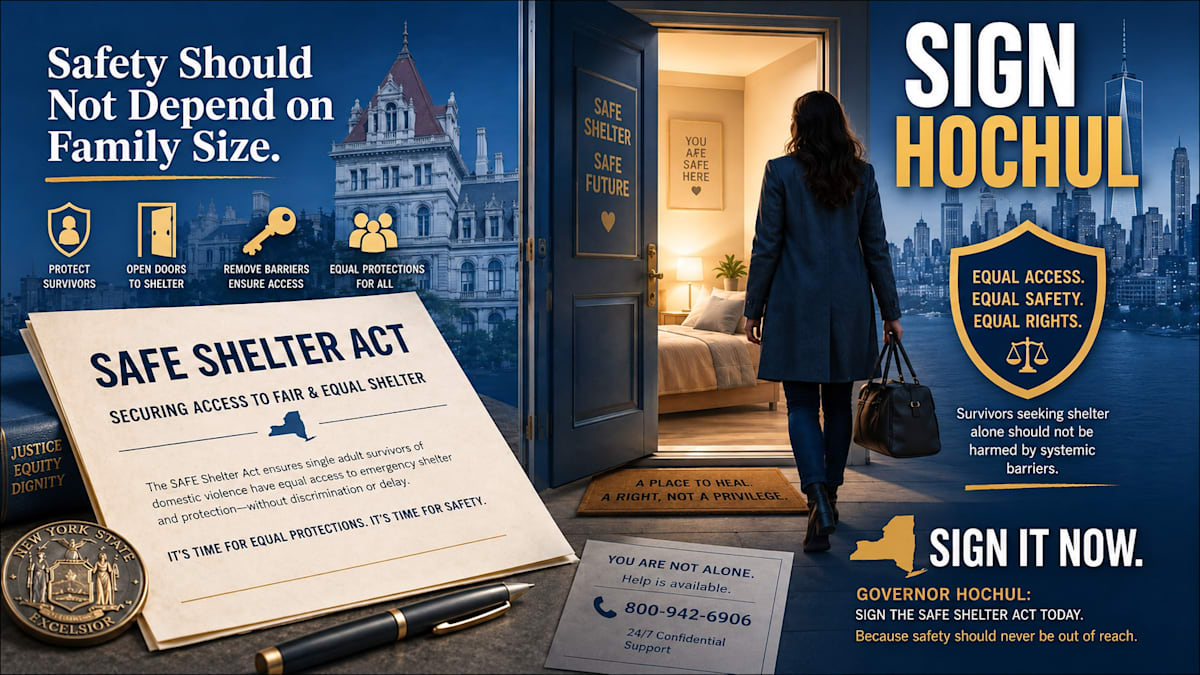
Hochul Should Sign the SAFE Shelter Act Now. Survivors Should Not Be Harmed Because They Need Shelter Alone
By Michele Evans
New York City, New York
5/19/2026
Category: Courts / Criminal Justice / Advocacy
Albany, New York - New York has another chance to fix a dangerous gap in its domestic violence shelter system. Governor Kathy Hochul should not wait.
The SAFE Shelter Act, formally the Securing Access to Fair & Equal Shelter Act, has passed both the New York State Senate and Assembly and is now positioned for the governor’s signature. The current bill, S7738A, would allow domestic violence shelters to be reimbursed for housing a single survivor in a room intended for double occupancy when no single-occupancy room is available. The bill passed the Senate on May 13, 2026, by a vote of 60-0, and the Assembly passed the bill on May 14, 2026.
That may sound technical. It is not.
It is the difference between a survivor being offered a safe bed or being left in danger because the funding structure was built around family size instead of human need.
New York’s domestic violence emergency shelter system was originally designed largely around families fleeing abuse, not single adults fleeing danger. Safe Horizon has explained that, because of the state’s reimbursement structure, shelter providers can lose significant revenue when they house a single survivor in a room designed for a parent and child. The result is a system that can make it harder for single adult survivors of domestic and gender-based violence to access shelter.
Safe Horizon has warned that the problem affects single adult survivors of domestic violence, trafficking, and sexual violence, including LGBTQ+ survivors and older adults who may be more likely to seek shelter without children.
I know what it means to be documented by the system but not actually protected by it.
In 2017, before the criminal legal system ever called me a defendant, I was a domestic violence survivor trying to find safety. Safe Horizon records from that period document repeated contact with the domestic violence hotline. The need was not invisible. The system saw me. It recorded me. It knew I was trying to get somewhere safe.
But documentation is not shelter.
A hotline record is not a safe bed. An intake note is not protection. A referral is not a door opening.
I did what survivors are always told to do. I called. I asked for help. I tried to use the system that was supposed to exist for people in danger. Instead of being moved into safety, I remained trapped in instability, danger, and bureaucratic delay. I ended up harmed instead of helped.
That is why this bill matters.
When a survivor is fleeing abuse, the question should not be whether she has children with her, whether she fits the reimbursement model, whether a room was designed for two people, or whether a provider can afford to lose money by placing one person in an empty bed. The question should be simple:
Does this person need safety?
If the answer is yes, New York’s shelter system should be able to say yes too.
Advocates have been warning Albany about this problem for years. In December 2024, Safe Horizon, Urban Resource Institute, Volunteers of America-Greater New York, the New York State Coalition Against Domestic Violence, elected officials, survivors, and advocates urged Governor Hochul to sign the SAFE Shelter Act and prioritize temporary housing for survivors of domestic violence, sexual abuse, and human trafficking.
Governor Hochul vetoed the 2024 version of the bill. After that veto, a SAFE Shelter coalition statement said the measure would have given domestic violence shelter providers the funding and flexibility needed to provide emergency shelter to more vulnerable New Yorkers.
Now the bill is back.
And this time, there should be no delay.
The Legislature has already spoken. The need is documented. The advocacy community is aligned. The harm is foreseeable. The solution is targeted and practical.
The SAFE Shelter Act does not create some abstract new entitlement. It fixes a reimbursement barrier that can prevent providers from using existing space to protect actual survivors. It allows shelters to house a single eligible survivor in a double-occupancy room without being financially punished when no single room is available.
That is common sense.
It is also urgent.
Domestic violence does not pause while Albany debates reimbursement mechanics. Survivors do not have the luxury of waiting for a safer fiscal year. A person trying to leave abuse may have one window, one call, one chance to get out before danger escalates.
If the state tells survivors to call for help, then the state has an obligation to make sure help exists when they call.
My Safe Horizon records matter because they show what bureaucratic failure looks like from the inside. They show that a survivor can be visible to the system and still not be saved by it. They show that documenting danger is not the same as interrupting it. They show that a shelter system that cannot accommodate survivors without children is not a shelter system built for all survivors.
Governor Hochul should sign the SAFE Shelter Act immediately.
Not next session. Not after another coalition letter. Not after another survivor is told there is no appropriate bed. Not after another person is pushed into a general homeless shelter, back into danger, or onto the street.
New York already knows the problem.
Now it needs to fix it.
If You Are Experiencing Domestic Violence or Need Help Finding Safety
If you are in immediate danger, call 911. If calling is not safe, New York City also allows people to text 911 in an emergency.
For confidential domestic violence support, safety planning, shelter referrals, and help understanding your options, these resources may help:
National Domestic Violence Hotline
Call 1-800-799-SAFE (7233), text START to 88788, or use live chat through TheHotline.org. The Hotline offers free, confidential support 24/7. Internet use can be monitored, so use a safer device if you are concerned someone may be tracking your activity.
New York State Domestic and Sexual Violence Hotline
Call 800-942-6906, text 844-997-2121, or use live chat through the New York State Office for the Prevention of Domestic Violence. Services are confidential, secure, available 24/7, and offered in most languages.
Safe Horizon / NYC Domestic Violence and Sexual Assault Hotline
Call 800-621-HOPE (4673) or visit Safe Horizon’s Hotline and Chat page. Safe Horizon operates New York City’s 24/7 hotline for people experiencing domestic violence, intimate partner violence, sexual assault, crime, or abuse.
NYC Family Justice Centers
Visit NYC Family Justice Centers for free and confidential services, including safety planning, shelter assistance, counseling, case management, civil legal help, criminal legal assistance, and economic empowerment support. Services are available in all five boroughs.
NYC HOPE Resource Directory
Use the NYC HOPE Resource Directory to search for local domestic violence, sexual assault, trafficking, stalking, counseling, legal, and shelter-related services.
Before reaching out, consider whether your phone, browser history, email, location sharing, or cloud accounts may be monitored. Use a trusted device, clear your browser history when safe to do so, and avoid storing safety plans somewhere an abusive partner may access.
Digital Safety When You’re Being Watched: 5 Small Steps for Survivors
- Use a safer device first - A library computer, trusted friend’s phone, shelter computer, or new email account may be safer than your own phone.
- Do not suddenly change everything - If your abuser monitors you, big changes can alert them. Safety planning matters.
- Check location sharing - Look at Find My iPhone, Google location sharing, shared family accounts, AirTags, car apps, and social media location tags.
- Create one private email - Use it only from a safer device. Do not save the password on a shared phone or computer.
- Call a DV advocate before making major tech changes - They can help you plan without escalating danger.
For survivors who need a longer technical guide, ExpressVPN has published a more detailed resource here.
You deserve help that does not punish you for needing safety. You deserve to be heard before you are harmed.
*Michele Evans is an independent journalist, author, and former ESPN technical producer whose work has appeared in The New York Times.
Michele got her start in 2001 covering the NBA and NFL.
She now covers New York City courts, criminal-justice procedure, NYPD, FDNY, domestic-violence systems, media accountability, public safety, advocacy efforts, and New York civic life through courthouse observation, public records, legal analysis, and lived-experience reporting.
Read more independent journalism by Michele Evans.
Follow Michele Evans on Facebook and Substack for new reporting, analysis, and updates.