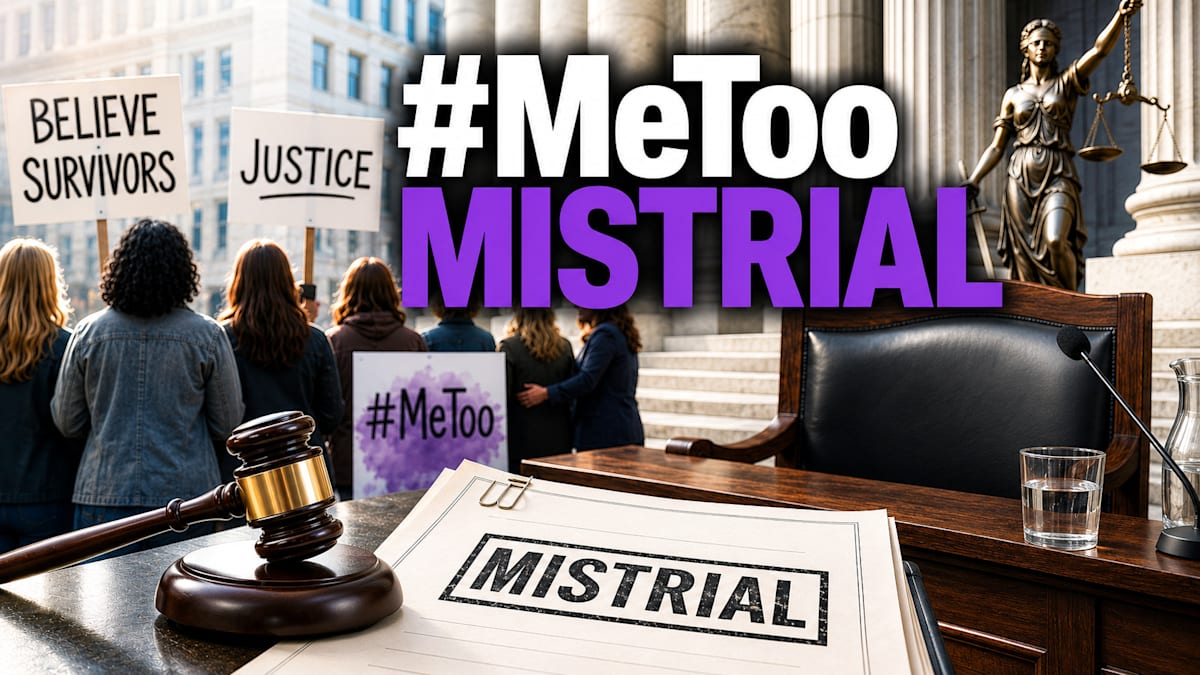
Harvey Weinstein’s Mistrial Shows Why #MeToo Still Matters
wk8s9u71vmpeb8i17h904irekkzi2.22 MBHarvey Weinstein’s Mistrial Shows Why #MeToo Still Matters
By Michele Evans New York City, New York 5/15/2026
Category: Courts / Criminal Justice / Advocacy / Media Accountability
New York City, New York - When Harvey Weinstein’s latest New York sex-crimes trial ended in a mistrial, it did not end the story. It exposed something larger: how difficult it remains to translate public reckoning into courtroom accountability.
Weinstein’s third New York rape trial ended after jurors could not reach a unanimous verdict on the charge involving Jessica Mann. The deadlock reportedly leaned 9–3 toward acquittal, and a hearing is now scheduled for June 25 to determine what comes next.
Weinstein remains incarcerated because of other convictions, including his California rape conviction and a separate New York conviction involving Miriam Haley.
But the mistrial matters beyond Weinstein himself.
For many people, Weinstein became the public face of the #MeToo movement because his alleged pattern of abuse helped reveal how power, silence, money, fear, and professional gatekeeping can work together to protect influential men.
The movement was never only about one producer, one industry, or one verdict. It was about whether institutions are capable of hearing women, protecting vulnerable people, and holding powerful figures accountable when the harm is difficult, intimate, old, complicated, or aggressively denied.
That is why a mistrial should not be mistaken for a cultural reset.
A hung jury does not mean the allegations were meaningless. It does not erase the testimony. It does not erase the women who came forward. It does not erase the broader record of abuse that brought Weinstein down in the first place. What it does show is the burden survivors still face when trauma is placed under the microscope of a criminal trial.
Sexual-assault cases are uniquely difficult to prosecute. They often turn on credibility, memory, delay, coercion, consent, power imbalance, and the private dynamics between two people. Defense strategies frequently exploit those gray areas.
A survivor’s behavior before or after the alleged assault becomes evidence. Their messages become evidence. Their hesitation becomes evidence. Their fear becomes evidence. Their attempt to survive the aftermath becomes evidence.
That is one of the central lessons of #MeToo: abuse does not always look the way the public expects it to look.
The movement forced society to confront the fact that victims may continue communicating with abusers. They may freeze. They may stay silent. They may be professionally dependent on the person who harmed them. They may try to normalize what happened because naming it would threaten their job, safety, reputation, or future. Those realities can be hard to explain in a courtroom built around neat timelines and binary verdicts.
Weinstein’s mistrial also arrives at a moment when some public figures are questioning whether #MeToo’s momentum has faded. At Cannes, Cate Blanchett recently said she believes the movement “got killed very quickly,” while pointing to persistent gender imbalance and unresolved power structures in the film industry. Her comments reflect a broader anxiety: that the public spectacle of accountability may have outpaced the deeper institutional reforms #MeToo demanded. That is the danger.
If #MeToo is reduced to conviction counts, then the movement becomes vulnerable every time a jury deadlocks, a case is overturned, a charge is dismissed, or a powerful defendant survives one proceeding.
But #MeToo was never supposed to be a scoreboard. It was a demand for cultural and institutional truth.
The mission remains urgent because the underlying systems remain familiar: powerful people insulated by status; victims punished for imperfect responses; institutions protecting reputations before people; and public conversations that too often treat legal uncertainty as moral exoneration.
A mistrial is not vindication. It is not closure. It is a legal pause, a procedural outcome, and in this case, another reminder that justice systems struggle with the very kinds of abuse #MeToo was created to expose.
The question now is not whether #MeToo “survived” the Weinstein mistrial. The question is whether the public still understands what the movement was trying to teach us.
It was never only about one man.
It was about the machinery that made him possible.
*Michele Evansis an independent journalist, author, and former ESPN technical producer whose work has appeared in The New York Times.
Michele got her start in 2001 covering the NBA and NFL.
She now covers New York City courts, criminal-justice procedure, NYPD, FDNY, domestic-violence systems, media accountability, public safety, advocacy efforts, and New York civic life through courthouse observation, public records, legal analysis, and lived-experience reporting.