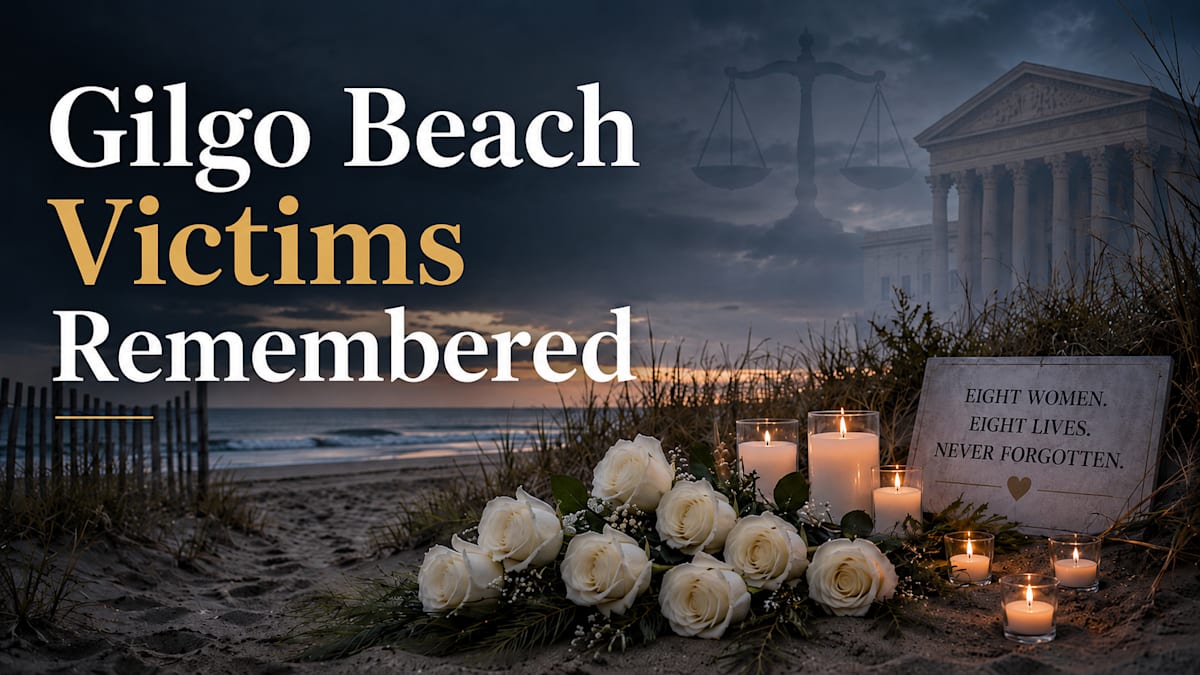
Gilgo Beach Families Finally Face Killer as Rex Heuermann Receives Life Without Parole
ngzx6enx65056v07nwd4uxya76h72.15 MBGilgo Beach Families Finally Face Killer as Rex Heuermann Receives Life Without Parole
After decades of grief, the sentencing belonged not to the serial killer, but to the women whose lives were stolen and the families who refused to let them disappear.
By Michele Evans New York City, New York 6/19/2026
Category: Courts / Public Interest / Criminal Justice
RIVERHEAD, N.Y. - For more than a decade, the phrase “Gilgo Beach” has carried a darkness across Long Island. It became shorthand for missing women, abandoned remains, failed investigations, grieving families, and a coastline where unanswered questions washed up year after year.
On Wednesday, in Suffolk County Court, those questions finally met a sentence.
Rex Heuermann, the Massapequa Park architect who admitted to murdering eight women between 1993 and 2010, was sentenced to three consecutive life sentences without parole, followed by an additional 100 years to life. The sentence ensures Heuermann will die in prison.
But the day was not really about him.
It was about Melissa Barthelemy.
It was about Megan Waterman.
It was about Amber Lynn Costello.
It was about Maureen Brainard-Barnes.
It was about Jessica Taylor.
It was about Valerie Mack.
It was about Sandra Costilla.
It was about Karen Vergata.
For years, these women were too often reduced to the location where their remains were found, the work they did, or the failures of the system that did not protect them quickly enough. At sentencing, their families reclaimed the room.
One by one, relatives spoke about daughters, sisters, cousins, mothers, and women with dreams, families, histories, and futures that were violently taken from them. Their statements transformed the hearing from a procedural ending into a public accounting of human loss.
Jessica Taylor’s family faced the killer on what would have been her 43rd birthday. The cruelty of that timing was impossible to ignore. Her loved ones spoke not only of rage, but of the permanent absence left behind when a life is cut off before it has the chance to unfold.
Valerie Mack’s family described a young woman whose vulnerability was exploited. Her loved ones reminded the court she had dreams. She had a life beyond the way her death was discovered and beyond the years her name sat inside an unsolved case file.
Megan Waterman’s daughter spoke from the impossible position of a child forced to grow up with the public horror of her mother’s murder. She was only a young child when her mother was killed. Years later, she would learn the details the way too many children of high-profile crime victims do: through public coverage, online searches, and the brutal permanence of the internet.
Maureen Brainard-Barnes’s family described years of grief, guilt, and unanswered questions. Her sister spoke about the emotional weight carried for decades and placed that burden where it belonged: on Heuermann.
The families of Melissa Barthelemy, Amber Lynn Costello, Sandra Costilla, Karen Vergata, Jessica Taylor, Valerie Mack, Megan Waterman, and Maureen Brainard-Barnes did what the justice system took years to do. They centered the women.
Heuermann’s brief words in court did little to change the gravity of the moment. He acknowledged that what had been said was true and said there were no words with meaning. The judge was unmoved. So were the families.
A sentence can punish. It can incapacitate. It can formally close a criminal case. But it cannot return a mother to her child. It cannot give back a sister’s voice. It cannot restore a birthday, a holiday, a phone call, a future.
That was the emotional truth of the courtroom.
This case also remains a painful indictment of how vulnerable women are treated before and after death. Many of the victims were sex workers. For years, that fact shaped the public response to the case in ways that should haunt New York. Too often, women who are poor, struggling, isolated, criminalized, or working in the sex trade are treated as easier to dismiss. Their disappearances are not always met with urgency. Their families are left to fight not only grief, but stigma.
The Gilgo Beach case exposed that failure in plain sight.
The investigation began after the 2010 disappearance of Shannan Gilbert, whose case led police to discover remains along Ocean Parkway. What followed was one of the most notorious serial murder investigations in New York history. For years, families waited while the case stalled, shifted, and drew public scrutiny over missed opportunities and investigative failures.
Heuermann was arrested in 2023 after a renewed task force, FBI involvement, DNA evidence, cellphone records, and vehicle evidence brought investigators to his door. In April, he pleaded guilty to murdering seven women and admitted to killing an eighth.
On Wednesday, the legal system delivered its final answer.
Life without parole.
Three times over.
Plus 100 years to life.
For the families, the sentence was necessary. But it was not restoration. It was not healing neatly tied with a courtroom bow. It was justice arriving decades late, after years of anguish that no punishment can fully balance.
The women at the center of this case deserved safety. They deserved urgency. They deserved to be searched for, protected, believed, and remembered as full human beings from the beginning.
At sentencing, their families made sure they were.
The killer leaves the courtroom as a prisoner.
The women leave the record as names, lives, mothers, daughters, sisters, and human beings whose stories should never again be buried beneath the man who murdered them.
*Michele Evansis an independent journalist, author, and former ESPN technical producer whose work has appeared in The New York Times.
Michele got her start in 2001 covering the NBA and NFL.
She now covers New York City courts, criminal-justice procedure, NYPD, FDNY, domestic-violence systems, media accountability, public safety, advocacy efforts, and New York civic life through courthouse observation, public records, legal analysis, and lived-experience reporting.