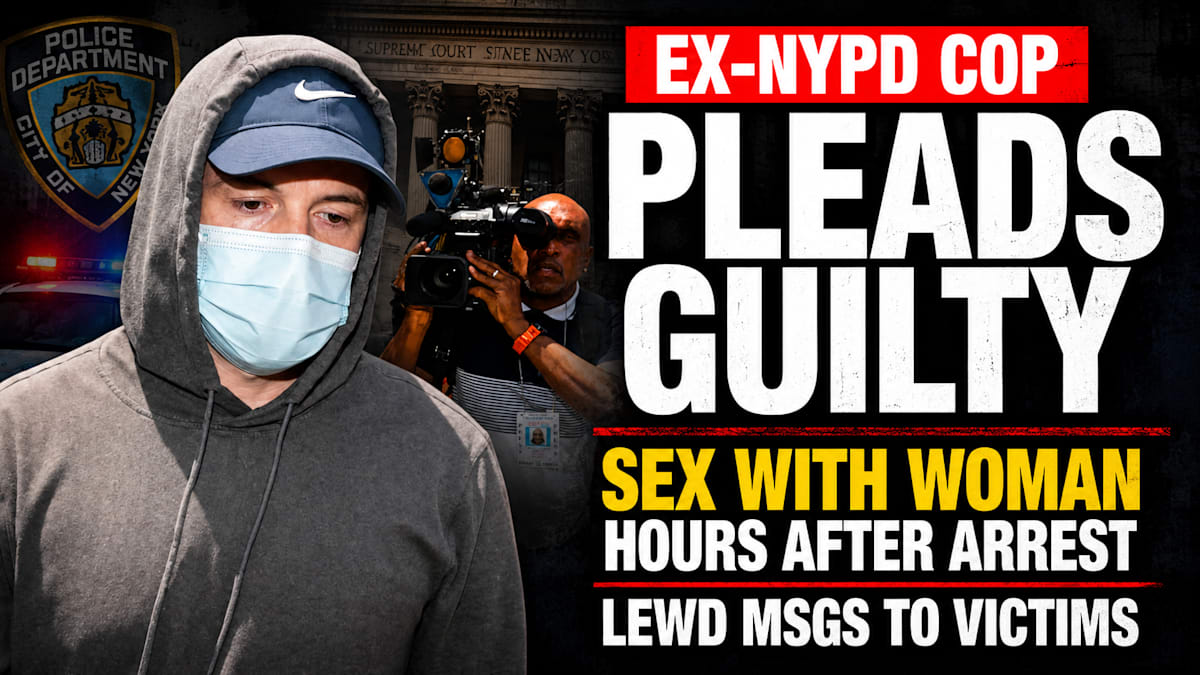
Former NYPD Officer Pleads Guilty After Sex With Woman Hours After Arrest, Lewd Texts to Victims
gukoxpso6ne3uiz8qbjllnc85dq12.13 MBFormer NYPD Officer Pleads Guilty After Sex With Woman Hours After Arrest, Lewd Texts to Victims
By Michele Evans New York City, New York 6/10/2026
Category: Court / NYPD / Public Safety / Criminal Justice
New York City, New York - NYPD Officer Matthew Lambert walked out of Manhattan Criminal Court on Wednesday with a gray hoodie pulled over his head after pleading guilty to official misconduct in a case that reads like a flashing red warning sign about power, access, and vulnerable women in the criminal justice system.
Lambert, 33, pleaded guilty to three counts of official misconduct and accepting an illegal gratuity after prosecutors said he had sex with a woman just hours after arresting her, while also sending inappropriate messages to two crime victims whose cases he was investigating.
This is not just a “cop behaving badly” story.
This is about an officer allegedly using the machinery of policing itself as an opening: an arrest, a desk appearance ticket, an NYPD-issued phone, victim interviews, investigative access, and the trust people are forced to place in police when they are arrested, victimized, or trying to report a crime.
According to prosecutors, the most alarming incident began around 8:30 p.m. on May 20, 2024, when Lambert arrested a woman for petty larceny. While booking her at the precinct stationhouse, he allegedly told her he could “probably” get her a desk appearance ticket so she would not have to spend the night in a jail cell.
He did give her the desk appearance ticket.
Then, as he walked her out of the stationhouse, prosecutors said he told her, “I told you I was going to get you out.”
That sentence is the whole problem.
Because once an officer has just controlled whether a person goes home or spends the night in a cell, nothing about what follows can be treated like an ordinary private interaction.
Later that night, prosecutors said Lambert began texting the woman. The messages allegedly moved from “come say hello” language to sexual photographs sent from his NYPD-issued phone. Prosecutors said Lambert left work around 12:10 a.m., met the woman, and had sex with her in his personal car.
The woman had just been arrested by him hours earlier.
That is the part no one should rush past.
An arrest is not a pickup line. A desk appearance ticket is not leverage. A person leaving a precinct after being processed is not on equal footing with the officer who just had power over their freedom.
Lambert was also accused of sending inappropriate messages to two women whose cases he was investigating.
In one case, prosecutors said he was assigned in March 2024 to investigate a missing package complaint filed by a woman. After interviewing her on his NYPD-issued phone, he allegedly began sending flattering and personal messages. He asked about “celebration drinks” when the case was over and told her he would still work hard on her case if she said no.
That kind of message is exactly why this matters.
Even when the officer says the case will be handled professionally, the victim is now placed in the impossible position of wondering whether rejecting him could affect how seriously her complaint is treated.
In another case involving an assault victim, prosecutors said Lambert texted the woman compliments, including comments about her appearance and teeth, while the investigation was still active.
The issue is not merely that the texts were inappropriate.
The issue is that the women were not random people he met at a bar. They were women connected to criminal investigations. One was a woman he arrested. Others were victims whose cases placed them directly under his professional authority.
Manhattan District Attorney Alvin Bragg said the conduct damaged faith in the criminal justice system and discourages people from coming forward to report crimes.
He is right.
Because when victims believe the person taking the report may use their phone number to flirt, pressure, or pursue them, public safety takes a hit. When women believe an arresting officer may use release from custody as a doorway to sex, trust collapses. When an officer can allegedly do this using an NYPD-issued phone, the question is not only what he did. It is what systems were supposed to stop him.
The timeline also raises serious questions.
The NYPD’s Internal Affairs Bureau reportedly learned of the inappropriate conduct the day after Lambert had sex with the petty larceny suspect. He was stripped of his gun and shield and reassigned to Patrol Service Area 2’s “Viper Room,” where officers accused of misconduct are often sent to watch NYCHA surveillance feeds in north Brooklyn.
Lambert later resigned from the NYPD on Dec. 4, 2025 in connection with the misconduct allegations, according to prosecutors.
As part of the plea deal, he was sentenced to two years probation, 100 hours of community service, and mandatory counseling. He also agreed not to seek recertification or employment as a police officer or peace officer in New York State.
But the public deserves more than a quiet ending.
Lambert joined the NYPD in 2014 and had been assigned to the detective squad in the 13th Precinct in Gramercy Park. During his 11-year career, he made 96 felony arrests and 101 misdemeanor arrests. He also had six Civilian Complaint Review Board complaints involving 18 allegations, including force, abuse of authority, and discourtesy, with three allegations substantiated. He was also reportedly named in seven lawsuits that led to $150,000 in settlement payouts.
That history should be part of the public conversation.
Not because every complaint proves misconduct. Not because every lawsuit tells the whole story. But because patterns, warning signs, supervision, and accountability systems matter when an officer is given power over victims, suspects, witnesses, addresses, phone numbers, case files, arrests, and freedom.
This case should force a basic question:
How many safeguards exist to stop officers from using police contact information for personal or sexual contact?
There should be a bright line in New York City policing. Officers should not pursue, pressure, proposition, flirt with, or sexually communicate with people they meet through arrests, victim reports, police investigations, emergency calls, or official databases.
Not during the case.
Not after the arrest.
Not through an NYPD-issued phone.
Not after offering help with release.
Not with “celebration drinks.”
Not with “I’ll still work hard on your case.”
Not with compliments dressed up as harmless conversation.
When the badge is involved, the power imbalance is already in the room.
This case is not only about Matthew Lambert. It is about whether New York City has a police accountability system strong enough to protect people at the exact moment they are most exposed to police power.
Victims should not have to wonder if reporting a crime will make them a target.
Women under arrest should not have to wonder if getting out of a cell comes with strings attached.
And New Yorkers should not have to wait until after the damage is done to learn an officer had already generated complaints, lawsuits, and warning signs.
The criminal case may be resolved.
The public-trust problem is not.
*Michele Evansis an independent journalist, author, and former ESPN technical producer whose work has appeared in The New York Times.
Michele got her start in 2001 covering the NBA and NFL.
She now covers New York City courts, criminal-justice procedure, NYPD, FDNY, domestic-violence systems, media accountability, public safety, advocacy efforts, and New York civic life through courthouse observation, public records, legal analysis, and lived-experience reporting.