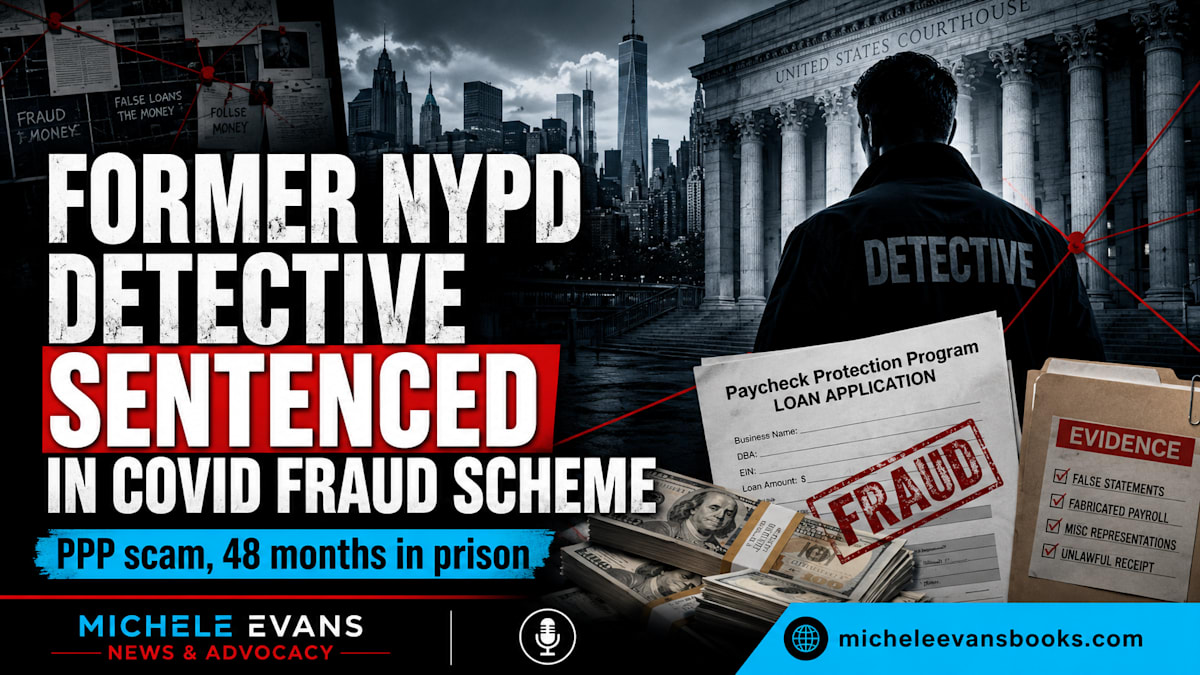
Former NYPD Detective Sentenced to Four Years in COVID Relief Fraud Scheme
5zt0bhf4tsed4eaemo9v3njgvafa2.14 MBFormer NYPD Detective Sentenced to Four Years in COVID Relief Fraud Scheme
When the Help Line Becomes the Hustle
By Michele Evans New York City, New York 6/4/2026
Category: Courts / Criminal Justice / NYPD
Brooklyn, New York - A former NYPD detective was sentenced to four years in federal prison this week after prosecutors said he helped turn a pandemic relief program into a fraud pipeline.
John Bolden, 47, of Valley Stream, was sentenced Wednesday in Brooklyn federal court to 48 months in prison for wire fraud conspiracy tied to the Paycheck Protection Program, the COVID-era federal relief program created to help small businesses survive when the country was shutting down.
But according to federal prosecutors, Bolden was not helping struggling small businesses keep workers paid. He was helping people get fraudulent loans.
And not just one or two.
The U.S. Attorney’s Office for the Eastern District of New York said Bolden helped more than 65 people obtain fraudulent COVID relief loans by submitting online applications with false information. Prosecutors said the applications included fictitious IRS Schedule C forms with false employment, income, gross income, and net income details.
The scheme ran from May 2020 through October 2022, according to prosecutors.
That timeline is important.
This was not one desperate mistake made in the chaos of March 2020. This was a prolonged operation that continued long after New Yorkers had watched businesses close, workers lose paychecks, families line up for food, and entire communities try to survive a public-health and economic emergency.
Bolden was not a random applicant. He was an NYPD detective at the time of the conduct. Prosecutors said he had partnership interests in a tax-preparation franchise and used that position to help clients, family members, co-defendants, and more than 65 individuals seek PPP money.
Federal prosecutors said Bolden sought to steal nearly $3 million from the program and succeeded in stealing at least several hundred thousand dollars.
Judge Diane Gujarati sentenced Bolden to four years in prison and ordered him to pay $303,138 in restitution and forfeit $112,002.
The case cuts deeper because of the badge.
Police officers are not merely private citizens when they use systems, records, and public trust. They are sworn public servants. They have access, authority, credibility, and institutional protection that ordinary people do not have.
That is why alleged or proven misconduct by law enforcement cannot be treated like ordinary fraud with a uniform in the background. The uniform is part of the public-interest story.
U.S. Attorney Joseph Nocella Jr. said Bolden organized a scheme that allowed “clients, family members and NYPD co-workers” to obtain federal funds using fictitious tax records. FBI officials said Bolden betrayed his oath and helped others steal PPP funds.
That word, oath, matters in this case.
Because New Yorkers are constantly told to trust systems that too often fall hardest on poor people, incarcerated people, defendants, survivors, tenants, migrants, and working-class families. We are told the law is the law. We are told paperwork is paperwork. We are told one mistake can follow a person forever.
Yet here, prosecutors say a detective helped manufacture fraudulent paperwork to pull money out of a federal emergency program while the country was still recovering from a once-in-a-generation crisis.
The PPP program was created to keep small businesses afloat. It was supposed to be a bridge for people facing collapse.
Instead, in this case, prosecutors say it became a hustle.
Bolden was not the only former NYPD detective tied to the case. Anthony Carreira, another former detective, previously pleaded guilty and was sentenced in March to time served. Prosecutors said Carreira knowingly submitted false documentation to obtain PPP funds. Christian McKenzie, Bolden’s cousin, also pleaded guilty and is scheduled to be sentenced in July. Prosecutors said McKenzie fraudulently obtained a loan and steered other applicants to Bolden in exchange for proceeds.
So the public-interest question is not only, “Did one man commit fraud?”
The larger question is how these networks form around public institutions, how long they operate, and how often the public only learns about them after federal prosecutors step in.
This is also why corruption stories cannot be treated like isolated scandals.
New York is in a moment where trust in public institutions is already under enormous strain. The city is fighting over jail conditions, police accountability, budget priorities, migrant shelters, public safety, public records, and whether the systems with the most power are actually accountable to the people who fund them.
A COVID fraud case involving former law enforcement is not just a crime blotter item. It is a reminder that accountability cannot only move downward.
It has to move upward, sideways, and inside the institutions themselves.
The people who needed PPP funds were trying to stay open.
The people who needed rent relief were trying to stay housed.
The people who needed unemployment benefits were trying to survive.
And according to prosecutors, a sworn NYPD detective helped turn one of those lifelines into a scheme.
That is the turn.
Because when public servants exploit emergency programs, they are not just stealing money. They are stealing from the crisis itself. They are stealing from the people who were told help was limited, systems were overwhelmed, and survival would require patience.
Four years in prison answers one part of the case.
The harder question is what New York does with the pattern.
*Michele Evansis an independent journalist, author, and former ESPN technical producer whose work has appeared in The New York Times.
Michele got her start in 2001 covering the NBA and NFL.
She now covers New York City courts, criminal-justice procedure, NYPD, FDNY, domestic-violence systems, media accountability, public safety, advocacy efforts, and New York civic life through courthouse observation, public records, legal analysis, and lived-experience reporting.