City Wants To Close Rikers. First It Has To Stop Dropping Stuff On Brooklyn
2oxkvq5xq2gx7izy37rpmn0ys9xw2.44 MBCity Wants To Close Rikers. First It Has To Stop Dropping Stuff On Brooklyn
By Michele Evans New York City, New York 6/10/2026
Category: Courts/ Criminal Justice / Rikers Island
Brooklyn, New York - New York City has a very simple sales pitch for the borough-based jail plan:
Close Rikers.
Build smaller jails.
Make the system safer, fairer, and closer to the courts.
Lovely.
Now comes the Brooklyn chapter, where the city is trying to prove it can replace one of the most notorious jail complexes in America without turning Boerum Hill into a construction-zone obstacle course.
According to the city, the new Brooklyn Borough-Based Jail Facility at 275 Atlantic Avenue is supposed to be part of the answer to Rikers Island. The Department of Design and Construction says the Brooklyn jail will include 1,040 beds for men, on-site services, programming space, recreation areas, staff offices, secured entry, parking, and 30,000 square feet of community space on the ground floor.
The project is scheduled for completion in spring 2029.
That is the official version.
The neighborhood version sounds a little more like: please stop dropping things from the sky.
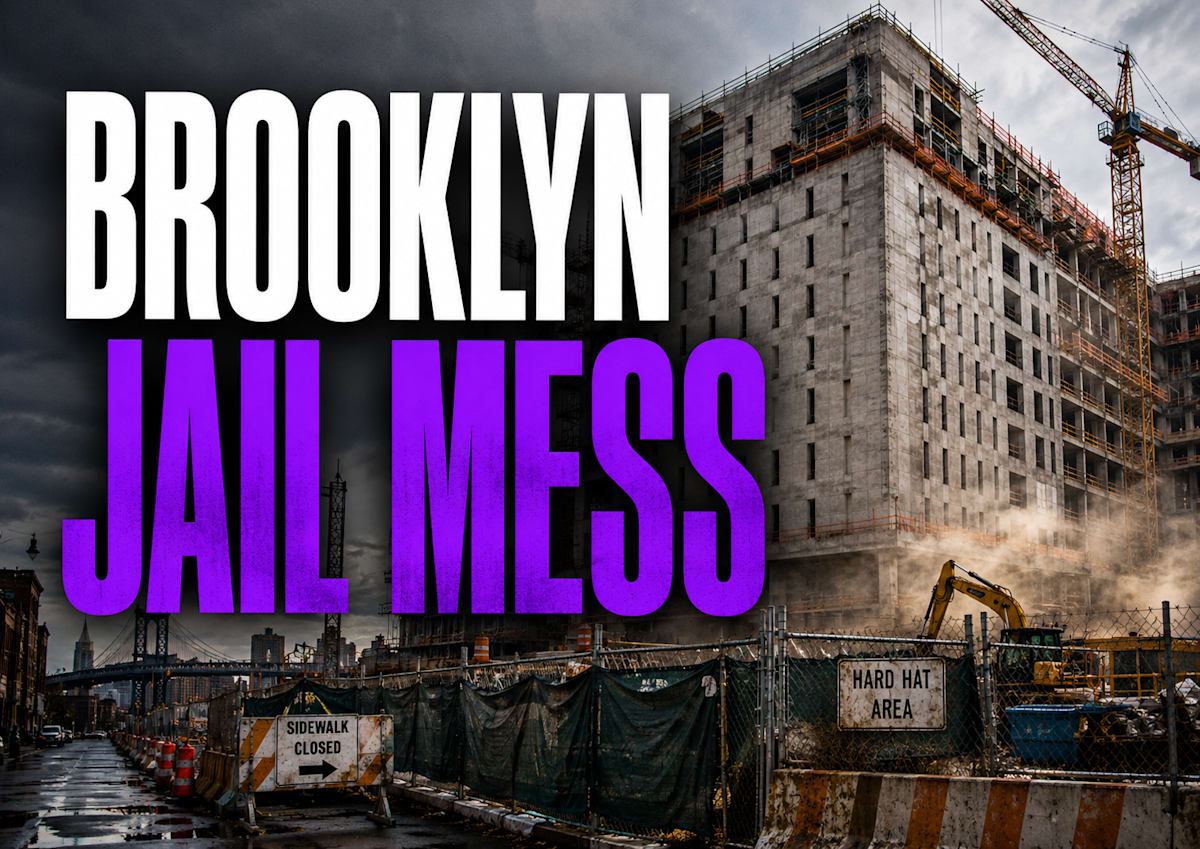
The New York Post reported that the Brooklyn jail construction site has drawn complaints from residents over falling debris, airborne dust, sidewalk and patio closures, and repeated safety concerns. The report described buckets, metal ductwork, and construction trash allegedly falling near residents and businesses. The site has also reportedly faced multiple stop-work orders, including recent ones tied to unsecured debris and housekeeping problems.
So yes, the city is trying to build a jail designed to be safer than Rikers.
But first, apparently, everyone nearby has to survive the construction.
This is the problem with New York’s big promises. The press release always arrives polished. The construction site arrives with dust, noise, delays, complaints, violations, and somebody from City Hall saying everything is moving along.
The Brooklyn facility is not just another development project. It is a test case for whether the city can actually execute the Rikers replacement plan without losing public trust block by block.
Because the argument for closing Rikers has never just been about buildings.
It is about whether New York can run a jail system without chaos, violence, neglect, delay, and bureaucratic shrugging.
If the replacement plan itself starts looking chaotic, that becomes a political gift to everyone who wants to say the whole thing is impossible.
And that is dangerous.
Rikers should close because Rikers has failed. It has failed people in custody, correction staff, families, attorneys, medical providers, and the public. But closing Rikers requires more than slogans. It requires competence.
The Brooklyn jail is supposed to be the city’s proof of concept.
Instead, neighbors are getting a front-row seat to the usual New York infrastructure routine: big promise, bigger price tag, messy rollout, angry residents, official reassurance, repeat.
The city says the Brooklyn facility reached a major milestone this spring when the final piece of structural steel was placed in a topping-out ceremony. Officials called it a step toward closing Rikers.
That may be true.
But a ceremonial beam at the top of a building does not mean much if people below are worried about what might come down next.
The larger borough-based jail timeline is already stretched. Brooklyn is expected in 2029. Bronx and Queens are not expected until 2031. Manhattan is expected in 2032, according to testimony summarized from a City Council infrastructure hearing.
That means the city is not just behind the original dream. It is now trying to keep public confidence alive for years.
Every construction failure matters.
Every stop-work order matters.
Every neighborhood complaint matters.
Not because Boerum Hill residents deserve more sympathy than people trapped on Rikers. They do not.
But because a city that cannot safely manage the construction of a jail is asking New Yorkers to trust it to safely manage the jail itself.
That is the hard part.
The city can say the new jail will be smaller, safer, and more humane.
It can say there will be services, recreation space, programming, and community benefits.
It can say this is the path away from Rikers.
But on Atlantic Avenue, the question is more immediate:
Can the city build the thing without making everyone around it feel like they need a hard hat?
Because if New York wants people to believe it can finally fix its jail system, Brooklyn is a very bad place to start dropping the evidence.
*Michele Evansis an independent journalist, author, and former ESPN technical producer whose work has appeared in The New York Times.
Michele got her start in 2001 covering the NBA and NFL.
She now covers New York City courts, criminal-justice procedure, NYPD, FDNY, domestic-violence systems, media accountability, public safety, advocacy efforts, and New York civic life through courthouse observation, public records, legal analysis, and lived-experience reporting.